A few days ago, I created a basic dapp using Next.js, React, Rainbowkit, Wagmi, Foundry Anvil and Tailwind css.
Read about it here:
https://t.co/8rJDJUSfJB
Check it out here:
https://t.co/DOzDD87Pvl
Tell me what you think too.
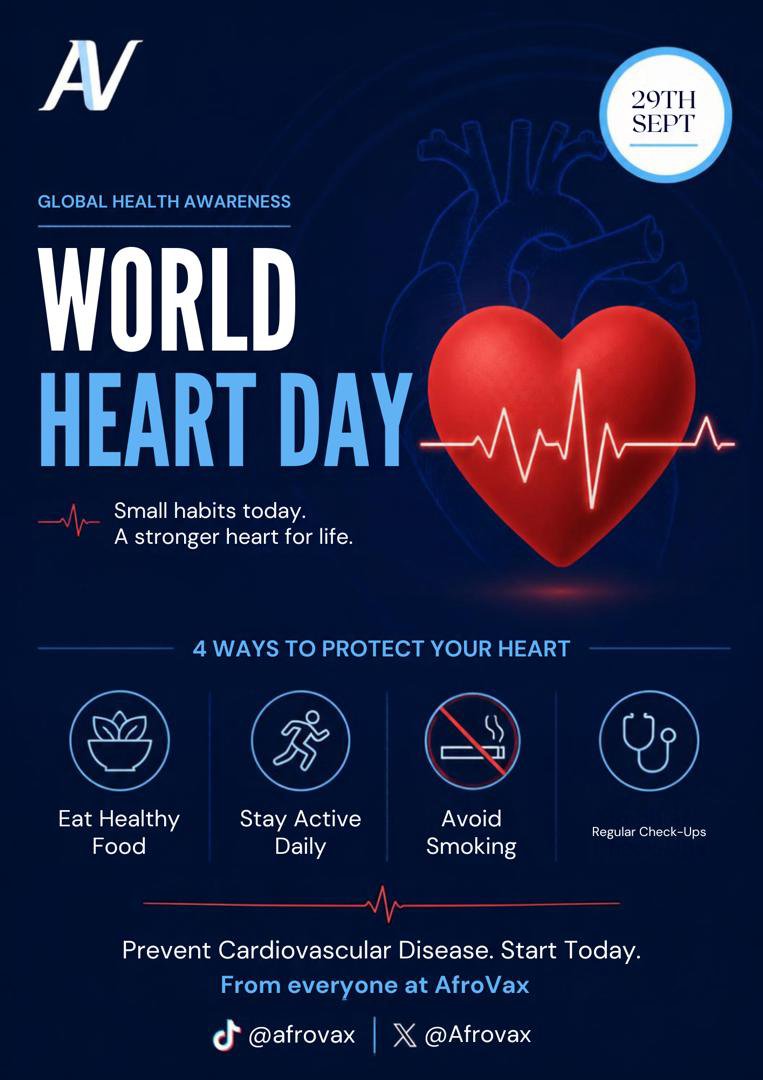
Every heartbeat matters. 🫀💙
This World Heart Day, AfroVax joins the global community in promoting heart health and healthy living.
Eat well. Stay active. Avoid smoking. Get regular check-ups.
A stronger heart for life.
#WorldHeartDay#AfroVax#HeartHealth
Today is D-day.
Our boys are now at the Università Campus Bio-Medico di Roma for the Grand Finale of the International STEM Olympiad in Rome, Italy.
I’m optimistic about their victory.
"If there is one lesson I have learned throughout my journey, it is that success is rarely determined by who starts first or even who starts strongest. More often, it is determined by who remains committed long enough to see their vision become reality."
Ray Kroc, the "founder" of McDonald's as we know it today, said this - "Nothing in the world can take the place of persistence.
Talent will not; nothing is more common than unsuccessful men with talent.
Genius will not; unrewarded genius is almost a proverb.
Education will not; the world is full of educated failures.
Persistence and determination alone are omnipotent."
That quote alone inspired me to pursue entrepreneurship.
@guccidikhead Appreciate this feedback.
Yeah, my next focus would be on chain-state edge cases like you mentioned.
After this deployment, I see the importance of simulations. Great work you guys are doing at @contractdotdev .
A few days ago, I created a basic dapp using Next.js, React, Rainbowkit, Wagmi, Foundry Anvil and Tailwind css.
Read about it here:
https://t.co/8rJDJUSfJB
Check it out here:
https://t.co/DOzDD87Pvl
Tell me what you think too.
The gift of being young, energetic, and able to actualize a plethora of potential is not realized until you are older and full of regret.
That ignorance is the greatest tragedy of life.
One thing I am grateful for is knowing this secret on time at 22. I have done things. Grateful 🙏🏿
We admire people who achieve things that “we think” we cannot, because either we have been told it is hard, or we tried a bit of it and found it difficult. We then give up and praise those whom we think are better than us. They may seem better because they have found a hack that others haven't discovered yet.
Nobody can be better than you at something when you consistently try to improve on previous attempts. That is what sets the high achievers apart from those who achieve less. It is something we must learn from within and turn into a habit. Excellence is a habit. Achieving excellence is not easy, but you can “hack yourself” into it.
I had a conversation with @bernard_parah yesterday over lunch, and he reminded me of the Y Combinator interview question: “Give an example of a time you hacked something.” It kept ringing in my head as I drove around Accra. I knew I hacked things daily, but I was trying to remember the first time I did it and turned it into a habit.
I thought it was at age 11 when I had to find a way to survive the long holiday and was broke, but I realized I could wash my neighbor’s poultry for 1 Naira 50kobo. That money became the capital I used to start a business selling canned tomatoes, and I made more money than other boys in the market by being better dressed and selling to people still in their cars by the road.
They were more affluent, and they would rather buy from a clean, polite, well-spoken, and well-dressed young boy than the rough hawkers who didn't care about their appearance. They also likely bought the premium brand then called “De Rica,” and I had found the main importer in the market of original De Rica tomatoes with embossed expiry dates.
I outsold all of the other hawkers and ended up getting canned Derica tomatoes on credit from the supplier because of my volumes. I was doing this during the holidays and did better than those who did it daily to survive. I did better because I figured out the market and hacked it.
The thing is that it wasn't the first time I hacked something. I went back into my memories and realized that the very first time was when I was 7 years old, when I hacked my time by doing tasks early and defeating procrastination. The key was to look beyond the tasks and not the tasks themselves.
If I had to read for exams, I looked forward to the holidays afterward and the club sandwich my parents gave me as a reward for being first in my class. I made sure I did well in those exams by preparing early and listening attentively in class. I hacked and organized myself at age 7.
My parents also gave me motivation. This is the same Jedi mind tricks I now also use on my kids. It is not blackmail, it is motivation. You can always hack yourself and any situation to achieve optimal outcomes.
I will have to turn this into a proper article and share it with my kids. That is part of the hacking process. I need to find out whether De Rica is publicly listed and buy their shares. They were the first luxury product that I sold.
The math on a 24-hour day stopped working decades ago and most people just never run the numbers.
8 hours sleep. 8 hours work. That's 16, before anything else.
Add the modern requirements that nobody counts. 1 hour of real exercise. 30 minutes of getting ready and showering. 30 to 90 minutes of commute. Cooking and eating three meals, or shopping and prepping for them, is 90 minutes minimum if you're being honest. Dishes, laundry, basic household upkeep, hygiene, packing tomorrow's bag is another hour.
That's 5 to 6 hours of obligations the original framework never accounted for.
Running total: 21 to 22 hours. With a 45-minute one-way commute and a real kitchen, you have under 90 minutes left.
Inside that window you're supposed to read books, see friends, date, pursue hobbies, learn skills, watch the shows everyone references at work, and call your parents.
The "eight hours labour, eight hours recreation, eight hours rest" framework comes from Robert Owen in 1817, written for a factory worker who walked to the mill, ate whatever was in front of him, and didn't lift weights. We kept his arithmetic and added 5 hours of modern obligations on top.
The people who appear to "have it all" are doing one of five things: outsourcing domestic labor to a spouse or paid help, cutting sleep, cutting exercise, having no kids, or living in a 30-square-meter apartment with no maintenance burden. Usually multiple. The math is the same for everyone, the cuts are just hidden.
The honest answer is you choose. Most people cut sleep and pay for it in cognition. Some cut exercise and pay for it in long-term health. The cultured ones cut the culture and read 5 books a year instead of 30.
There is no version where you don't choose.
Picked up a newspaper to read for the first time in a long while. It felt soo good to read something with life and intention behind it.
Too many AI generated write-ups these days.
There's a physicist at Stanford named Safi Bahcall who modeled this exact principle and the math is wild.
He calls it "phase transitions in human networks." When you're stationary, your probability of a lucky event is limited to your existing surface area: the people you already know, the places you already go, the ideas you've already been exposed to. Your opportunity window is fixed.
When you move, your collision rate with new nodes in a network increases nonlinearly. Double your movement (new conversations, new cities, new projects) and your probability of a serendipitous encounter doesn't double. It roughly quadruples. Because each new node connects you to their entire network, not just to them.
Richard Wiseman ran a 10-year study at the University of Hertfordshire tracking self-described "lucky" and "unlucky" people. The single biggest differentiator wasn't IQ, education, or family money. Lucky people scored significantly higher on one trait: openness to experience. They talked to strangers more, varied their routines more, and said yes to invitations at nearly twice the rate.
The "unlucky" group followed the same routes, ate at the same restaurants, and talked to the same 5 people. Their networks were closed loops. No new inputs, no new collisions.
Luck isn't random. Luck is surface area. And surface area is a function of movement.
The lobster emoji is doing more work than most people realize. Lobsters grow by shedding their shell when it gets too tight. The growth requires a period of total vulnerability. No protection, no armor, soft body exposed to the ocean.
That's the cost of movement nobody posts about. You have to be uncomfortable first. The new shell only hardens after you've already moved.
I have written a long thread on this here before. Evil “seems” to win more because we take good for granted because it is in abundance. We never forget evil as it stands out.
Evil is also determined and focused, it is not bothered about appearances. It just does the job.