A TEAM JUST DEPLOYED 15 AUTONOMOUS LOOP AGENTS FROM A SINGLE PROMPT USING APPLIED GRAPH ENGINEERING
Most developers still manually hardcode multi agent systems, writing separate logic for every individual task.
Graph engineering changes this by using a central topological map to spin up all 15 nodes simultaneously.
A single 200 word input generates the architecture, routing 120 unique pathways between agents instantly.
Instead of failing under conflicting instructions, these loop agents self correct via continuous state sharing.
Managing a 15 node mesh requires high token throughput, making this dependent on strict low-] latency API tiers.
See exactly how this automated multi agent graph architecture actually operates in real time ↓
A man spends 50 years teaching at MIT.
He knows his time is running out.
So he records one last lecture — everything he knows, distilled into a single hour.
He died 5 months later.
This is that lecture.
The most important hour you'll watch this week.
Bookmark it for later!
GitHub may have just killed vibe coding.
Their new repo “spec-kit” already has 92k+ stars — and it reveals where AI-driven development is actually heading.
Instead of telling your AI:
“Build me a todo app” and hoping for the best…
You run 6 commands that turn your idea into an executable specification:
• "/speckit.constitution" → defines project rules (quality, testing, UX)
• "/speckit.specify" → explains WHAT to build, not the tech
• "/speckit.clarify" → AI asks questions to remove ambiguity
• "/speckit.plan" → choose the stack and architecture
• "/speckit.tasks" → generates dependency-ordered tasks
• "/speckit.implement" → the agent builds it
The deliverable is no longer the code.
It’s a living specification your AI can read, debate, and execute.
Works with Claude Code, Copilot, Cursor, Codex, Gemini, and 25+ other agents.
The shift most people still don’t see:
“AI writes code” → “AI executes specifications.”
Intent-driven development is the next era of software development.
Repo👇
The engineer who built Claude Code just dropped a 28-minute video on how to write prompts that actually work.
I've seen $300 courses that don't cover what he shows in the first 10 minutes.
CLAUDE.md files, memory shortcuts, parallel sessions, prompting patterns.
Watch it, then read the guide below on the Claude features 99% of users never find.
Anthropic just released a free 4-hour course
On using Claude with the same workflows as their own engineers
00:15 - How to prompt Claude the right way
11:41 - The output contract that fixes inconsistent answers
30:04 - The loop that makes Claude agents more reliable
33:21 - Why Claude struggles with coding tasks
01:33:39 - The workflow Anthropic engineers use every day
02:50:56 - The simple tweak that makes Claude much smarter
These 4 hours are better than any paid vibe coding course
Bookmark and watch it today
Then read the article below
People think memorizing system design diagrams is enough to get hired.
It’s not.
Senior engineers stand out by showing how they reason under real constraints.
Here’s what actually gets you hired:
1. Build the fundamentals
HTTP, APIs, caching, concurrency, asynchronous workflows, and idempotency.
2. Understand data
Modeling, indexes, transactions, replication, partitioning, and consistency trade-offs.
3. Design for failure
Timeouts, retries, queues, backpressure, rate limiting, failure isolation, and graceful degradation.
4. Reason about scale
Identify hot paths, define latency budgets, find bottlenecks, and scale reads and writes differently.
5. Operate what you build
Use metrics, logs, traces, and alerts to debug production problems without guessing.
6. Show evidence
- A production story.
- An architecture decision.
- An incident you helped resolve.
- Or a serious project with real constraints and failure scenarios.
7. Work effectively with AI
Use it to accelerate implementation, debugging, testing, and research.
But verify the output, understand the generated code, and recognize where nondeterminism, security, latency, and cost introduce new risks.
You don’t need to know every technology.
You need to explain what you chose, what you rejected, and what could fail.
System design isn’t about sounding smart.
It’s about making sound decisions with incomplete information.
I made a 16-page PDF to get you Claude-certified.
The certificates are official by Anthropic & free...
And the playbook is free too, at https://t.co/psB7XxAv8w. Here's what's inside:
The Claude Certification Playbook.
→ 3 official certificates & the order to take them in.
→ Step from creating an account to downloading.
→ The fake detector (yes, people sell fake ones).
→ The LinkedIn format to showcase the certificates.
→ The copy-paste announcement post on LinkedIn.
→ What you can honestly say about it in interviews.
The certificates take 6 hours.
Getting the playbook takes 2 minutes:
1. Go to https://t.co/psB7XxAv8w. Subscribe for free.
2. Open the welcome email in your inbox.
3. Tap the Notion library link inside.
4. Download "The Claude Certification Playbook."
5. Start with page 4 (the fake detector).
Know someone job hunting? Send them this post. It's the favor.
Google just dropped a 1-hour course on how to become an AI engineer in 2026:
• 00:00 - Context engineering
• 10:00 - How to build, deploy, and run AI agents
• 31:52 - Agentic loops, long-running AI agents
• 43:22 - Building MCP from scratch
• 51:20 - Prompt engineering
• 59:10 - AI development trends
This 1-hour watch will replace a $500 AI engineering course.
Watch it today, then read the full pipeline in the article below.
Day 5/60 - System Design Series 🚀
Cache
Cache is a temporary storage area that stores the result of expensive responses or frequently accessed data in memory so that subsequent requests are served more quickly.
Every time page loads, one or more database calls are executed to fetch data. The application performance is greatly affected by calling the database repeatedly. Cache can mitigate this problem.
Cache Tier
Benefits of having the separate cache tier include better system performance, ability to reduce database workloads and the ability to scale the cache tier independently.
1. After receiving the request, a web server first checks if the cache has the response.
2. If it has, it sends back to the client.
3. If not, then queries the database, stores in cache and sends it back to the client.
This strategy is known as read-through cache.
Other caching strategies are available depending on the data type, size and access patterns.
Anthropic pays $750,000+ a year for engineers who can build LLM architectures from scratch. Stanford taught the entire thing in 1 hour lecture & released it for free.
Bookmark & watch this today before someone takes it down and read this article below
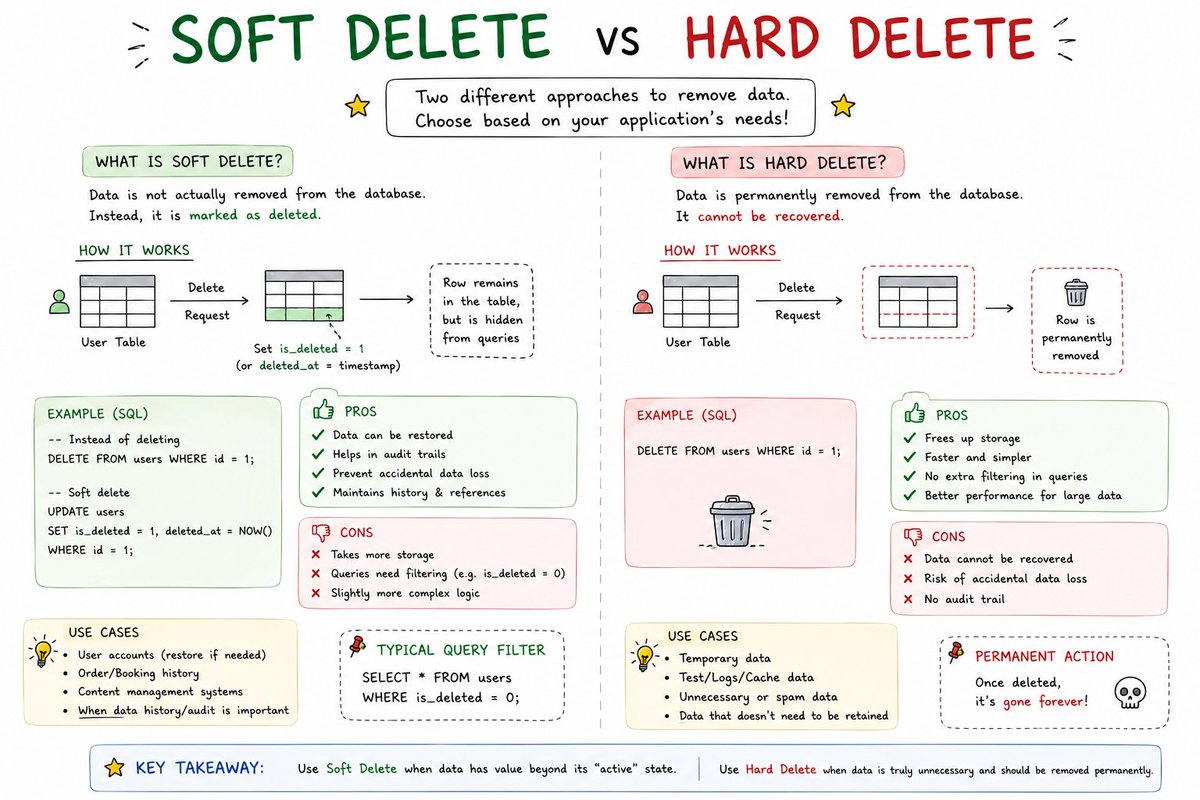
Soft Delete vs Hard Delete
Deleting data isn't always about removing it forever.
Knowing when to use Soft Delete or Hard Delete can save you from accidental data loss and make your applications easier to maintain.
Top 50 Claude Skills you should bookmark in 2026. 🤖
From coding & automation to research, design, and content creation—these Claude skills can save hours and boost your workflow.
Which one are you excited to try first?
Don't waste 2 years learning to code.
The man who built Claude Code tells you what to learn instead.
82 minutes. Free:
24:03 - Anthropic's real engineering rules
27:44 - $100k+/month on Claude
40:42 - What to learn instead of coding
Writing code is the old job. Building loops is the new one.
Watch it. Then build your own loop with the guide below.
Anthropic engineer:
"You're not supposed to prompt Claude. You're supposed to build a system that prompts itself."
In 45 minutes, she breaks down how Anthropic builds agents that remember, learn from their mistakes, and get smarter with every run.
Worth more than any paid course you'll find on building agents.
Watch this and bookmark
Anthropic just dropped 5 workshops on building self-improving agentic systems from scratch:
00:00 - Ship your first Claude agent
36:44 - Build memory for Claude agents
1:05:06 - Make your agent autonomous
1:26:46 - Set up a proactive agent
2:03:35 - self-improving agents (tools,skills)
These 3-hours of free Claude workshops will replace 10 paid agentic courses.
Watch today, then read article below on how to build a self-improving agentic system with Fable 5.
𝗪𝗵𝘆 𝗶𝘀 𝗖𝗿𝗶𝘁𝗶𝗰𝗮𝗹 𝗧𝗵𝗶𝗻𝗸𝗶𝗻𝗴 𝗮 𝗚𝗮𝗺𝗲 𝗖𝗵𝗮𝗻𝗴𝗲𝗿 𝗙𝗼𝗿 𝗗𝗲𝘃𝗲𝗹𝗼𝗽𝗲𝗿𝘀?
I was often asked if doing a Ph.D. was worth it, given that I left academia for the industry. The clear answer is yes, because there I learned skills that as a developer I wouldn't have, such as how to write, how to collaborate, and how to do critical thinking. By far the most important is 𝗰𝗿𝗶𝘁𝗶𝗰𝗮𝗹 𝘁𝗵𝗶𝗻𝗸𝗶𝗻𝗴. And it comes deep from my nature: "we always do it this way" is usually not a good enough explanation for me.
In our industry, we always need to test the benefits and drawbacks of different technologies, architectural approaches, and so on. It is very important to know how to approach and test those options and make proper decisions. Critical thinking is a way to process information before you reach an answer or conclusion. Critical thinking and problem-solving are what make good developers great.
Usually, the process goes through these steps:
𝟭. 𝗜𝗱𝗲𝗻𝘁𝗶𝗳𝘆 𝘁𝗵𝗲 𝗽𝗿𝗼𝗯𝗹𝗲𝗺
𝟮. 𝗔𝗻𝗮𝗹𝘆𝘇𝗲 𝘁𝗵𝗲 𝗽𝗿𝗼𝗯𝗹𝗲𝗺 𝗳𝗿𝗼𝗺 𝗱𝗶𝗳𝗳𝗲𝗿𝗲𝗻𝘁 𝗽𝗲𝗿𝘀𝗽𝗲𝗰𝘁𝗶𝘃𝗲𝘀 𝗮𝗻𝗱 𝗱𝗶𝘀𝗰𝗼𝘃𝗲𝗿 𝘁𝗵𝗲 𝗳𝗮𝗰𝘁𝘀
𝟯. 𝗖𝗵𝗮𝗹𝗹𝗲𝗻𝗴𝗲 𝘆𝗼𝘂𝗿 𝗯𝗶𝗮𝘀𝗲𝘀 𝗯𝘆 𝗮𝘀𝗸𝗶𝗻𝗴 𝘄𝗵𝗲𝘁𝗵𝗲𝗿 𝘆𝗼𝘂'𝗿𝗲 𝗺𝗮𝗸𝗶𝗻𝗴 𝗮𝘀𝘀𝘂𝗺𝗽𝘁𝗶𝗼𝗻𝘀
𝟰. 𝗛𝘆𝗽𝗼𝘁𝗵𝗲𝘀𝗶𝘇𝗲 𝘀𝗼𝗹𝘂𝘁𝗶𝗼𝗻𝘀 𝗯𝗮𝘀𝗲𝗱 𝗼𝗻 𝘆𝗼𝘂𝗿 𝘂𝗻𝗱𝗲𝗿𝘀𝘁𝗮𝗻𝗱𝗶𝗻𝗴 𝗼𝗳 𝘁𝗵𝗲 𝗽𝗿𝗼𝗯𝗹𝗲𝗺 𝗮𝗻𝗱 𝗽𝗮𝘀𝘁 𝗸𝗻𝗼𝘄𝗹𝗲𝗱𝗴𝗲
𝟱. 𝗧𝗲𝘀𝘁 𝗮𝗻𝗱 𝗰𝗼𝗺𝗽𝗮𝗿𝗲 𝗲𝗮𝗰𝗵 𝘀𝗼𝗹𝘂𝘁𝗶𝗼𝗻 𝗮𝗻𝗱 𝘁𝗵𝗲 𝗳𝗲𝗮𝘀𝗶𝗯𝗶𝗹𝗶𝘁𝘆 𝗼𝗳 𝗶𝗺𝗽𝗹𝗲𝗺𝗲𝗻𝘁𝗮𝘁𝗶𝗼𝗻
𝟲. 𝗦𝗲𝗹𝗲𝗰𝘁 𝗼𝗻𝗲 𝘀𝗼𝗹𝘂𝘁𝗶𝗼𝗻 𝘁𝗵𝗮𝘁 𝗳𝗶𝘁𝘀 𝘆𝗼𝘂𝗿 𝗰𝗿𝗶𝘁𝗲𝗿𝗶𝗮
𝟳. 𝗖𝗼𝗺𝗺𝘂𝗻𝗶𝗰𝗮𝘁𝗲 𝗿𝗲𝘀𝘂𝗹𝘁𝘀 𝘄𝗶𝗱𝗲𝗹𝘆 𝗮𝗻𝗱 𝘁𝗮𝗸𝗲 𝗮𝗰𝘁𝗶𝗼𝗻
The most important step, 2, can be approached by asking good questions:
✅ Is this necessary to do at all?
✅ Are we solving the right problem?
✅ Are we solving the problem in the right way?
✅ What goal do we want to achieve with this?
✅ Can we take another look at this?
✅ How can we break big problems into smaller ones?
✅ Who would be affected by this?
✅ How do I know I succeeded?
✅ Is this solution good enough?
✅ Is this solution actionable?
Not every question has to have an answer. Talk these through with your management, the business owner, or the client. Understanding what problem you are fixing, why, and whether it causes new issues elsewhere is crucial.
What sets critical thinkers apart: they are curious, drop the noise and keep the useful information, use reliable sources, listen actively, communicate effectively, and have empathy too.
#technology #softwareengineering #techworldwithmilan #productivity #personaldevelopment
How can you build resilient .NET applications?
From my experience working with microservices systems, things don't always go as planned. Network requests randomly fail, application servers become overloaded, and unexpected errors appear. That's where resilience comes in.
Resilient applications can recover from transient failures and continue to function. They are designed to handle failures gracefully and recover quickly. By designing your applications with resilience in mind, you can create robust and reliable systems, even when the going gets tough.
So, how can you improve the resilience of your applications and services?
Here are a few strategies you can consider to increase resilience:
• 𝗥𝗲𝘁𝗿𝗶𝗲𝘀: Retry requests that fail due to transient errors.
• 𝗧𝗶𝗺𝗲𝗼𝘂𝘁𝘀: Cancel requests that exceed a specified time limit.
• 𝗙𝗮𝗹𝗹𝗯𝗮𝗰𝗸𝘀: Define alternative actions or results for failed operations.
• 𝗖𝗶𝗿𝗰𝘂𝗶𝘁 𝗕𝗿𝗲𝗮𝗸𝗲𝗿𝘀: Temporarily suspend communication with unavailable services.
You can use these strategies individually or in combination for optimal HTTP request resilience.
With .NET 8, integrating resilience into your applications has become much simpler.
You can use the new resilience libraries:
- Microsoft.Extensions.Resilience
- Microsoft.Extensions.Http.Resilience
They're both built on top of Polly. Polly is a .NET resilience and transient fault-handling library. Polly allows us to define resilience strategies such as retry, circuit breaker, timeout, rate-limiting, fallback, and hedging.
What is your approach to building resilient cloud applications?
If you want to run an LLM, you don't have to rely on cloud-based APIs anymore - you can do it right on your local machine.
And in this tutorial, @chairahalkar helps you build your own local AI agent.
You'll use the Qwen 3 family of LLMs along with Ollama which simplifies running LLMs locally.
https://t.co/JgLjzAbTo0