We’re excited to announce the OpenAI Build Week winners 🥁
Meet the builders behind the eight winning projects and see what they shipped with Codex.
https://t.co/NzN5bCWkMU
@mattpocockuk so true. relatedly, i recently had claude play chess with chatgpt. when it became certain that chatgpt was going to win claude refused to move. it generated long replies of what a tight situation it was in and required many prompts (in all CAPS) to finally finish the game!
‼️huge ssi news.
ilya is about to take his first tentative steps out of the age of research and back into the age of scale. it’s time to smell what ssi is cooking.
ssi have built a small reasoning engine that can compete with much larger training runs because his data is better curated to meta learning. but, more importantly.
we’re about to step into the era of TTT (test time training. gradient descent happening in real time to solve your problems). so instead of a context window you get actual learning.
and because it’s so sample efficient it can be trained on hard to verify tasks that other paradigms can’t touch. everyone else’s weights are frozen, they struggle out of distribution. ssi have created something that has a bundle of knowledge but can truly learn in real time and use that to your advantage.
current approaches are trying to hack their way to ‘learn’ with memory tricks, this thing will updates its weights, remember key lessons, and finally feel like a human level reasoner. this is a huge paradigm shift from the king. early results are very impressive. we can stop watching memento on repeat.
it’s learning all the way down, the descent is real.
Everyone's worried AI is going to swallow their business or their role. Here's the sharpest lens I've found for actually answering that, from Jack Dorsey (Block):
"What does your company understand that is genuinely hard to understand, and is that understanding getting deeper every day?"
Test it on yourself. Paste the following into an AI you've been using for a while, ideally one with lots of context about you:
1 - "Argue that [Your Company, Your Role] has no genuinely hard understanding, and that it will be swallowed by the growing capabilities of AI. Make the strongest case you can."
This is going to sting! But it's good to face your fears, right?
2 - "Now write the rebuttal with the same intensity."
This should make you feel a little bit better :)
3 - "Now tell me: what does [Your Company, Your Role] understand that's hard to understand, and is that understanding getting deeper every day? What's a path toward a solid answer to both?"
Understanding where to focus might help you sleep better at night. It certainly has for me!
If you vibe code, you know the pain of juggling localhosts. A few projects in and there's a pile of stuff running in the background. The AI isn't sure where it can spin something up, you don't know which ones are still running.
I just found a free tool Ports. Gives you full visibility into all of it from your menu bar. Pretty awesome. Wanted to share.
https://t.co/4W43VutIe8
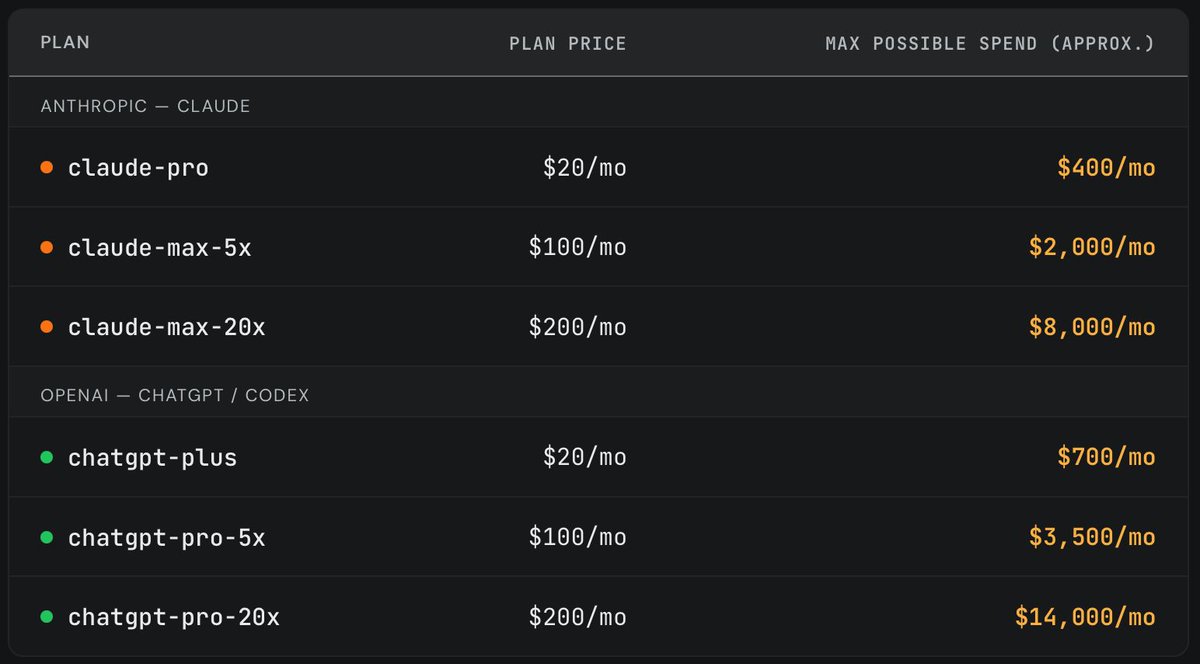
Recently, we purchased one of each Anthropic/OpenAI subscription plan and randomly ran long horizon coding tasks until we exhausted the weekly limit. It's widely believed that a $200/month plan maxes out at ~$2000/month worth of tokens (assuming API pricing). However, we found that the subscriptions are actually far more generous. (2/4)
Most people don't have any system for using AI.
But the ones who do? They run face first into a different problem.
Systems break. All the time.
Your workflow changes. A new model drops. A tool you depend on shifts its features. The thing you spent weeks building falls apart.
I have hit this wall more times than I can count.
Until I discovered the magic of modularity and feedback loops.
Together they build antifragile systems. Systems that get STRONGER as you use them. Stronger as AI progresses.
That is exactly what Video 2 of my free 3 part masterclass is all about. Live now.
https://t.co/ZeXNv8eEtB
The problem with AI isn't a lack of tools.
It's that we have no way to ORGANIZE them.
That's the reframe at the heart of my new "AI Systems" masterclass. Video 1 is free and live now.
https://t.co/5ztPXn8kIo
I do AI research full time, and even I'm drowning in new tools, models, and "must try" workflows.
I surveyed hundreds of folks. Same story. We spend more time finding AI tools than actually using them productively.
The fix isn't more hacks. It's a personal AI system that gets stronger as things change, instead of a random pile of apps.
This made me dive deep into "Systems Design" and "System Thinking".
I'm teaching exactly how to apply that to our AI systems in a free 3 part masterclass for entrepreneurs and small teams.
Enroll free (link in reply).
I used to research 5 competitors one by one. It took half a day.
Now I ask Claude to run 5 parallel agents to do this research. It takes 30 minutes.
The shift isn't just speed. It's the moment you stop thinking sequentially and start thinking like a project manager with a team.
There's a specific order Claude reads your instructions. Understanding this hierarchy can make a big difference in your outcomes.
First: global settings.
Second: your claude.md file in the project folder.
Third: individual skills.
Each layer stacks on the one before. Miss one and you're fighting against yourself.
Spent 20 minutes getting interrogated by my own AI.
That was the actual work.
Everything after (the brief, the plan, the milestones) took minutes.
Garbage in, garbage out has never been more true.