YOU DON’T NEED A LAB TO BUILD HARDWARE ANYMORE
Tinkercad lets you design circuits, simulate Arduino code & 3D model all in your browser
no installs. no setup. no excuses
perfect for beginners → powerful enough for real prototyping
🚨 This guy just revealed how to use Claude Code for FREE — no subscriptions, no limits.
A full step-by-step tutorial showing how to run it locally, plug in open-source models, and build complete AI agent workflows from scratch.
If you're serious about learning AI, this is not optional
Someone just built a Claude Code for electronics.
It's called Blueprint. Type what you want to build and it generates wiring diagrams, bills of materials, and step-by-step assembly guides for your Arduino or Raspberry Pi project.
100% Free.
A case of silent aspiration: during the test, the patient attempts to swallow a liquid with barium (contrast medium), but it passes into the trachea without triggering cough reflex.
Photos of the Artemis II crew, NASA astronaut Reid Wiseman, Artemis II commander, NASA astronaut Victor Glover, Artemis II pilot, NASA astronaut Christina Koch, Artemis II mission specialist, and Canadian Space Agency (CSA) astronaut Jeremy Hansen, Artemis II mission specialist following their successful splashdown and recovery in the Pacific Ocean yesterday.
The Artemis 2 crew, returning from a lunar flyby, is doing something they've never done with people on board.
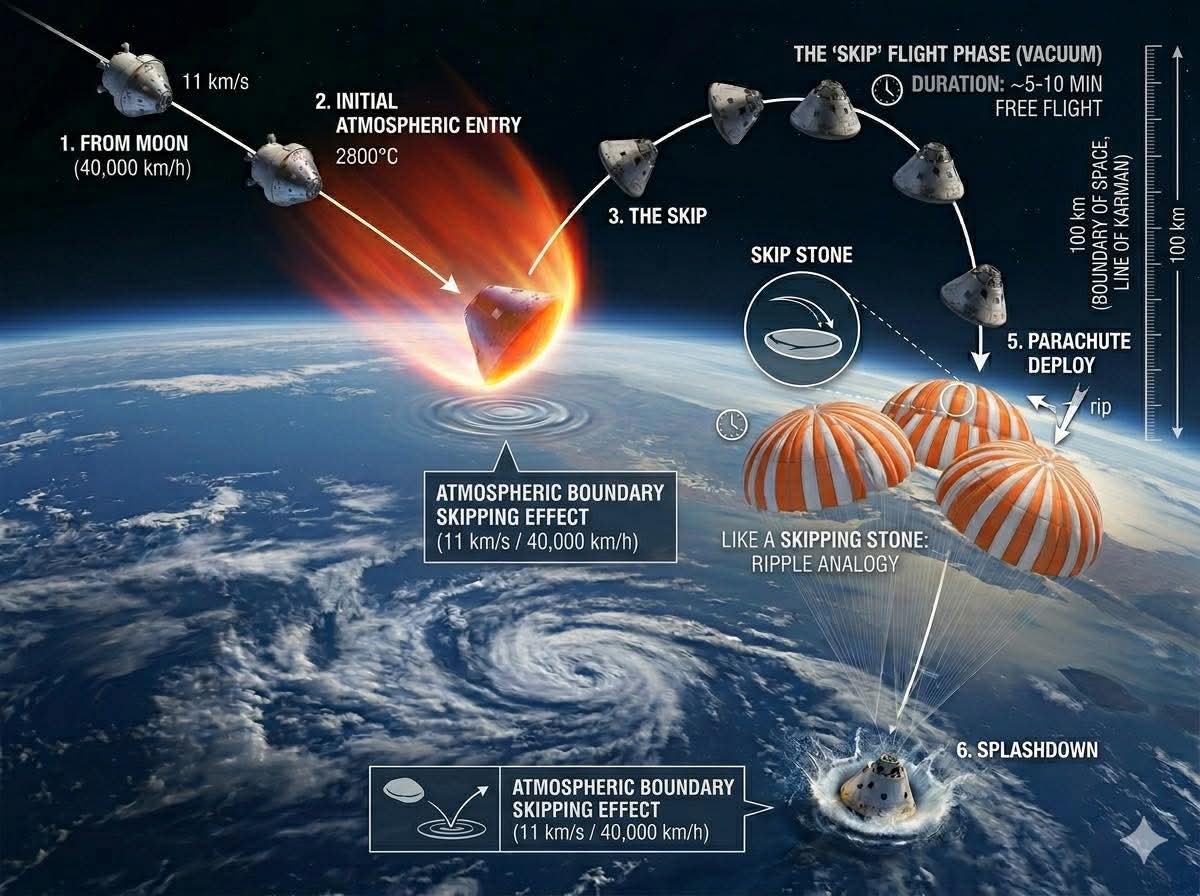
Orion is flying at 40,000 km/h. At that speed, the atmosphere isn't air, it's a wall. You can't just dive down—the crew would be crushed by the G-forces, and the ship would burn up.
So they came up with this idea. Orion will enter the atmosphere, heat up to 2800 degrees, and bounce back into space. Like a pebble bounces off water. Remember throwing flat stones down a river as a kid?
Up there, it has a couple of minutes to cool down. Then it reenters and lands.
The trick is that such a jump drops the G-forces from 10g to 4g. The difference between tolerable and done.
The Apollo missions returned differently. They didn't jump, they simply glided through the upper atmosphere like a skier down a hill, gradually losing speed. One pass and that's it. It worked, but the G-forces were severe.
The Soyuz reenters the ISS quite simply. Its speed is half that of Orion, and the atmosphere handles it in one pass. No tricks needed.
But Orion arrives from the Moon. Different speed, different task. That's why they came up with this jump.
But if the calculations are off even slightly, the rebound will throw the ship back into orbit, into space. There are no braking engines left. They'll simply wait for the Earth to pull them in. With a finite supply of oxygen. And if the rebound is even higher, they'll be blown off into space altogether.
I hope everything goes perfectly...
Keep an ear out for a sonic boom this Friday afternoon! 🚀 NASA says the Orion capsule carrying the Artemis II crew will re-enter the atmosphere around 4:54 p.m., wrapping up its historic trip around the moon. It’s scheduled to splash down in the ocean about 50 miles west of San Diego right at 5:07 p.m. 🌊💥
Today at 1:57PM Eastern Time, the Astronauts aboard Artemis ll, currently on the far side of the Moon, became the farthest Humans have ever been from Earth, breaking the record set by the crew of Apollo 13 in 1970.
🚨: CONFIRMED SEPARATION!
The powerful Orion spacecraft of the Artemis II mission has been precisely released from the SLS upper stage, paving its way toward its historic rendezvous with the Moon.
Tomorrow, humanity will take a giant leap: Orion will perform the first crewed lunar flyby in over half a century.
The era of returning to the Moon has begun!