No interface in crypto gets more screen time than the spot DEX. Just because they all similarly perform token swaps, does not mean that their tokens give holders similar rights.
Fundamentals is adding 4 new Spot Market assets to help illustrate this point. 🧵
Filecoin, Arweave, Storj and Sia all sell the same thing: persistent decentralised storage.
They sit in the same subsector and are a totally fair comp set, yet have tokens that play entirely different roles.
Here's what "storage tokens" actually do 🧵
AI forces you to evolve horizontally, stop worrying about how your skill set becomes redudant.
If dev, learn the basics of project mngmt, research mindset and understand the business in which you operate.
If researcher, learn the basics of software development processes etc.
Fundamentals lets you analyze a token in less than 90 seconds.
Identify a peer group and compare token functionalities with our new filter-first interface.
🧵
Most analysts struggle to see the difference between @graphprotocol and @POKTnetwork, since they both deal with data access.
Here's how to use the Fundamentals framework to compare their similarities and differences.
ethereum:0xc944e90c64b2c07662a292be6244bdf05cda44a7 $POKT
Privacy tokens had seen a resurgence in the last twelve months. But what does privacy token even mean?
Now that the mania has passed, here's how to analyze these assets beyond the narrative. We looked at three "privacy tokens" to break down their similarities and differences.
New Token: cosmos:native
ATOM set the precedent in the Cosmos ecosystem for how its network tokens are designed. Understanding ATOM’s set of token functionalities provides a benchmark for the other tokens in the interchain.
✅ Right to participate in Cosmos Hub block production: bonded ATOM is required to join the active validator set; stake determines eligibility and voting power
✅ Staked ATOM is a performance bond: slashable on double-signing and downtime.
✅ Right to vote on Cosmos Hub governance: economic parameters, community pool allocation, protocol upgrades, and validator set changes are all ATOM-gated
✅ With Replicated Security live, bonded ATOM validators also secure consumer chains. The ownership that runs the Hub extends its cryptoeconomic reach outward.
But…
🧑⚖️ Cosmos ecosystem growth doesn't automatically accrue to ATOM unless it rents security from the Cosmos Hub.
New token: solana:hntyVP6YFm1Hg25TN9WGLqM12b8TQmcknKrdu1oxWux
✅ Real-world value creation via wireless infrastructure (hotspots providing coverage + data transfer)
✅ Transparent usage measured via Data Credits spend
✅ Data Credits acquired by irreversibly burning HNT
✅ Emissions paid to the operators who make that usage possible
Infrastructure usage creates value, burns capture it, emissions redistribute it.
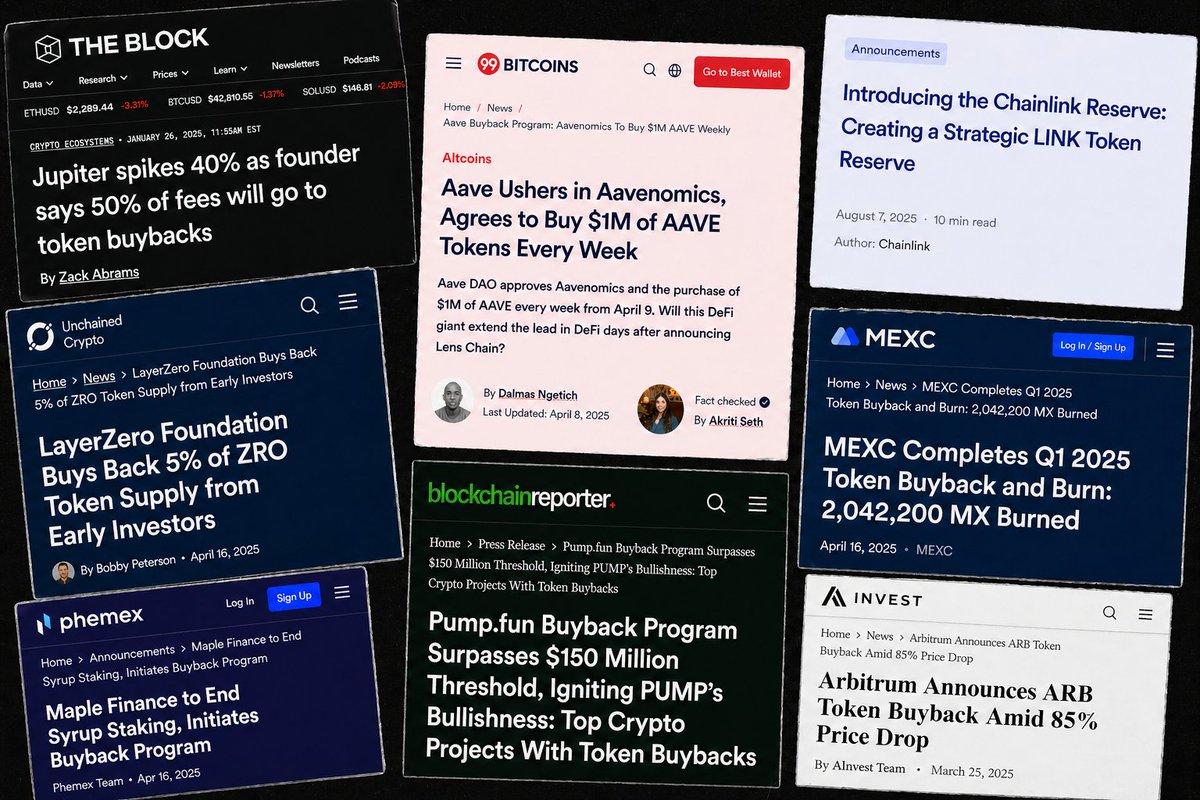
2025 taught us that systems need to generate value. Then it taught us that value needs to go somewhere the token can actually capture it.
But should systems really be shoveling their runway into non-descript treasuries?
New Token: HYPE
✅No off-chain matching engine. No privileged operator controlling fee routing.
✅Every order, match, liquidation, and settlement is an on-chain state transition.
✅One of the most profitable businesses.
✅Driving value back to its holders.
🧵
Especially important to consider given all the happenings regarding the Security Council's $71M ETH freeze linked to the rsETH hack.
Interestingly, those funds are now in a wallet controlled by the ARB DAO, such is the ebbs and flows of control across the various stakeholders.
New token: JTO
@jito_sol is simultaneously:
✅ A block engine (MEV infrastructure)
✅ A liquid staking protocol (jitoSOL)
✅ A restaking engine (NCNs)
✅ A DAO controlling billions in fee flows
So what sector is it?
Most people benchmark Bitcoin against Ethereum, Solana, and Cardano.
This peer group is incomplete, which leads to poor comparative analysis.
Those systems are primarily blockspace businesses. Developers and applications are the core buyer, purchasing execution capacity. Monetary demand is incidental.
Bitcoin produces blockspace too. But that's the secondary service.
AI tool that automatically creates emojis in messages that changes suggested when you click on the emoji.
Over time learns what you emotion you want to express and your attitude to emojis.