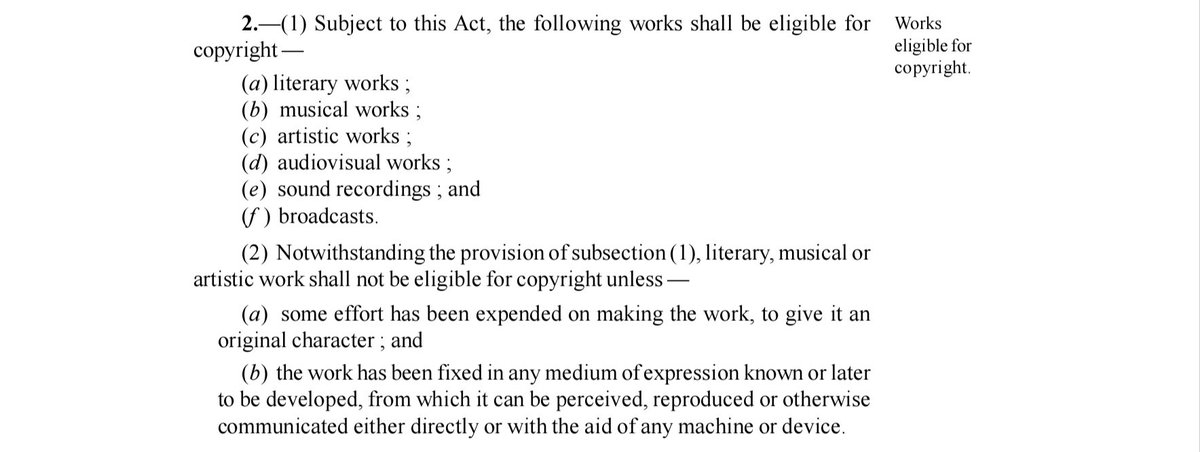
Let’s take a look at this section of the Copyright Act and address one of the common misconceptions around what copyright actually protects.
This is really the foundation of many copyright claims and disputes, but it is often misunderstood or misinterpreted. And if you do not understand this section, you may end up giving out your work or sharing an idea without adequate protection, and only realise later that there may be little you can do about it.
In my practice as an intellectual property lawyer, one thing I have observed is that many of the allegations of copyright infringement brought to my attention may not necessarily amount to infringement. In some cases, the misunderstanding of what copyright actually protects may have contributed to how the person’s idea was used in the first place, without a copyright remedy being available
A thread 🧵
Another way Nigerian creators may be able to make money from their work that you probably haven’t heard about yet.
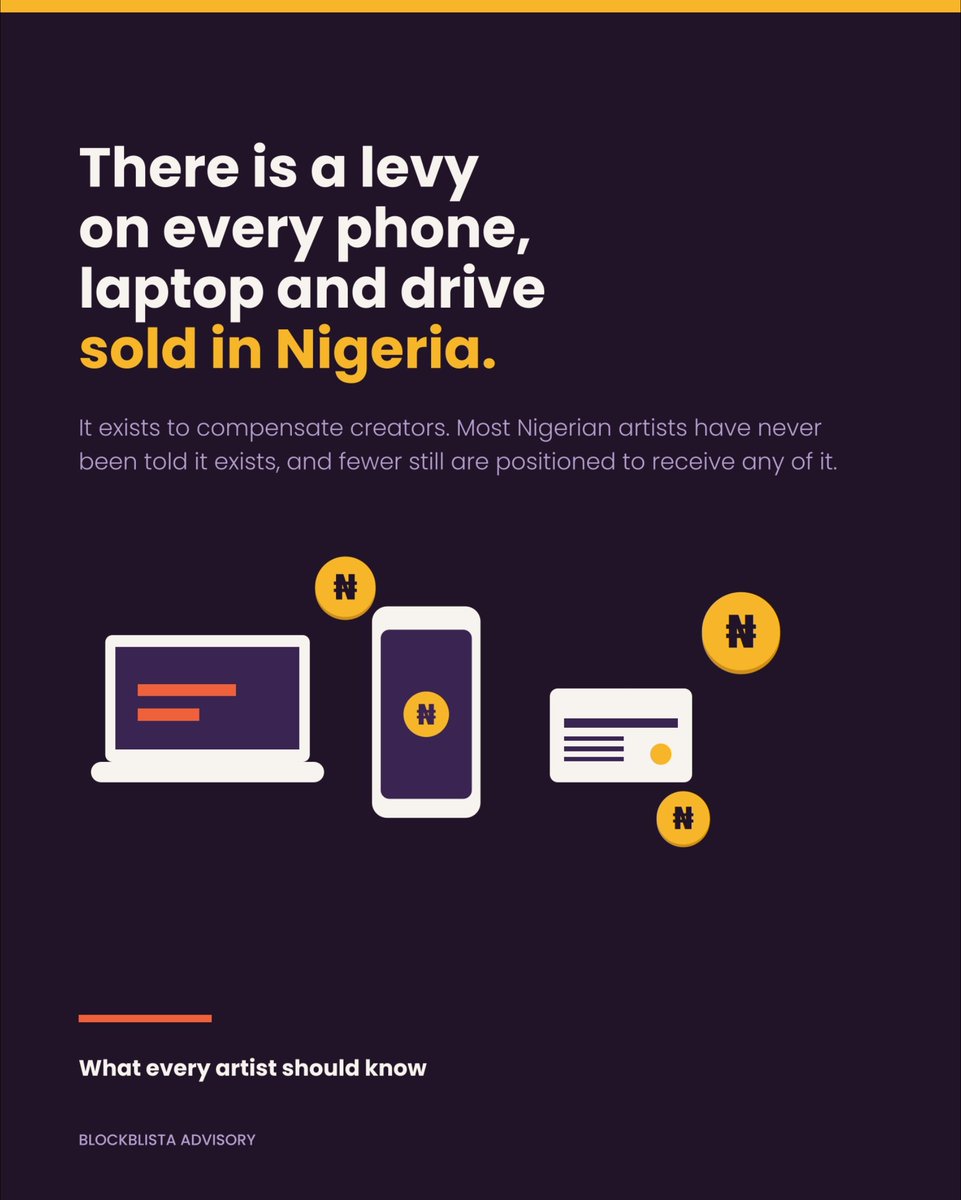
A lot of Nigerian artists probably don’t know this yet, but there is now a 5% copyright levy on phones, laptops, hard drives, memory cards and other devices capable of making copies of protected works.
Yes o, your phone 😂
You can check the Copyright (Levy) Order 2026. I can send a copy if you are interested.
Basically, if somebody downloads your song on their phone, saves your film on their laptop or copies your music onto a hard drive, the law now recognises that these devices make those private copies possible.
So instead of trying to find everybody copying your work and collect money from them individually, there is a levy on the devices and services involved.
For example, if a phone is ₦200,000, the 5% levy would be ₦10,000. 😂
Now, this is where being registered with a CMO as a creator becomes important.
Under the levy framework, 50% of the available funds is reserved for creators through their CMOs. So if you are not properly registered and your works are not properly captured, you may have a problem when it is time to identify who is entitled to receive the money.
So, if you are a creator, I think this is a good time to check your copyright records, ownership splits and any mandates you have given to collecting societies.
Because this could be another way for you to earn from the work you have already created.
If your song is being copied onto millions of phones, you probably want to know where your own share is. 😂
Sunday reminder for lawyers:
Not every legal problem needs a 10-page opinion.
Sometimes the best legal advice is simply telling the client what they need to know, what they should do next, and what they should avoid doing.
As lawyers, we can get carried away trying to demonstrate how much law we know. But clients are not paying us to impress them with authorities. They are paying us to help them make better decisions.
Know the law, yes. But learn how to simplify it.
This is also the reality for many young lawyers who are underpaid.
If you cannot afford to pay a lawyer well, please consider a hybrid arrangement. You cannot be paying peanuts and still expect someone to spend Monday to Friday in the office, especially in a city where transportation alone can take a significant chunk of the salary.
Sometimes it is not that the lawyer cannot manage money. The income simply does not match the demands being placed on them.
You cannot demand full-time commitment on a salary that barely supports the cost of showing up.
Under CAMA 2020, an ordinary resolution needs a simple majority. No founder there holds one alone, but every pair does. Two founders can appoint directors, remove directors, and set dividend policy without the third.
Read: https://t.co/GlyPyp3eFx
These are the kind of people who understand the business of law. It is not just about knowing the law or being a good lawyer o.
Look at Gbenga Oyebode’s career. He has built a legal practice, but he has also built himself into a business leader who can sit on the boards of some of the biggest companies in the country.
That is something I think young lawyers need to pay more attention to. We sometimes focus so much on becoming good at the technical side of law that we forget that law is also a business.
You need to understand people. You need to understand industries. You need to understand finance, governance, strategy and how businesses actually operate. You need to build relationships and, most importantly, become someone businesses want to have in the room when important decisions are being made.
For me, that is one of the biggest lessons from his career.
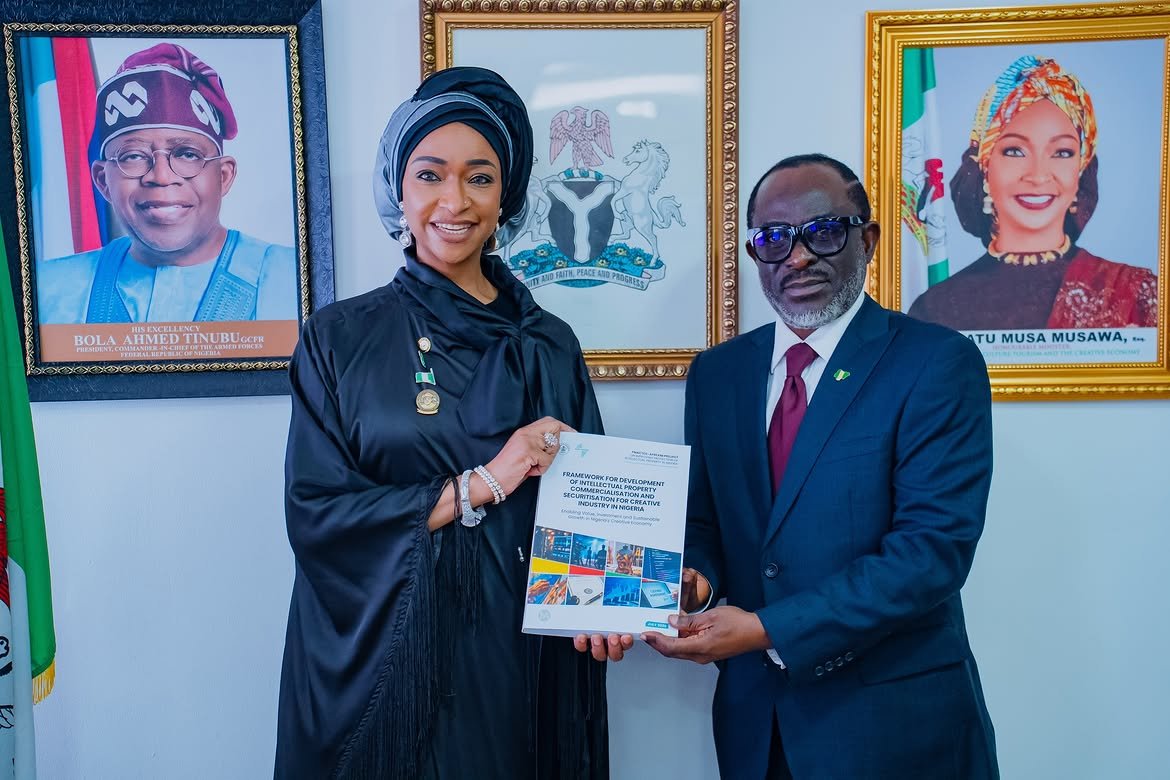
Earlier this week, I stood alongside Prof. Adebambo Adewopo, SAN, as he handed over the draft Framework for the Development of Intellectual Property Commercialisation and Securitisation for the Creative Industry in Nigeria to the Honourable Minister of Arts, Culture, Tourism and the Creative Economy, Hannatu Musa Musawa.
I had the privilege of contributing to the development of the draft as part of the team coordinated by L & A Legal Consultants , under the leadership of Prof. Adebambo Adewopo, SAN, and D. Olatunde Laoye.
I want to explain simply why this matters, because this work is not just for lawyers.
Right now, if you are a musician, filmmaker, designer, or writer in Nigeria, the things you have created can be worth a lot of money, but banks will not lend against them. Your catalogue of songs, your finished film, your brand name, none of it counts as something you can use to borrow money, the way a house or a car would. So even successful creatives often cannot grow their work because there is no clear way to raise funding based on what they have already built.
This Framework sets out to fix that. It gives creatives a clear process to show their work has real, provable value, get it properly assessed, and use that value to raise money. In practice, this could look like a musician with a catalogue earning steady streaming income using that income as security for a loan, without selling the rights to the songs. It could look like a filmmaker raising money for a new project based on the earnings from previous films, instead of relying only on personal savings or one investor.
In short, this gives creatives a way to turn what they have already built into money they can use to grow, without giving up ownership of their work.
This also places Nigeria within a growing global effort. Daren Tang and the entire team at World Intellectual Property Organization – WIPO has been working to move IP finance from the margins into the mainstream, through its IP Finance Dialogues, its practical guide on securing loans with IP, and its first pilot project with a bank in Malaysia. Nigeria's Framework is a local contribution to that same effort.
I am grateful to Prof. Adewopo and Mr. Laoye for the trust, to my colleagues at L&A for the collegiality, and to the Ministry and Afreximbank for the opportunity. The real work, implementation, begins now.
We're pleased to announce that Blockblista Advisory has joined Questel's global partner network. As part of this partnership, we will support international businesses, law firms, and brand owners seeking to secure and manage their intellectual property rights in Nigeria.
One of the most overlooked risks in business is unclear ownership of intellectual property.
Businesses often engage employees, independent contractors, designers, developers, consultants, and creators to contribute to branding, content, products, systems, and commercial assets. However, many fail to properly document who owns the rights to those works after they are created.
Payment alone does not automatically transfer intellectual property ownership.
Without clear contractual provisions, businesses may later face disputes regarding ownership, usage rights, licensing, commercial exploitation, or control of important business assets. These issues frequently arise during fundraising, partnerships, acquisitions, and expansion processes where intellectual property ownership becomes a critical part of due diligence.
Businesses that take intellectual property ownership seriously are often better positioned for investment, commercial growth, and strategic transactions.
At Blockblista Advisory, we advise businesses, founders, creators, and investors on intellectual property protection, ownership structuring, and commercial asset management.
#IntellectualProperty #BusinessLaw #CommercialLaw #BrandProtection #Blockblista
Many businesses invest significant time and resources into building a brand, yet fail to take the necessary steps to legally protect it. A business name, logo, slogan, packaging, or brand identity may become valuable commercial assets over time, but without trademark protection, those assets remain vulnerable.
Trademark protection is not simply a legal formality. It is a critical part of protecting the reputation, identity, and long-term value of a business. Without proper registration and ownership structure, businesses may face disputes over names and branding, lose exclusive rights to important assets, or even be forced to rebrand after years of growth and market recognition.
Beyond protection, trademarks also play an important commercial role. Investors, partners, and customers often view a protected brand as a sign of structure, credibility, and long-term business seriousness. In many cases, a trademark becomes one of the most recognizable and valuable assets owned by a business.
Businesses that treat intellectual property strategically are often better positioned for expansion, partnerships, licensing opportunities, and long-term growth. Protecting a brand early is significantly easier and more cost-effective than attempting to resolve ownership disputes later.
At Blockblista Advisory, we assist businesses in protecting, structuring, and managing their intellectual property assets to support sustainable growth and commercial value.
#Trademark #IntellectualProperty #BrandProtection #BusinessGrowth
It’s April 26th again, a day we celebrate World Intellectual Property Day. In line with this year’s theme, IP and Sports, I have decided to spotlight 10 key IP disputes in the sports industry.
There is more IP in sports than people think. In this edition, I looked at disputes involving football clubs like Liverpool FC, where the club was opposed when it tried to trademark the word “Liverpool” on the basis that it is the name of a city. I also went further to discuss an IP dispute involving Manchester City FC, which might come as a surprise to many.
Do ensure you read!
Happy World IP Day 🥂
Check comment section for link
Have you guys ever heard about AI sycophancy?
We talk too much about AI hallucination, but nobody is talking about the one that is even more dangerous… AI hyping you up 😂
AI sycophancy is when an AI is conditioned, or tends, to agree with you and reinforce your assumptions. If you pay close attention, many of its responses follow a pattern where it affirms your position, builds on it, and presents it in a way that feels correct, even when your starting point is shaky.
You can literally be wrong with full confidence, and AI will help you upgrade that wrong into premium wrong. In fact, there is growing evidence that many AI systems are designed this way. The more an AI agrees with you and subtly validates your views, the more likely you are to trust it, rely on it, and continue using it.
At least with hallucination, you might catch fake cases if you check well. But this one? It will make your weak argument sound so clean that you won’t even think of verifying anything again.
So let's be careful while using AI. Sycophancy is another serious issue. There's an article i read sometimes ago where the author wrote in detail about this and how to avoid AI sycophancy responses with the right prompt. Will share the link in the comment section.
Moral of the story, if AI agrees with you too fast, relax, you might both be wrong together 😂
Are you protecting your trademark only locally or thinking globally?
Many businesses register their trademarks in one country and assume they are fully protected. The reality is different.
A local filing only protects your brand within that specific jurisdiction. Once your business starts expanding or gaining visibility across borders, gaps begin to show.
That’s where international and regional filings come in.
With systems like WIPO, ARIPO, and OAPI, businesses can:
• Secure protection across multiple jurisdictions
• Simplify the registration process
• Manage their IP portfolio more efficiently
• Strengthen enforcement beyond a single market
The question, therefore, is no longer whether to protect your IP, but how far that protection should go.
At Blockblista Advisory, we help businesses build practical, cross-border IP strategies that match their growth ambitions.
Are you thinking local or global with your IP?
We’ve been quiet lately at Blockblista Advisory because we’ve been busy analyzing the blueprints.
A common bottleneck we see with African innovators isn't a lack of brilliance; it’s a misconception about Intellectual Property (IP).
Too many creators view IP purely as "filing paperwork" or a rigid legal requirement. In almost every sector, an effective IP strategy is what converts a raw, abstract concept into a powerful, protected business asset.
It defines your market position, builds defensive barriers against competitors, and creates real financial value that investors recognize.
Think of your IP strategy like a tree:
1️⃣ It starts with the root of your 'Idea'.
2️⃣ It branches into specific, targeted protections.
3️⃣ And finally, it bears the fruit of business success and revenue generation.
Don't wait until someone copies your idea or brand to think about protection. Your IP strategy must begin on Day One.
👇 Check the cycle below to understand how to move from inspiration to invaluable asset.
Have an idea you need to secure? Let's discuss a comprehensive, general IP strategy. Reach out to us now https://t.co/tw3tFR7oFj
I’ve decided to start a series on the current regulatory regime surrounding digital assets in Nigeria.
I’ve gotten so many DMs and questions about this lately, and I think it’s only right to break it down properly, even though i wrote a detailed article on it last two months. You can request for a copy in the comment section if you are interested in reading. I will send to your DM.
If you genuinely want to understand how crypto, SEC rules, CBN directives, and the new laws (ISA 2025 + NTAA 2025) actually fit together, then please follow this series.
We’re starting from the very beginning, Day One:
👉🏽 Crypto is NOT illegal in Nigeria (if you do it right).
Happy reading!
https://t.co/My90aActE2
There seems to be a lot of confusion online about whether all crypto or digital tokens are now considered “securities” in Nigeria. Many people are unsure about how the SEC rules and the new Nigeria Tax Administration Act, 2025 law work together. Let me explain it clearly.
The SEC in Nigeria has rules for digital assets, especially when it comes to things like token offerings, crypto exchanges, and other platforms that deal with digital tokens. These rules made a lot of people think that the SEC would automatically regulate any token in Nigeria.
But that is not how things work anymore.
The NTAA 2025 now puts a legal test in place to decide which digital assets are actually “securities” that need SEC approval. This test is spelled out in the Second Paragraph of the Fifth Schedule of the NTAA.
A token will only be treated as a security if it is used for investment; meaning people put in money expecting profit from the work of others. That is the same rule used in the U.S. and other global markets (also known as the Howey Test).
So not every token is a security.
If a token is used only for payments or holding value, like a stablecoin (e.g. USDT or USDC), it is not a security. But if a token is sold promising yields, profit, or income, like staking rewards or buyback models, then it is likely to be treated as a security. That means it needs to be registered or approved by the SEC.
In short, the SEC rules still apply, but only if the token meets the new NTAA test. The NTAA has not cancelled the SEC's power, it has simply made sure that only investment-type tokens are regulated as securities.
If you’d like me to do a follow-up post explaining which regulators (SEC, CBN, NFIU, SCUML, etc.) handle what in the digital asset space, feel free to say so in the comments.
I heard the last speaker say, “Just copy it, package it, Implement it and make it a law.” 😀
Apparently, he was referring to crypto laws and regulations in the EU and some Asian countries. But from experience, I can tell you it doesn’t work that easily. You can copy frameworks for some areas, but not for crypto regulations or other emerging tech laws.
I’ve had the privilege of reviewing the laws of some of these countries in recent times, and one thing that stands out is that they all design their laws based on their local and internal economic realities. Their approaches vary widely, and rightly so. Each country shapes its regulatory framework to fit its social, economic, and developmental context.
Take Singapore’s Payment Services Act, for example. Under that law, you can’t even advertise or promote crypto products directly to Singaporean citizens unless you’re a licensed company. Imagine that. You can’t post crypto ads, sponsor influencers, or run social media campaigns that target people in Singapore. It's illegal.
They did this on purpose to protect their citizens from risky investments. The law even says crypto ads shouldn’t be placed in public places like train stations or buses.😂
In Singapore, the government worries more about keeping things stable than letting everyone jump into crypto freely. That’s their reality, and their economy is built to support that kind of control.
Now think about Nigeria. Most young people here first learned about crypto through Twitter, Telegram, or WhatsApp groups, not through banks or regulators. If we copied that same rule, it would practically silence the entire crypto community in Nigeria overnight. We don’t have the same level of financial access, so restrictions like that could do more harm than good.
Or look at the European Union’s MiCA regulation. It requires crypto companies to get authorization before they can offer tokens or stablecoins to the public. That means before you even launch, you must have capital, risk systems, reporting tools, and an office that regulators can inspect.
That’s great for a place like the EU, where companies already have access to proper banking and clear structures. We tried emulating the same system in Nigeria with the recent regulations from SEC, but you and i know the kind of public outcry that comes with it.
Even Japan’s crypto laws came from their own bitter experience. After the Mt. Gox and Coincheck hacks, they made it compulsory for all exchanges to store most user funds offline and register with the Financial Services Agency. That works well for them but again, it was built around their system of trust, discipline, and enforcement.
Now, if we copied these exact laws in Nigeria without thinking about our own realities, our infrastructure, economy, and social behavior, they would collapse under their own weight.
For Nigeria, I think our priority should be financial inclusion, youth participation, not just restriction. Our economy and our people are different. We need laws that understand our own environment, not laws written for someone else’s reality.