Stop prompting like a beginner.
I have been working with AI for years and the prompt matters more than the model.
Here are 5 things I do to make every prompt better:
One thing I genuinely appreciate in this video is the honesty in everything he said. Pure reality.
As I always say, whether you succeed in this profession is largely in your hands. The moment you become a lawyer, you already have one of the strongest tools to create value for yourself. The problem is that many lawyers wait too long before they start exploring beyond salary.
Truth is, salary alone can hardly sustain anybody long term, even in some top firms. Once real life responsibilities start coming, you will understand very quickly. That’s why young lawyers need to start thinking beyond monthly pay. Build visibility. Build relationships. Build expertise people can pay for.
And please, never joke with online visibility. We are now in a time where people can discover your competence without ever meeting you physically. Opportunities, referrals, speaking engagements, clients and collaborations now come from visibility too.
You can be 10 years at the Bar and still struggle financially if nobody knows what you do or what value you bring.
In my presentation today, I told young lawyers that:
The merge salaries they receive cannot sustain them. So they have to start thinking of how to build an alternative source of income through billing for consultation, and building side private practice. Watch this and enjoy
I’ve never really been the type to believe that opportunities only come from applying for things. I believe a lot in networking because many opportunities and even career breakthroughs come through referrals and relationships. A lot of the doors that open for people today are often because someone somewhere knows them, trusts them, or has seen their consistency over time.
And honestly, not having connections is not an excuse. For people like some of us who were not born with a silver spoon, networking is almost necessary. So far there is nothing restricting you from exploring, contributing to conversations, and putting yourself out there, then you already have a chance.
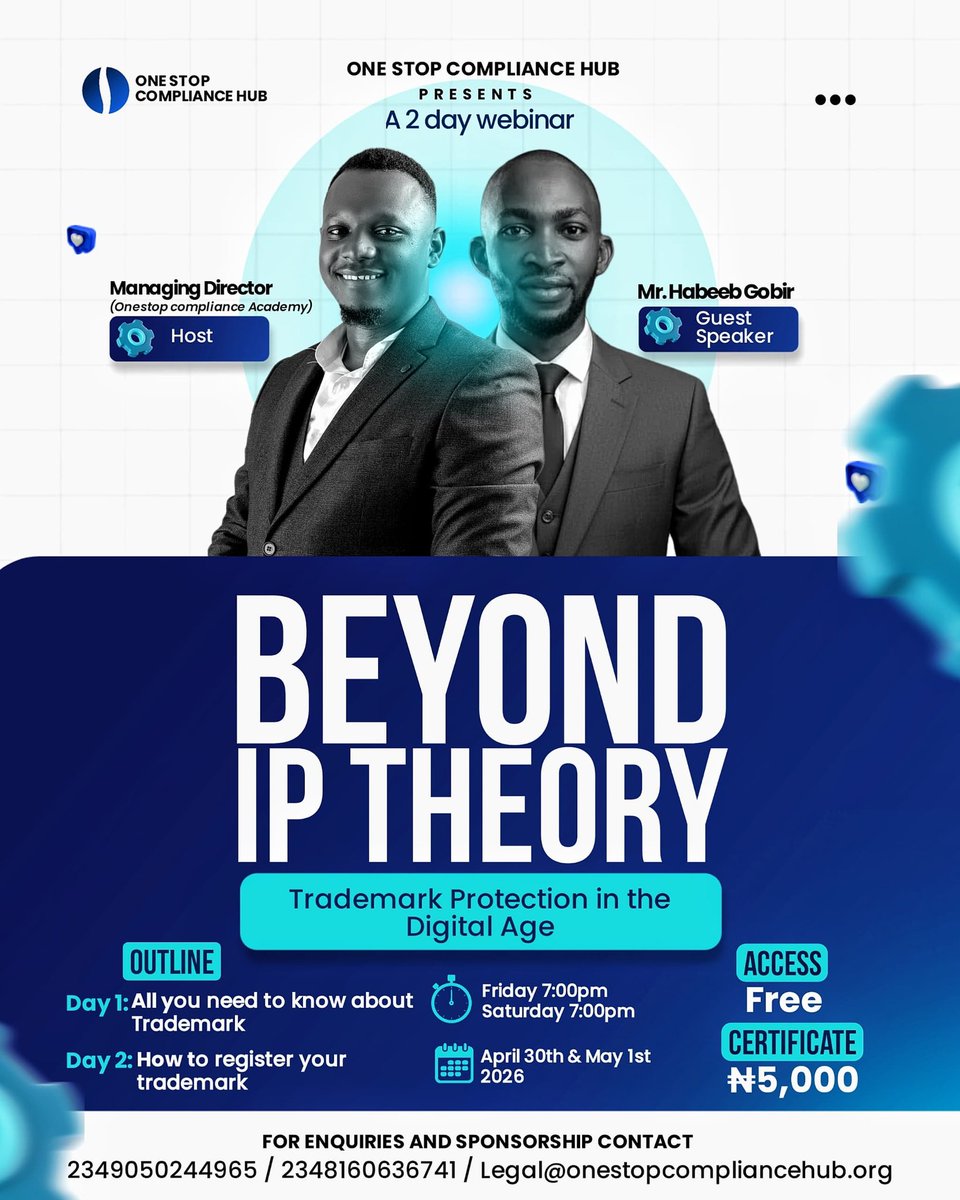
I had a great time with the One Stop Compliance Hub team last Saturday. It was an engaging session where we explored the theoretical foundations of trademark law and how those principles apply in practice. Many thanks to Mr. Oluwafemi Adediran(APAc) for the invite.
There’s something very rewarding about breaking down legal concepts and seeing them click for people, especially when you can connect theory to real-world things. The conversations, questions, and insights shared during the session made it even more worthwhile.
Grateful for the opportunity to speak and contribute. Looking forward to more sessions like this.
If you missed it or would like to revisit the session, I’ve shared the YouTube recording below.
https://t.co/fRWvL8cVfh
Go ahead, share your idea, or hire someone without an agreement. I’m sure clarity and structure are overrated anyway.
We’ll be here when that works out exactly how expected!
You don’t always need to claim colour when filing your trademark.
Yes, you heard me right.😅
I know that sounds strange at first, because most people assume that claiming colour makes their mark stronger, but in practice, it can actually limit you.
Section 16 of the Trade Marks Act allows an applicant to limit protection of their logo to a colour. Once you claim a particular colour, your mark is protected only in those colours. That becomes the scope of your registration. If you don’t claim any colour, then the presumption is that your mark is protected in all colours.
Now, let me be clear about something, because this is where people get confused.
This does not mean you can go ahead and file a trademark just for a colour on its own. Colours are non conventional marks and they are generally not registrable in Nigeria as standalone trademarks.
What Section 16 is talking about is colour as a feature of an already registrable mark, not colour by itself.
Now, back to the practical side of this.
The advantage of claiming colour is that it helps you protect a very specific brand identity, especially where colour is a key distinguishing feature of your mark. But the downside is that you are narrowing your protection, because if someone uses a similar mark in a different colour, it may be harder to establish infringement.
On the other hand, if you leave colour unclaimed, your protection is broader and more flexible, and that makes it easier to challenge similar marks regardless of colour variation, but you lose that precision tied to a specific colour identity.
So when someone comes up with something very similar to your mark but just changes the colour slightly, you may struggle to argue infringement if you claimed colour, but you would be in a stronger position if you didn’t.
And this is where I usually have to slow clients down a bit. Because a lot of people want to lock in their brand, especially when they are attached to a particular colour, but they don’t realise they are also narrowing their protection at the same time.
And the thing is, brands don’t stay the same. Colours change, and now your registration is stuck in a version of your brand that you might not even be using fully anymore. So you’ve restricted yourself without even realising it
I’m curious though, how do others approach this, especially in practice? Do you prefer claiming colour as a feature, or leaving the mark unclaimed for broader protection?
I was reading one of the recent decisions of the Supreme Court in Cowrie Business Solutions Ltd v. Nigeria Deposit Insurance Corporation & Ors, and a part of the ratio immediately caught my attention.
Not because the principle was new, but because of how it was expressed
There is something almost poetic about how the Justices approached the concept of abuse of court process. It took me back to the era of jurists like Justice Oputa, JSC, where judgments were not only authoritative but also rich in expression, deliberate in tone, and memorable in delivery.
Take a moment to reflect on the wording:
> “…the appeal paraded an indelible trademark of an abuse of court process.”
It’s fascinating how the Court borrows from the language of intellectual property to describe procedural misconduct. Almost as if to say that the abuse was so clear, so distinct, and so unmistakable that it carried its own identifiable mark.
Moments like this remind you that law is not only technical, it is also intellectual and, in its own way, artistic.
If your lawyer is asking questions that feel uncomfortable, that’s usually a good sign. It means they are thinking ahead. The quiet lawyer that just agrees with everything is the one you should worry about.
I think a lot of lawyers won’t say it out loud, but this is very real.
There’s that constant tension between what you feel personally and what the role demands professionally. Especially in criminal practice, you’re not there to validate the facts emotionally, you’re there to test the case against your client and ensure due process is followed.
That discomfort doesn’t make you weak, it actually shows you’re still human. The key is knowing that the system only works if everyone plays their role properly.
So yes, that mix of uneasiness and fulfilment. Very valid experience.
As a criminal law attorney, I enjoy taking up serious criminal cases; like murder, rape, armed robbery, cultism and kidnapping. They are the only cases I feel like I am doing something serious and feel better fulfilled for handling them. Although a part of me feels uneasy, in the end. It’s always a mix of personal guilt and professional fulfilment.
Has anyone here experienced such before?