Serial acquirers are my favorite business model to own. A holding company that buys small, durable businesses, keeps the managers in place, and redeploys the cash into the next acquisition. Done with discipline, it compounds for decades. Here are the ones I most admire.
"We forecast Constellation to deploy $3.0B capital on acquisitions in FY27e, up from $1.9B in FY25. $CSU is likely to generate one of the highest returns for shareholders over the long term in our coverage universe."
⚔️ 𝐁𝐑𝐄𝐀𝐊𝐈𝐍𝐆: $QNT ’s second patent in the United States is set to be granted on July 28, 2026.
The same IP has already been awarded protection in Europe and Japan.
Now the world’s largest technology market joins the list.
In simple terms, the patent makes it possible for different blockchains to execute a single instruction, like a transfer or swap, as a coordinated system, ensuring every network reaches the same trusted result.
This is the exact kind of infrastructure a tokenized, global financial system requires.
Another patent.
Another moat.
$QNT extends its lead again.
Dr. Peter Glidden: "A 12 year worldwide meta-analysis study revealed Chemotherapy has a 97% failure rate. So why is it still used? It's one reason & one reason only, money.”
🚨 BREAKING: Google Gemini can now analyze any stock like a Wall Street analyst (for free).
Here are 10 insane Gemini prompts that replace $4,000/month Bloomberg terminals:
(Save this 🔖 you’ll need it later)
@kristinnsms Granted. But that’s the flaw, not the defense, a net number flatters you right up until it doesn’t. By the time maintenance confirms it, you’re not reading a warning, you’re reading an obituary.
Fifteen years from now, most of today’s crypto stars will be forgotten.
The networks that survive will be those that become critical infrastructure.
My highest-conviction picks for 2030-2040:
🥇 #BTC
🥈 #ETH
🥉 #LINK
4️⃣ #HBAR
5️⃣ #QNT
Watch the rails, not the headlin
Funny how the market finally realizes this:
Compressed ICT multiples don’t hurt serial acquirers like $CSU, $TOI.V and $LMN.V ~ they feed them.
Lower valuations = larger acquisition pipeline, higher future IRRs, less competition for assets.
The bear case became the fuel.
$TOI.V Q1 ’26: For VMS roll-ups, FCFA2S and ROIIC are what compound. FCFA2S +2% reflects M&A absorption (working capital). LTM M&A multiple 1.2x sales sets up structural ROIIC vs public SaaS 6.4x and Asseco 7x EBITDA. The spread is the engine; thesis intact. $CSU.TO
Mohnish Pabrai talked about buying $CSU.TO $LMN.V $TOI.V for $WAGN at the VALUExBRK event!
Thanks to Guy Spier for live streaming this great event!
Youtube link: https://t.co/2VDS8fDQdt
Official VALUExBRK link: https://t.co/yBHQKCrb2M
@ReneSellmann VMS serial acquirers are arguably the most AI-resilient software class trading today: thousands of fragmented vertical workflows, embedded switching costs, no SaaS-replacement risk. Bottom-calling is timing theater. The moat keeps compounding through it.
6/ The expiration of Veeva's agreement with Salesforce removes artificial development constraints. Being off Salesforce's platform means Veeva now controls its own roadmap, margins, and AI integrations. As of Q3 FY2026, over 115 live Vault CRM deployments are underway, with 9 of the top 20 pharma companies committed to Vault CRM.
This software depression is the best thing that could happen for $TOI.V and $CSU holders long term… they know what to buy, and now they get it for 1/3 of the price.
@DutchInvestors Not all serial acquirers are equal.
$CSU.TO $TOI.V $LMN.V are compounding machines.
The rest? Good, but not exceptional.
Capital allocation skill > narrative.
@ReneSellmann Improvement beats quality > but only if it survives and is priced right.
Most turnarounds fail. Most ‘great’ stocks are overpaid.
The edge = asymmetric improvement.
@_inpractise AI lowers the cost to write code. It does NOT kill:
🔒 Regulatory certification
🔒 Vertical workflow incumbency
🔒 Customer trust
Compressed multiples = ICT acquisitions at lower prices than ever.
The bear case accidentally built the bull case for $CSU $TOI $LMN.V 🧩
"If you're losing, we'll take your capital and put it elsewhere."
That's the CEO. Talking about AI. On an earnings call. About his own businesses.
$CSU is down 52% from its all-time high. I'm buying more.
5 reasons the AI selloff is actually bullish for Constellation Software:
1. CSU just unlocked an entirely new class of deal. PEMS (Permanent Engaged Minority Shareholder).
Now they can take permanent minority stakes in public companies too large to acquire outright & get a board seat and influence the direction
First target: Sabre. Mark Leonard designed the strategy from his board seat. The "they'll run out of deals" bear case just died.
2. Private software valuations haven't dropped yet but they will.
Business owners anchor to 2021 prices the same way home sellers do. But many are aging boomers figuring out succession. The AI narrative is planting doubt. Give it 18-24 months.
3. 1,000 parallel AI experiments. Some CSU businesses will lose to AI. When AI threatens one vertical, capital gets redirected to the 999 others. Most "software stocks" can't do this
4. CSU's customers are the last humans on earth to switch software. Municipal water utilities. Court case management. Funeral homes. Transit agencies. The hospital system that last changed vendors in 2011 isn't switching to an AI agent in 2026.
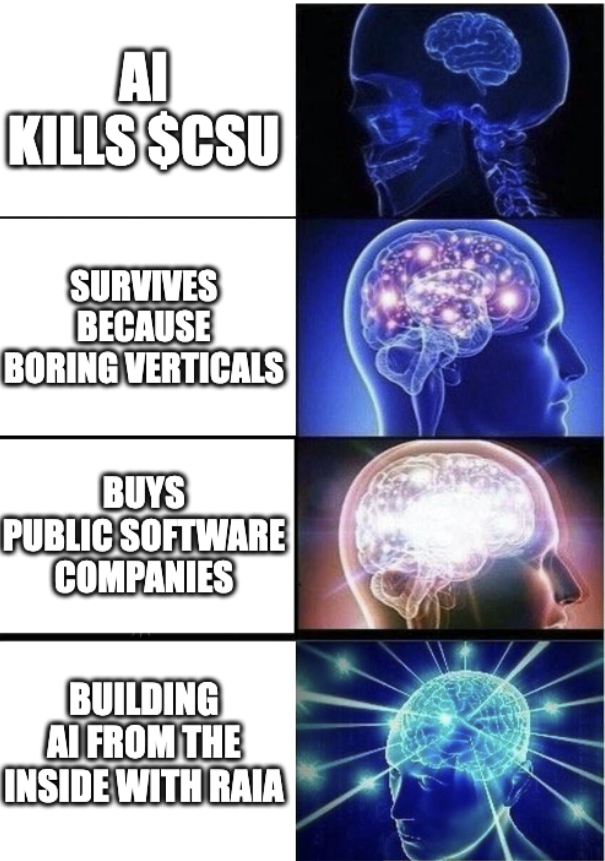
5. CSU isn't just surviving AI. It's building AI from the inside. VMS Ventures. Raia, built an AI agent platform inside the ecosystem.
Its already live: 48,000 conversations across CSU's global finance team, 70% resolved without a human. 50% of tickets solved end to end at IDEAL.
The fat pitch doesn't come with a clean narrative. It comes when the market is terrified and the numbers say otherwise.
@adrivalue When shareholders block buybacks, incentives, and capital reductions… something’s off.
Meanwhile $TOI.V just quietly compounds without the drama.
Silence > noise.
Not all governance is created equal 😉