BREAKING: May CPI inflation rises to 4.2%, the highest level since April 2023.
Core CPI inflation also rises to 2.9%, the highest since September 2025.
Inflation in the US is officially back above 4% and more than double the Fed's target.
Odds of Fed rate hikes are rising.
TOMORROW: MOST IMPORTANT DAY FOR MARKETS IN A DECADE
Every fund over $100M files their 13F with the SEC on May 15 - mandatory disclosure of every long position held in Q1
One day per quarter when you see what smart money was doing while retail watched the news
Watch these five:
• Leopold Aschenbrenner - beat S&P by 47% in his first 6 months
• Warren Buffett - 60 years in markets, never had a down decade
• Stanley Druckenmiller - 30 years without a losing year
• Bill Ackman - the most vocal macro trader alive
• Ray Dalio - largest hedge fund in the world
New Fed Chair, Iran deal talks, Trump-Xi summit, and markets at critical levels - all in the same week
This is the most significant 13F filing day in a decade
Watch closely
Lot o’ $mu maxis are about to learn two very expensive lessons…
1) memory is the most cyclical, commoditized part of the semi complex, and
2) the absolute worst time to buy cyclical, commodity businesses is when they look “cheap”
Jensen Huang just told every college student on Earth the one thing that determines whether they get hired.
It is not their GPA.
It is not their degree.
It is not their internship.
Huang: “If I have a choice between two, I would hire the one who’s expert in using AI.”
He did not say prefer. He said hire.
One gets the job. One does not. The only variable is whether you learned to use the machine.
Then he went down the list.
Accountant. Hire the one who uses AI.
Lawyer. Hire the one who uses AI.
Marketing. Supply chain. Sales. Customer service.
Every function. Same answer.
The person who can command the model does not have an edge. They are the only candidate in the room.
Everyone else is applying for a job that no longer exists.
Huang: “If you’re a carpenter, if you’re an electrician, go use AI. If I were a farmer, I would absolutely use AI.”
That line should demolish every assumption about who this technology is for.
This is not a Silicon Valley tool for software engineers.
This is infrastructure for anyone who builds anything with their hands or their head.
A farmer who uses AI to optimize soil, predict weather, and manage yields is not competing with other farmers.
They are operating at a level that used to take an entire department.
An electrician who uses AI to model loads, simulate wiring, and quote jobs in seconds does not compete with other electricians.
They compete with firms.
One person with the model replaces the output of a team without it.
That is not a prediction. That is Tuesday.
Huang: “Every college student should graduate and be an expert in AI.”
Not familiar with it. Not aware of it. Expert.
The university system is still training students to execute the work.
The market already moved. It wants the person who directs the machine that executes it.
Four years of tuition. Thousands of hours of lectures.
And if you walk out the door without mastering the one tool that redefines every industry you could enter, you burned all of it.
Huang: “I want to see what it could do to elevate my job, so that I could be the innovator to revolutionize this industry myself.”
That is the part most people miss.
AI does not replace ambition. It multiplies it.
The carpenter who learns the model does not lose their craft. They scale it.
The pharmacist who learns the model does not become redundant. They become dangerous.
One person. Deep skill. Full command of the machine. That used to be called a company.
The question is no longer what do you know.
It is what can you build with the machine that knows everything.
And the people who cannot answer that are not falling behind.
They already fell.
He is finally getting exposed. What his team and fans actually did to bailu and zhaojinmai are even worse. He is a bully. I don't know why they are hyping him up and shipping with these poor girls who avoid him like plague right now.
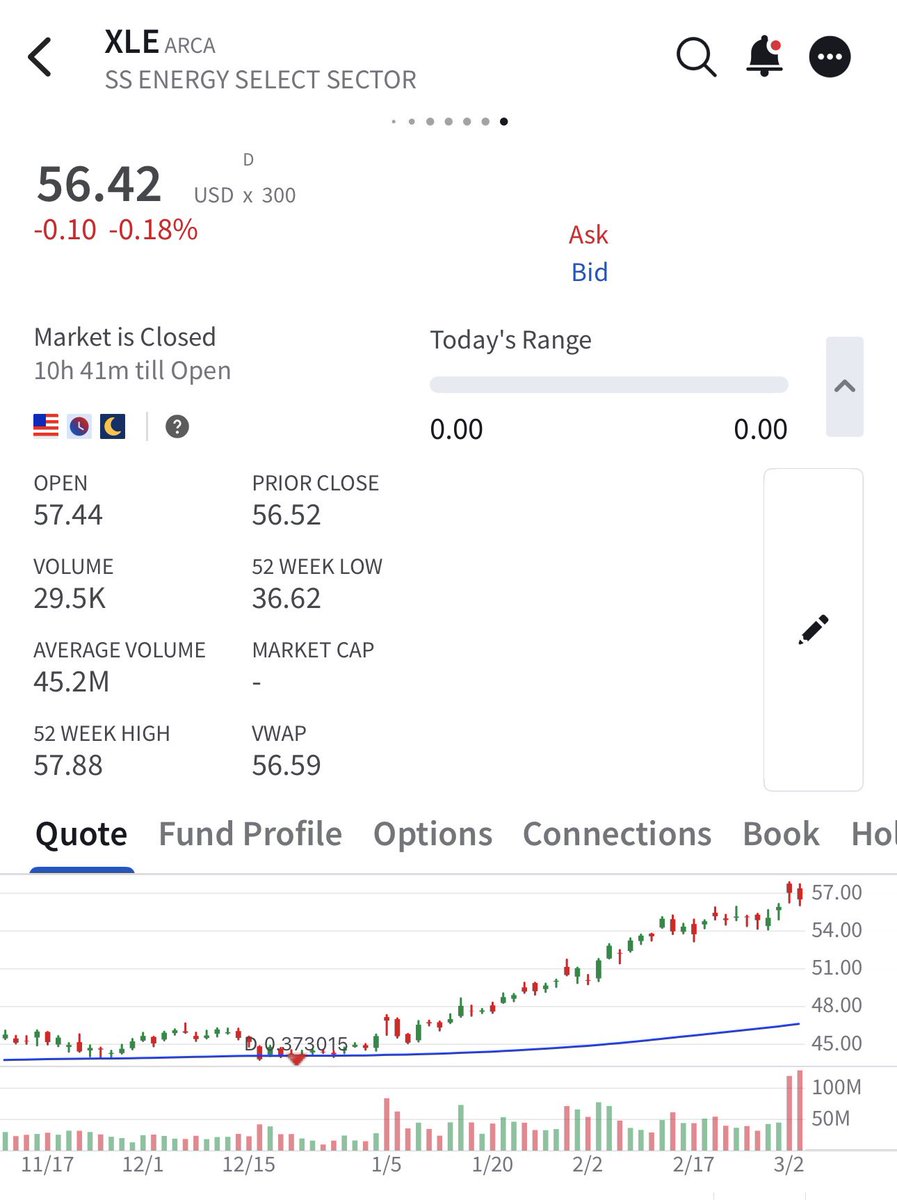
$XLE just printed the biggest volume of the entire move right at the highs.
That usually means smart money selling into strength while late buyers chase the headlines.
Oil can still spike if something gets bombed, but energy stocks might already be telling you the war trade is getting closer to the end.
Iran is being defanged day by day. Ignore the headlines — stick to the facts.
Missiles fired:
Day 1 ~300+
Day 2 ~200
Day 3 ~100+
Day 4 ~50
Meanwhile, the Israeli stock market is up ~5% since the start of the operation. That’s the smart money, not the dumb money trading headlines.
All the major powers have an incentive to keep the Strait of Hormuz open. A solution will come. Oil markets will likely be flooded again.
Be smart. Look at the future, not the headlines.
Iran lost its navy, air defense and ~70% of its rocket launchers. Soon they’ll be more harmless than a Disney bunny.
Stan Druckenmiller’s current positions:
- LONG Korea + Japan (+ Brazil)
- LONG Copper (AI + tight supply)
- LONG Gold (geopolitics)
- SHORT Bonds
Portfolio is no longer "AI-driven". He’s bearish on the Dollar but bullish on the US economy with disinflationary growth.
Perplexity just took its shot at killing OpenClaw, and I'm completely blown away.
Their new Computer tool is the most powerful agentic system on the market right now.
Think OpenClaw, but on steroids (easier setup, better security + more)
My top 10 mega prompts (copy/paste):
we're making @blocks smaller today. here's my note to the company.
####
today we're making one of the hardest decisions in the history of our company: we're reducing our organization by nearly half, from over 10,000 people to just under 6,000. that means over 4,000 of you are being asked to leave or entering into consultation. i'll be straight about what's happening, why, and what it means for everyone.
first off, if you're one of the people affected, you'll receive your salary for 20 weeks + 1 week per year of tenure, equity vested through the end of may, 6 months of health care, your corporate devices, and $5,000 to put toward whatever you need to help you in this transition (if you’re outside the U.S. you’ll receive similar support but exact details are going to vary based on local requirements). i want you to know that before anything else. everyone will be notified today, whether you're being asked to leave, entering consultation, or asked to stay.
we're not making this decision because we're in trouble. our business is strong. gross profit continues to grow, we continue to serve more and more customers, and profitability is improving. but something has changed. we're already seeing that the intelligence tools we’re creating and using, paired with smaller and flatter teams, are enabling a new way of working which fundamentally changes what it means to build and run a company. and that's accelerating rapidly.
i had two options: cut gradually over months or years as this shift plays out, or be honest about where we are and act on it now. i chose the latter. repeated rounds of cuts are destructive to morale, to focus, and to the trust that customers and shareholders place in our ability to lead. i'd rather take a hard, clear action now and build from a position we believe in than manage a slow reduction of people toward the same outcome. a smaller company also gives us the space to grow our business the right way, on our own terms, instead of constantly reacting to market pressures.
a decision at this scale carries risk. but so does standing still. we've done a full review to determine the roles and people we require to reliably grow the business from here, and we've pressure-tested those decisions from multiple angles. i accept that we may have gotten some of them wrong, and we've built in flexibility to account for that, and do the right thing for our customers.
we're not going to just disappear people from slack and email and pretend they were never here. communication channels will stay open through thursday evening (pacific) so everyone can say goodbye properly, and share whatever you wish. i'll also be hosting a live video session to thank everyone at 3:35pm pacific. i know doing it this way might feel awkward. i'd rather it feel awkward and human than efficient and cold.
to those of you leaving…i’m grateful for you, and i’m sorry to put you through this. you built what this company is today. that's a fact that i'll honor forever. this decision is not a reflection of what you contributed. you will be a great contributor to any organization going forward.
to those staying…i made this decision, and i'll own it. what i'm asking of you is to build with me. we're going to build this company with intelligence at the core of everything we do. how we work, how we create, how we serve our customers. our customers will feel this shift too, and we're going to help them navigate it: towards a future where they can build their own features directly, composed of our capabilities and served through our interfaces. that's what i'm focused on now. expect a note from me tomorrow.
jack
This 40-minute Peter Thiel lecture will teach you more about business than a 2-year MBA program:
Summary:
• Value Creation and Capture:
A valuable company must both create value (X dollars) for the world and capture a percentage (Y%) of that value.
X (total value created) and Y (share captured) are independent variables; a company can succeed with either a large X and small Y or vice versa.
• Monopoly vs Perfect Competition:
Monopolies are stable, profitable, and create long-term value, unlike perfectly competitive industries where profits are eroded away.
The airline industry exemplifies a highly competitive market with very low profit margins despite large revenues, contrasted with Google’s search business that is smaller in revenue but much more profitable due to monopoly power.
Thiel argues there are only two types of businesses: monopolies and perfectly competitive firms, with very few in between.
• Market Size and Perception Lies:
Companies distort their market descriptions depending on their position.
Monopolists exaggerate market size by describing their market as a vast union of many different sectors to avoid regulatory scrutiny.
Non-monopolists minimize market size, describing it narrowly to appear unique and attract investment.
Example: A restaurant owner might claim to serve a tiny niche market (e.g., British food in Palo Alto) to claim uniqueness, while Google describes itself broadly as a technology or advertising company to dilute monopoly perception.
Successful startups begin by dominating a small market and then expand outward.
Examples include Amazon starting as an online bookstore, PayPal targeting eBay power sellers, and Facebook launching initially at Harvard.
Starting with a large, broad market is often a sign of misunderstanding the market and leads to intense competition and failure (e.g., many clean tech companies).
• Last Mover Advantage:
The greatest value lies in being the company that dominates a market long-term, not necessarily the first mover.
Most of the value of tech companies comes from future cash flows many years ahead, emphasizing durability over short-term growth.
• Historical Perspective on Innovation and Value Capture:
Throughout history, many scientific and technological breakthroughs created large societal value (X), but the innovators rarely captured substantial financial value (Y close to zero).
Examples include great scientists like Einstein and industries such as railroads or early aviation, where competition or structural factors prevented wealth capture.
Two main categories where value capture was successful:
1. Vertically integrated monopolies (e.g., Ford, Standard Oil) require complex coordination and capital investment.
2. Software businesses, benefiting from near-zero marginal costs and rapid adoption.
• Psychological and Cultural Aspects of Competition:
Society often romanticizes competition, seeing losing as a personal failure, but Thiel argues that competition itself is a form of losing, as it destroys value and capital.
Human nature is mimetic (imitative), leading to overcrowded markets and irrational competition.
Real success comes from escaping competition by finding unique, overlooked opportunities.