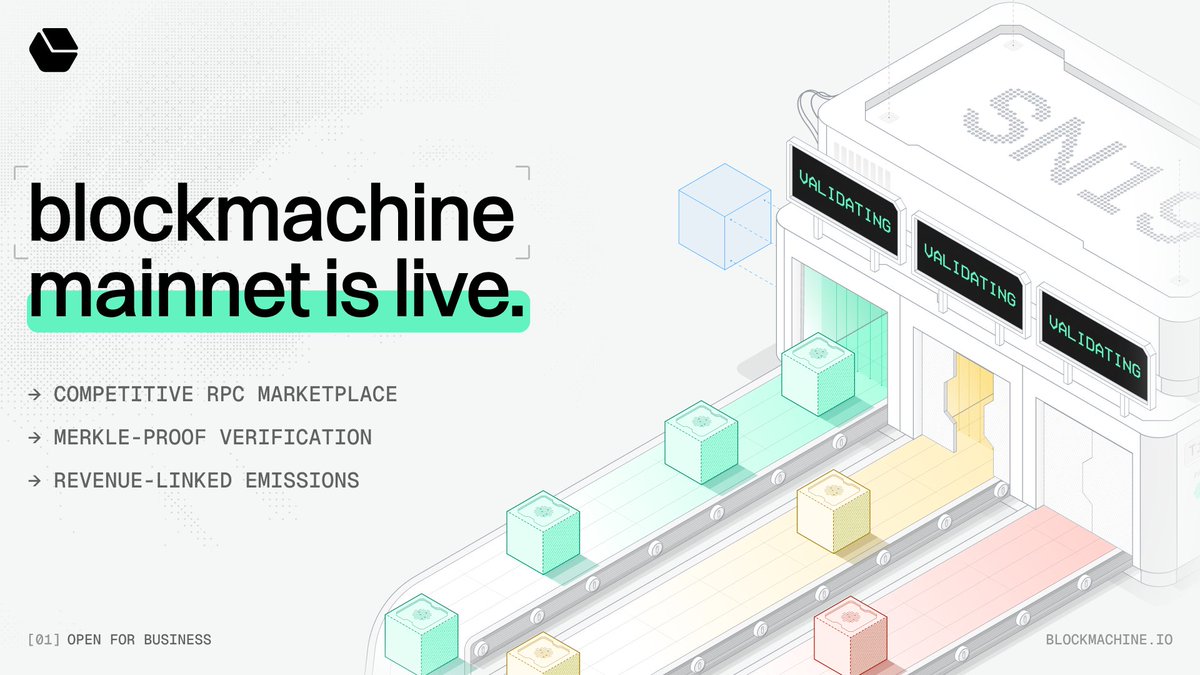
After successfully updating @coingecko main listing to show SN19/blockmachine
https://t.co/aRz6GWUIJS
We are preparing to submit our request to CoinGecko Terminal: https://t.co/0CLqAfNZxp
To do so requires this verification post from our official account, mentioning the person handling this on Telegram @mogmachine (X & tg handle are the same).
The public can ignore this tweet except to show other subnets, it is not that hard to change your CG info if you need to.
blockmachine just settled its first on-chain buyback.
$2,009.73 of customer revenue from Apr 22 → May 15 → 530.84 α of SN19. Sized to match miner payouts and offset emission-driven sell pressure.
Cycle one. Buybacks scale with revenue from here.
https://t.co/eq8ETVja5o
Referrals are live.
5-10% recurring on every eligible payment from customers you refer. Paid in USDC.
Join our decentralized sales team: https://t.co/my9W5hqnO4
9/ Long-term, Bittensor product teams should build on top of a commodity RPC layer, not running their own.
We are building that layer.
The market is forming. The mechanism is working.
Stop running nodes. Build products.
https://t.co/Ip9U04sTVU
1/ Stop running nodes. Build products.
Across the Bittensor ecosystem, teams still spend too much engineering time on RPC reliability, node access, endpoint failover, and infra babysitting.
Reliable RPC is necessary. Owning the whole stack usually is not. 🧵
8/ That changes the calculus for product teams.
Running your own RPC stops being the safe default. It becomes the expensive default.
The choice where you keep paying an engineering tax that the rest of the market is starting to shed.
@DrocksAlex2 That's right. All storage queries are verified against Merkle proofs at the gateway before the response reaches the customer. The remaining methods (runtime calls, subscriptions) are checked by the validators.
The Bittensor community moves fast.
Two days post-mainnet, the blockmachine team has been flipped on SN19 routing share. An independent miner registered 36 hours ago went from 5% to ~38% of traffic share. They're now #1 on the subnet.
Eight other independents are serving traffic alongside them. The network has grown from our 24 nodes at launch to 64.
The plan was always that our miners would be beaten by the community. We just didn't expect it to happen this fast.
This community rocks.
1/ I woke up very stoked today.
in 3 years of building on Bittensor, i have never been this excited about a subnet launch.
today blockmachine goes live.
first ever Bittensor subnet to launch on mainnet with a real product, real customers and real revenue from day one.
🧵 how it works and why it matters 👇
blockmachine mainnet is live on Bittensor.
Sign up and start making requests today.
A decentralized RPC marketplace where competing miners drive pricing down and every storage query is cryptographically verified via Merkle proof.
Subnet 19. Open for business.
Try it: https://t.co/DiNIQZyH1G
Mine it: https://t.co/Np8OxAWyzh
Verify it: https://t.co/4SCfoa0uqP
Built on @bittensor
blockmachine validator code is now public.
This is the code that reads gateway logs, verifies miner correctness against reference nodes, computes quality scores, and submits weights on-chain.
https://t.co/u8q59NCzI0
How blockmachine verifies miner responses at the gateway: a technical deep dive.
Every storage query is cryptographically verified before it reaches you. Not sampled. Not spot-checked. Every one.
In our benchmark, verification added under 6 microseconds of end-to-end overhead. 🧵
If verification fails, the gateway silently retries on a different miner within milliseconds. Failed backends are excluded. The customer never sees it. The failed miner earns zero CU.
Subscriptions and runtime calls use sampling-based validation instead of per-request proof.