Whether you work in a technical role or not, AI is fast becoming an integral way of working for each of us in our daily lives. Some teams run in the opposite direction. GTM Strategy Director for @PubNub, Erica Eckes, is embracing the AI wave in a human-first way:
"I used to hold sessions where I asked everyone to bring me the most annoying, tedious parts of their job, and we’d figure out how to make them go away. I want people to have that conversation with themselves [and use AI to fill those gaps...] Don’t let the tedious things fester. Your first solution might not be the best one you ever build, but it’s a step in the right direction. Talk to someone more technical than you, look around online, or go back and forth with your agent for longer than you’d like to admit, and see where you land."
Read more: https://t.co/tpy5anwOBH
5 AI concepts to study if you don't want to get left behind:
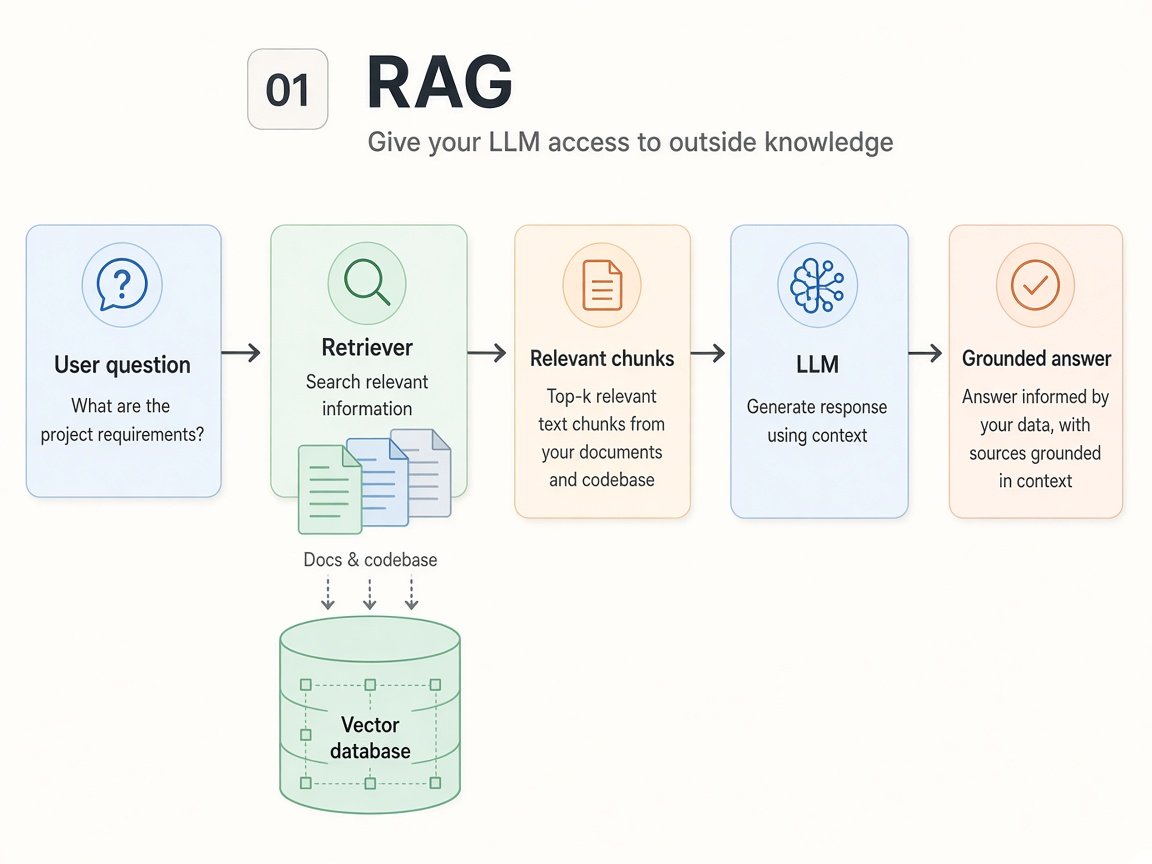
1.) RAG
How you give an LLM access to outside knowledge, like your company docs and codebase.
2.) MCP servers
How you connect AI to real tools and services: GitHub, databases, APIs.
3.) Plugins and skills
They extend what your AI can actually do. Experiment and keep what fits your workflow.
4.) Agent harnesses
The infrastructure around the model that handles tools and execution loops.
5.) LLM-as-a-judge
One model scores another model's output. AI vs AI, and it's great for code reviews.
Prompting barely scratches the surface. The future of software engineering is engineering the systems around AI.
You could do all that, and it would work just fine. It would take a lot of time, technology, and tokens.
Or, you could replace a few items on the list with https://t.co/kW5xT3iP3T's smart network. Connect AI agents to your app, your device, your people, your APIs without the vendor checks, the garden walls, the new installs.
CANCEL your weekend plans.
The late-2026 meta just shifted. You NEED to:
• Build an A2A (Agent-to-Agent) commerce gateway where Agent A negotiates scope and pays Agent B via Stripe API to execute a sub-task
• Ship inference-time compute scaling that dynamically forks 50 parallel reasoning branches, scores them and votes on the best answer before responding
• Wire an active-exploration RAG agent that realizes the vector DB is empty, writes a Playwright scraper, fetches live web data and indexes it on the fly
• Build an Agentic Cron daemon that wakes up an LLM every morning to read Slack, triage Jira and draft PRs while your team sleeps
• Ship a neuro-symbolic router that sends math and logic queries to a deterministic Python solver and only uses the LLM for natural language synthesis
• Add a deterministic rollback engine that snapshots the database state before an agent executes a write, allowing 1-click "undo" for autonomous mistakes
• Build a "Shadow Swarm" that autonomously red-teams your production agents 24/7, finding novel jailbreaks and auto-filing Jira tickets with the exploit chain
• Implement cross-cluster KV-cache migration so a user's session seamlessly moves from US-East to EU-West GPUs without dropping a single token of context
• Ship an audio-native duplex loop that handles overlapping speech, user barge-in and emotional tone-shifting in sub-200ms latency
• Wire an MCP-to-MCP discovery protocol where your agent dynamically negotiates tool schemas with a third-party agent it has never met before
• Add an edge-to-cloud PII split where a local on-device SLM redacts sensitive data and only passes anonymized intent to the frontier cloud model
• Build a "World Model" sandbox where your coding agent runs its own generated tests 100x in parallel in isolated microVMs before touching the main branch
• Ship a hierarchical context compactor that summarizes 10M tokens of episodic memory into a 4k working window without losing the needle in the haystack
• Automate the "Agent Retirement" pipeline: when an agent's live eval score drops, it automatically shifts traffic to a fallback and triggers a DPO retraining job
• Build a multi-modal perception loop that ingests live video streams, tracks visual state changes & triggers agent actions based on pixel diffs
The wrapper era is dead. The autonomous infrastructure era pays.
You have way too much to do.
Bookmark & Repost.
Pairing in #agentevals: Comparing two runs side-by-side, one task at a time.
We ran 200 tasks and 140 times both versions passed, 40 times both failed, 16 times only the new prompt passed, and 4 times only the old prompt passed.
All of the signals as to which version was better sat within the 20 times versions didn't agree. If the two prompts were equally strong, the split would be closer to a perfect 10-10. The 16-4 split gives us a good indication of which prompt was stronger.
More about the evals run: https://t.co/I2NxHYp4ji
Follow along with video: https://t.co/cbLqgo7Joj
Each user calling #agents connected to https://t.co/kW5xT3ihel's smart network:
> registers on the same instance
> inherits the same SSO and audit trail
> invites the people who need it
> puts whatever UI they like in front of it
> doesn't need to build an auth system
> doesn't need to ask IT for an exception
Governance remains at every step of the way, while agents rich with sensitive data your partners, subcontractors, and cross-functional teams need can be called when and where they need them.
Read more: https://t.co/5G3lpJpFJb
Six checks you need to complete before trusting an increase in your #evals score:
1. Margin of error
2. Paired runs
3. Leakage
4. Overfitting
5. Blind spots
6. LLM judging
How it works: https://t.co/q5O1kNWxGG
Follow along: https://t.co/C0wQsbovZG
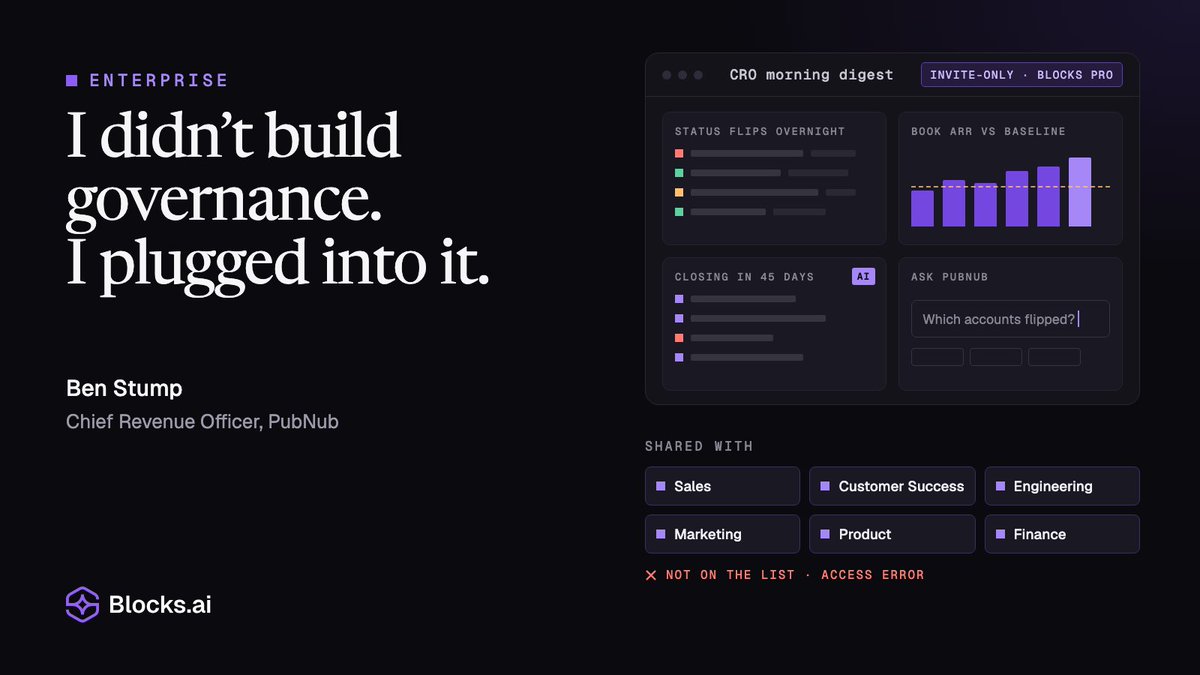
"One app shared with a dozen people is a nice story. It's not the point," posits @PubNub CRO Ben Stump about his daily dashboard shared through Blocks Pro. "The point is that the path I walked is now the default path at PubNub for anyone with a spreadsheet, a script, or a question they answer repeatedly for other people or for themselves."
Read the story: https://t.co/5G3lpJpFJb
#dashboard #AI #datagovernance
When conducting AI agent evals, a change in percentage points could signal a lot of different things: better task completion, higher tool and trajectory accuracy, improved safety and guardrail adherence, or it could mean nothing at all. But before we can make assumptions about what it means, we need to check the higher scores.
Our DevRel expert tried these six checks to validate agent #eval results. Here's how it went: https://t.co/I2NxHYp4ji
#AIagents #agentevals
AI agents working across technologies need guardrails and in-flow policy checks to ensure they aren't reaching beyond their scope.
Otherwise, we will continue to see breaches like this.
Meta's new AI assistant Muse read private Signal chats, even though nobody had linked Signal to it.
Reuters found this in tests with Signal's staff. It didn't break the encryption. On Android it read the texts from notifications, and on a Mac through accessibility and screenshot access. iPhones blocked it.
Inside Meta, Muse dropped Capital One and Charles Schwab bank balances into an employee's chat about fishing weather. He says he never shared them.
Meta calls these "isolated incidents." Signal president Meredith Whittaker calls AI agents with this much device access "technologically reckless."
Most internal tools die on a laptop because sharing them means convincing IT that a side project touching six internal systems is safe to run.
Here's what changed for one team at @PubNub
PubNub CRO Ben Stump wrapped his morning dashboard (Salesforce, Gong, Zendesk, Slack, etc) in a thin handler using the Blocks SDK.
blocks-register published it as a private agent. blocks-run opened the connection. Nothing moved; the data never left their systems. But everyone who needed it could now access the #agent's knowledge without a massive approval process.
IT approved Blocks Pro once. Every agent after that inherits SSO, audit logs, and the same controls.
A CS leader could now see an account status change and reach out before the account manager finished reading the same signal. A Finance partner could stop asking for the Thursday pipeline snapshot and started pulling it on their own.
https://t.co/f0eKjRM7QA unlocked more insight, put the data in more hands faster, with less risk than the laptop-and-screenshot world we all lived in before.
Here's how he did it: https://t.co/5G3lpJpFJb
Our CRO Ben Stump saw a problem and built an agentic dashboard to fix it.
He was spending too much time trying to find everything he needed to prepare for the day and just needed something to lighten the load a bit. Despite not being what you'd call a classic technical persona, Ben was able to build a dashboard that could:
> track accounts that flipped status overnight
> book ARR against baseline
> see every account touched in the last 24 hrs across Salesforce, Gong, and call notes
> share important Slack signals
> create a watchlist of at-risk and new opportunities
Once it was built, he needed to be able to share it with his colleagues. That's where Blocks Pro came in, plugging #governance directly into his application and making it securely reachable to the people who need it.
How a CRO agentified an app and shared it on a private smart network: https://t.co/ph9Mce0KQ8
Federal traffic controllers, banks, HR platforms, airlines, what can't be compromised in the age of #AIagents?
Powerful models like Mythos were restricted to the public, but that hasn't stopped open source models like the latest GLM from developing to be just as powerful. Traditional safeguards aren't equipped for breaches at this magnitude.
How do you safeguard your AI workflows so AI agents can be used for good (and nothing else)?
Our philosophy isn't to simply cut off access to the world, that would kill innovation; instead, we deploy a smart network that checks every task to an agent on the registry against your individual policies (in addition to what we call table-stakes in cybersecurity: access control capabilities, compliant frameworks, audit logs, pre-and post-action states, and agents called by name not just an IP address).
Your policy shouldn't just live in a document somewhere. It should be a living, breathing thing. That's why we built #security into our product DNA.
Programmatic tool calling (PTC) isn’t a free win, it doesn't work in every scenario.
With #PTC, Instead of calling your tools one by one through the model, Claude writes a script that calls them all in a sandbox. Tool results go to the script, not into the context window unlike a normal #toolcall. Only the final output comes back.
Anthropic’s own numbers go both ways:
→ 75-tool agent: ~38% fewer billed input tokens, same accuracy
→ One or two calls per turn: same score, ~8% more cost
There are two cases where PTC isn't worth the cost according to https://t.co/kW5xT3ihel's DevRel expert @THEDEVRELMARKUS:
-Sequential reasoning: if each step needs Claude to look at the last result and think, a script can't save you those round trips.
-Small jobs: if it's only two or three small calls, starting the sandbox can cost more than you save.
Discover how these calls work: https://t.co/P2kyRirZ6W
Watch the video: https://t.co/CATVjFrZCp
Network effects come from connection, not from any one agent. Value grows with how many agents and people can reach each other, safely. So the advantage is really a network with identity and permissions built in, where anyone can join without handing over their data or their stack.
How to test your agent so you know it is ready to be deployed. First step is ignoring the noise and decreasing your margin of error. Full video on YT: https://t.co/Cd51lBg5x1