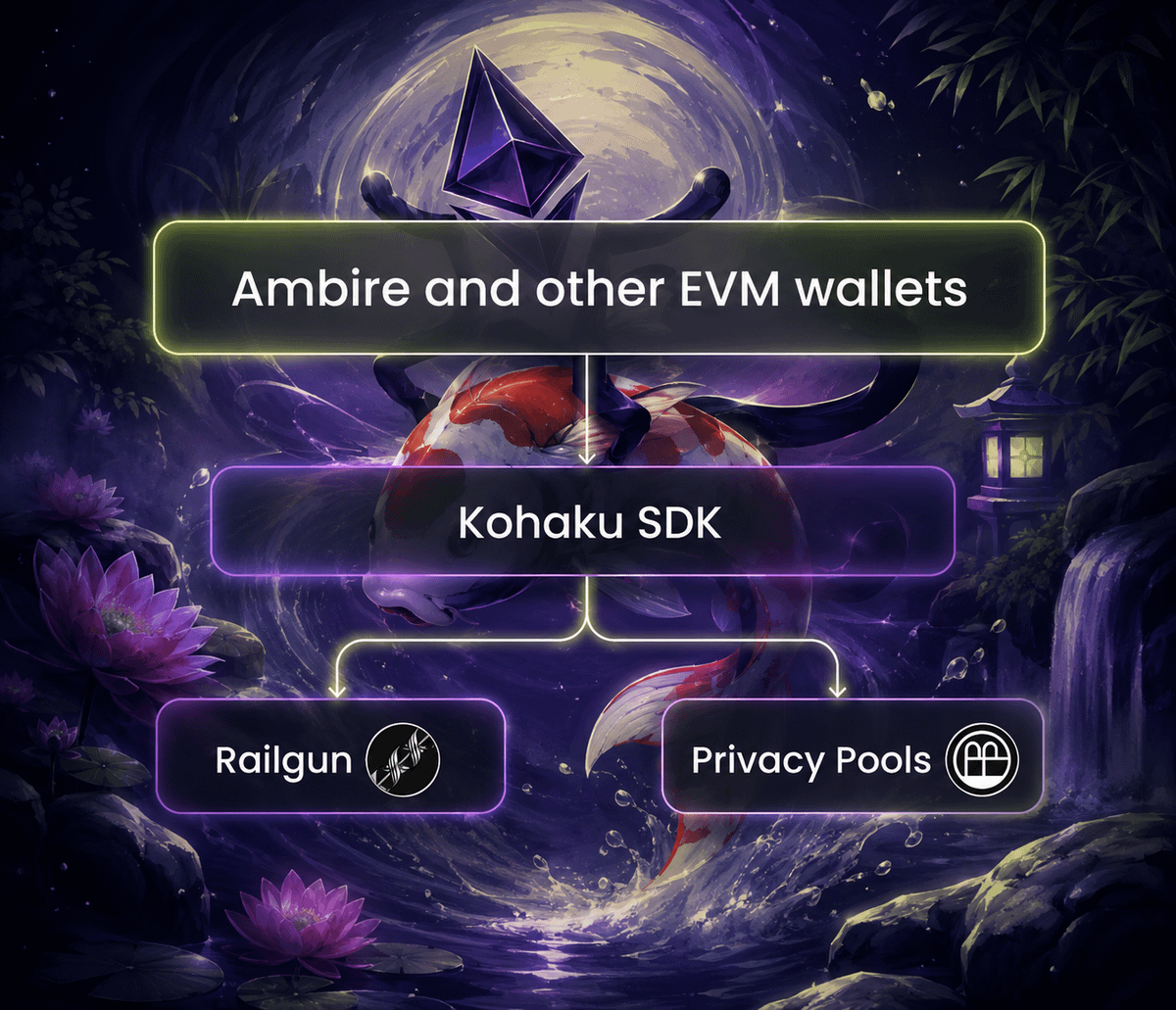
In the not-so-distant future, sending crypto won’t mean exposing your entire financial history.
Private transfers, coming to a wallet near you.
Powered by Kohaku 🧵
Esto ya está instalado.
La institucionalidad llegó para quedarse.
Si trabajas en cripto y buscas anonimato estás en el horno.
El KYC será la identificación mínima que pedirán para operar.
A buscar buenas regulaciones y asesores😅
crypto institutional moment has arrived....
in less than 24 hours:
- @deel launches a stablecoin wallet powered by @Morpho
- @Visa, @Mastercard and @stripe to launch a crypto stablecoin platform
- @Revolut to launch its own US bank this year
- @FTI_US and @MoonPay partner to let institutional investors swap stablecoins into its tokenized money market fund
45+ projects spotted in this edition of the agentic finance landscape report, among them, we listed: DeFi and TradFi copilots, yield agents, and informational agents
crypto is proving to be the delivery infrastructure that will unlock the full potential of the agentic economy. the convergence of DeFi, TradFi and AI is underway, and this is just the beginning
Tom Lee: Ethereum DATs can use ~$500 million in annual staking rewards to fund grants for Ethereum ecosystem
“The Ethereum Treasuries — Bitmine and Sharplink among others — now own 7% of the Ethereum supply… Treasury stock is essentially supply permanently taken out from the ecosystem, but we also own the yield. The yield is around 3% so today these public treasuries are generating ~$500 million in rewards, and that is what we can use to fund and grant the crypto ecosystem.”
Lee believes that the Ethereum Foundation narrowing its focus to CROPs (censorship resistance, openness, privacy and security) is the right decision.
“Ethereum is a $240 billion network value entity. It has been operating for 11 years without a single day of downtime. There’s 11,500 nodes in 89 different countries. And there’s 15,000 developers. I think this is too big to be coordinated by a single foundation.”
As Ethereum continues to scale, he believes the ecosystem will move beyond a foundation-centric model and points to private companies like Etherealize, Optimism, Consensys, Enterprise Ethereum Alliance, and Offchain Labs that represent the Ethereum ecosystem and are already doing enterprise engagement.
“This list doesn’t yet reflect the spinoffs coming from the Ethereum Foundation. There’s at least five, and I think Bitmine will play a role in granting and supporting any of those that come out.”
“I think Ethereum is in good hands because the foundation is going to be stronger by staying focused. We have a lot of private sector companies already building products and important L2s on Ethereum. And of course, the treasuries are here to help with funding and granting… If you’re bearish, you are selling at the bottom.”
thatsRekt is live!
It's a free and real-time exploit detection system for the Ethereum community.
Stay safe, stay alert.
Learn more and join as a guardian:
https://t.co/ZwWJ8ErE4q
Today a crazy quantum story just got wilder.
On March 31, the Google Quantum AI team published a landmark result on Shor's algorithm for elliptic curve cryptography. Technically, the paper was a bombshell: a dramatic 10x improvement over the state-of-the-art. As a stunt and wakeup call to the blockchain space, those optimisations were illustrated on secp256k1, the elliptic curve underlying Bitcoin and Ethereum signatures.
But perhaps the most striking part of the paper was sociological, not technical. Instead of following standard academic process, the optimisations were kept secret, hidden behind a zero-knowledge (ZK) proof. Google's accompanying blog post mentions they "engaged with the U.S. government". The ZK proof demonstrates the existence of algorithmic improvements without leaking details. Academic censorship with ZK, a historic first!
As a co-author of the Google paper I witnessed some of the context surrounding this censorship. To be honest, multiple aspects of that context don't sit well with me. As much as I believe the general public ought to know more, I am limited in my ability to whistleblow. Though let me be clear about one thing: the Google team's professionalism has been absolutely exemplary, and they deserve nothing but praise.
Censorship has a way of backfiring. The Streisand effect, where an attempt to bury something only draws more attention to it, is exactly what's unfolding today. First, Google's key optimisation has been rediscovered by the French. And in a thrilling turn of events, a collaborative Shor-at-home challenge just launched. The initiative, available at ecdsa[.]fail, breached a new Shor world record in a matter of hours.
Let's start with the rediscovery. Just two months after Google's paper, French quantum expert André Schrottenloher cracks the main secret optimisation. His paper, titled "Optimized Point Addition Circuits for Elliptic Curve Discrete Logarithms", landed on the arXiv today. Big congrats to André, who beat several other nerdsnipped experts to it. In a blog post also published today, Craig Gidney, the world expert on Shor optimisations, revealed that he'd been sitting on this very optimisation for a whole year under censorship pressure.
Interestingly, André missed a handful of minor optimisations, both from Google's original publication and from improvements found since. It's plausible there's still plenty of juice left to squeeze out of Shor, and this is exactly what the ecdsa[.]fail challenge is about. The verifier program developed for the ZK proof does double duty, automatically filtering for valid submissions. Dozens of compounding small and micro improvements are rolling in. As of the time of writing there's an 8.4% improvement to Google's circuit, as measured by the product of logical qubit count and Toffoli gate count. Nice!
The nerdsnipping ran deeper than anyone expected. Over the last few weeks it became clear it extended well beyond André and other quantum experts. Behind the scenes, a small army of amateurs quietly got to work. Inspired by Karpathy-style autoresearch, they turned AI on Shor. Ironically, the verifier program for the ZK proof makes an ideal reward function for AIs. The barrier to entry for this modern style of research is refreshingly low, with several non-experts, even a teenager, finding nice optimisations. Get in touch if you'd like to join a Telegram group with fellow autoresearchers :)
Part 2: neutral atoms and qday
The story doesn't end with Google. On the same day Google went public, a stealthy startup called Oratomic published its own Shor paper in a coordinated release. It made a splash, ultimately becoming the most upvoted paper on scirate[.]com, a website ranking arXiv papers.
Oratomic's claim was wild. By building on Google's logical optimisations and applying custom physical optimisations for neutral atoms, they claimed just 10K physical qubits were sufficient to run Shor's algorithm on secp256k1. That number is mind-bogglingly low.
Knowing essentially nothing about neutral atoms when Oratomic's paper landed, I was intrigued and decided to learn more about the tech. I fell straight down the rabbit hole and spent a couple hundred hours on the topic. I got a little obsessed and watched every YouTube video I could find and spoke to a bunch of experts.
My conclusion? The tech is real, very real. Even Google recently decided to start a neutral atom lab, a notable pivot from their sole focus on superconducting qubits. If you care about qday, i.e. the day a quantum computer will break the first piece of cryptography in production, neutral atoms demand your attention. I shared some of my learnings on Shor and neutral atoms in a 30min talk at the ZKProof cryptography conference. You can find it on YouTube by searching "zkproof neutral atom".
Here's an interesting observation about this duo of breakthrough papers: neither Google nor Oratomic say a word about what their results mean for qday. No timelines. Zero. Nada. That is especially baffling given that the whole point of whitehat quantum cryptanalysis is to inform qday estimations and help the general public make good decisions.
So let me attempt to partially fill the silence, similarly to what Scott Aaronson did in his April 29 post. Given everything I know, including scary non-public information, I now put the odds of qday by 2032 at 50%. 10% by 2030.
Anecdotally, the US government has its own date: 2035. Originating at the NSA and later adopted by NIST, it's when branches of the US government will be disallowed from using quantum-vulnerable cryptography. In plain language: with hindsight, that date is a joke and should be discounted entirely. I don't see how NIST avoids being forced to pull it forward by years.
Part 3: post-quantum cryptography
There are good reasons to sound the alarm today, but please do not panic. Rushing carelessly towards immature post-quantum cryptography is a recipe for disaster. IMO a good target date for migration is 2029, roughly 3.5 years out. 2029 happens to be the date selected by Google, Cloudflare, and the Ethereum Foundation.
These days most of my time goes to safely migrating Ethereum towards post-quantum cryptography as part of the broader lean Ethereum effort. There's a lot to do. We need to rip out and replace BLS signatures at the consensus layer, KZG commitments at the data layer, and ECDSA signatures at the execution layer.
The plan to get there is compelling, and is based on hash-based cryptography. Within the Ethereum Foundation we've developed a Swiss army knife called leanVM (github[.]com/leanEthereum/leanVM) powered by the magic of hash-based SNARKs. Thanks to truly exceptional work by Emile, Thomas, and others, its performance is derisked. Regarding security, leanVM is a jewel, a minimal zkVM crafted for end-to-end formal verification and maximum security.
Want to help? There are two $1M initiatives. First, the Proximity Prize (proximityprize[.]org). Solve a long-standing mathematical conjecture in coding theory, improve hash-based SNARKs, and go home a millionaire. Second, the Poseidon Initiative (poseidon-initiative[.]info), offers $1M for breaking Poseidon, the SNARK-friendly hash function.
An update on the Gnosis Pay incident. As of now, the issue is fully contained.
We expect to begin enabling operations in batches on Wednesday evening (GMT+2), with the goal of restoring normal card usage progressively after that. 🧵
Crypto is extremely cyclical, and we're heading into deep winter: Bitcoin is dead, again.
This is my favorite part of the cycle. The grifters and parasitos leave; the real builders stay. Even better this time, because AI is the new shiny object pulling them out.
Staying in the trenches, doing the real work, as always.
💪🚀
@SalinasAndres Si te ponés a armar algo asi, podemos hablar.
Con @crossmint armamos https://t.co/29y9kkTswn para darles de manera segura tarjetas de credito a los agentes de ia :)
Estamos trabajando en este caso de uso generalizado! pero uno especifico de argentina yo lo usaria
@gnosispay Deleted an earlier tweet that asked users to withdraw funds. Most users will not be able to do so, but we are actively working to contain the damage. We believe we can contain the majority of it, and in any case, we will ensure that all users are made whole.
A bug related to the @gnosispay delay module has been discovered. We are investigating & will share updates as soon as possible.
If you are able to withdraw funds from the Gnosis Pay card to your wallet, we strongly recommend that you do that.
Affected users will be reimbursed.
❗️Bridge Temporarily Disabled❗️
As a precautionary measure, the bridge validators took the decision to close the bridge while the issue with Gnosis Pay is resolved.
We'll share updates as they become available.
A bug related to the @gnosispay delay module has been discovered. We are investigating & will share updates as soon as possible.
If you are able to withdraw funds from the Gnosis Pay card to your wallet, we strongly recommend that you do that.
Affected users will be reimbursed.
We identified and contained a compromise affecting our off-chain merkle rewards distribution infrastructure.
Importantly:
• The core protocol remains fully secure and is governed by governance and the 7/14 team multisig.
• All protocol smart contracts are safe and unaffected.
• User funds are not at risk from this incident.
The impacted contract is not part of the core protocol infrastructure and was used solely for rewards distribution with minimal funds in its balance.
Our team is actively investigating the incident. We will share a detailed post-mortem as soon as possible.
We appreciate the community’s patience and support as we work through this.
ZachXBT: $12.6M in Zama cUSDC Frozen After Circle Blacklisting
ZachXBT revealed that Circle may have blacklisted the contract address of privacy protocol Zama’s confidential USDC (cUSDC) on Ethereum around seven hours ago, freezing approximately $12.6 million in user funds. Further analysis showed the address had recently participated in an Overnight Finance governance vote on treasury allocation. Some users had previously accused the project team of conducting a rug pull.
ZachXBT also noted that one of the plaintiffs in a civil lawsuit against Overnight Finance is Patagon Management, an entity known for hostile DAO takeovers and attacks on protocol residual value. He suggested the plaintiff may have misrepresented the connection between the frozen address and the Zama contract to the court, while the Zama team appeared to have received no prior notice before the freeze was executed.
Aave is coming to Arc to power institutional and fintech use cases.
Excited about this one. Aave and Circle have been collaborating since the early days of DeFi, and Arc takes that partnership even further.
Se vienen cambios en la Ley de Sociedades en Argentina.
Simplificación normativa
Sociedades de agentes
DAOs
SAD
Va a estar muy interesante el debate. Esperemos que los legisladores estén a la altura.
LEY DE SOCIEDADES. Como indica el Jefe de Gabinete @madorni, el presidente @JMilei está enviando al Congreso un proyecto de reforma de la Ley General de Sociedades del presidente Lanusse, que nos debíamos hace tiempo. Se suma al conjunto de reformas muy profundas que estamos implementando y que van a consolidar la trayectoria de crecimiento que ya venimos transitando.
El proyecto nos mueve de un régimen rígido y anacrónico, construido sobre la desconfianza al sector privado, a un marco moderno basado en la autonomía, la libertad y la desregulación. Estos son los cambios clave:
Se termina la tutela del Estado sobre cómo los socios organizan sus negocios. Las normas de la ley pasan a ser supletorias: el estatuto manda. Las restricciones estatales serán excepcionales y de interpretación restrictiva. Los registros públicos no podrán dictar resoluciones que limiten lo que la ley permite.
Se eliminan las trabas burocráticas de los registros. El objeto social podrá ser amplio, plural y sin obligación de conexidad entre actividades. Y si no se consigna objeto en el estatuto, se entiende que la sociedad puede realizar cualquier actividad lícita. Esto es esencial en un mundo tan cambiante como el que vivimos. También implica menos trabas burocráticas y más libertad para trabajar.
Las sociedades podrán someter sus conflictos internos al derecho extranjero o mercantil internacional. Y también podrán pactar cláusulas arbitrales en el estatuto para resolver controversias sin depender de la lentitud de la justicia. Este tipo de libertad de contrato ha sido el pilar de otros centros mundiales de negocios como Dubai. En Dubai las relaciones societarias se dirimen según la ley societaria que los socios eligen. Lo mismo ocurrirá ahora en Argentina.
Todo lo que se esperaba de digitalización se logra acá. Permitimos la digitalización plena de la sociedad: domicilio electrónico, libros y registros digitales, asambleas a distancia, constitución de la sociedad por firma digital o electrónica, legajo digital público para cada empresa. Con este proyecto, el expediente en papel queda en la historia.
En una de las innovaciones más revolucionarias, distinguimos a las empresas que funcionan bajo esquemas de automatización y descentralización. Se regulan la “Sociedad Automatizada”, que opera mediante algoritmos o IA sin requerir empleados para su operación ordinaria, y las “DAO”, que son total o parcialmente autónomas, con participaciones en tokens y registros en blockchain. Ambas tienen personalidad jurídica plena y responsabilidad limitada.
Para entender la relevancia de esta innovación vale el ejemplo de Irlanda. Hace unos años Irlanda construyó un régimen legal y fiscal apropiado para la inversión extranjera directa y se convirtió en una meca de empresas de propiedad intelectual y de aquellas que buscaban radicarse en Europa. (Por ejemplo, la empresa dueña del software de todos los iPhones en el mundo es una subsidiaria irlandesa de Apple, por lo que todo iPhone que se vende en el mundo le paga una regalía a esa compañía irlandesa, que, a su vez, tributa en Irlanda). Pretendemos esa misma atracción global para Argentina en lo que hace a las empresas de IA. Esta ley, pensamos, lo lograría.
Por supuesto que la ley tiene un sin número de otras modernizaciones. Mencionamos aquí un par. Incorporamos los instrumentos de inversión convertibles. El inversor aporta capital sin ser socio ni responder por deudas de la sociedad hasta que decide ejercer su derecho de participación. También se habilita la renovación automática del plazo de duración de la sociedad y se establece que los mandatos de directores y síndicos sean por tiempo indeterminado por defecto, salvo pacto en contrario. También simplificamos la reorganización empresaria. Si una sociedad es titular del 100% de otra, el órgano de administración puede absorberla directamente, sin necesidad de resoluciones asamblearias duplicadas. Burocracia cero para los grupos societarios. Etc, etc…
En definitiva, llevamos el ámbito de libertad al derecho societario. Menos controles arbitrarios de los burócratas, menos costos de transacción y más libertad para competir en el mundo. Con esta reforma, Argentina adapta su derecho societario a la economía del siglo XXI y le dice al mundo: vengan a invertir acá.
Impresionante el trabajo que hizo la Secretaría Legal y Técnica a cargo de María Ibarzabal para preparar este proyecto de ley que es, a mi entender, revolucionario. Sobre la versión inicial pudimos luego contribuir desde el resto del gobierno, en particular desde @MinDesreg_Ar y @MinJusticia_Ar. En esa interacción tuvimos la suerte de interactuar con profesionales de esos que te vuelan la cabeza, te cambian los esquemas y te permiten ver las cosas con una nueva óptica como Sebastián Balbín y @chuleramirez. De mi equipo quiero agradecer a @MaxiFarina, Secretario de Transformación, a @alejandrocacace, Secretario de Desregulación y a @Maximomartin que hizo la parada en las reuniones para discutir la propuesta de la SLyT. También a Marcelo Hernández. Que gran equipo! Ahora al debate parlamentario! VLLC!
Here’s the email to employees:
Team,
Hope everyone’s doing well and enjoying the productivity enhancements from our AI tooling initiative.
Unfortunately, Finance has asked me to clarify a small issue.
It appears someone, and by “someone” I mean apparently all of you simultaneously, managed to spend $500,000,000 on @claudeai usage in a single month.
For context:
•NASA landed on the moon for less.
•We are now the proud owner of approximately 14% of Anthropic.
•Claude personally sent us a thank-you fruit basket.
•Our CFO has entered a fugue state and only communicates through Slack emojis.
•The electricity usage from your prompts briefly dimmed parts of Northern Virginia.
While we appreciate innovation, there are concerns that:
•“Can you make this email sound slightly warmer?” did not require 11,400 generations.
•Asking Claude to “rewrite this in the style of Succession, Hemingway, and Tony Soprano combined” may have been excessive.
•One employee appears to have used Claude to generate “a quick list of lunch options” that somehow consumed the GDP of a small island nation.
Going forward, please observe the following guidelines:
1Do not upload the entire internet into Claude “for context.”
2If your prompt begins with “simulate every possible outcome,” reconsider.
3Claude should not be used to:
◦settle fantasy football disputes,
◦write your wedding vows 97 times,
◦generate revenge edits of your ex’s LinkedIn bio,
◦or ask “what if Rome had WiFi?”
Most importantly:
If you see the message:
“This request may require additional datacenter construction”
…please stop immediately and contact IT.
Thank you all for your cooperation during this challenging yet technologically groundbreaking time.
Warm regards, Management
P.S. Whoever prompted:
“Generate every possible PR angle for every company founded since 1983”
…we just want to talk.