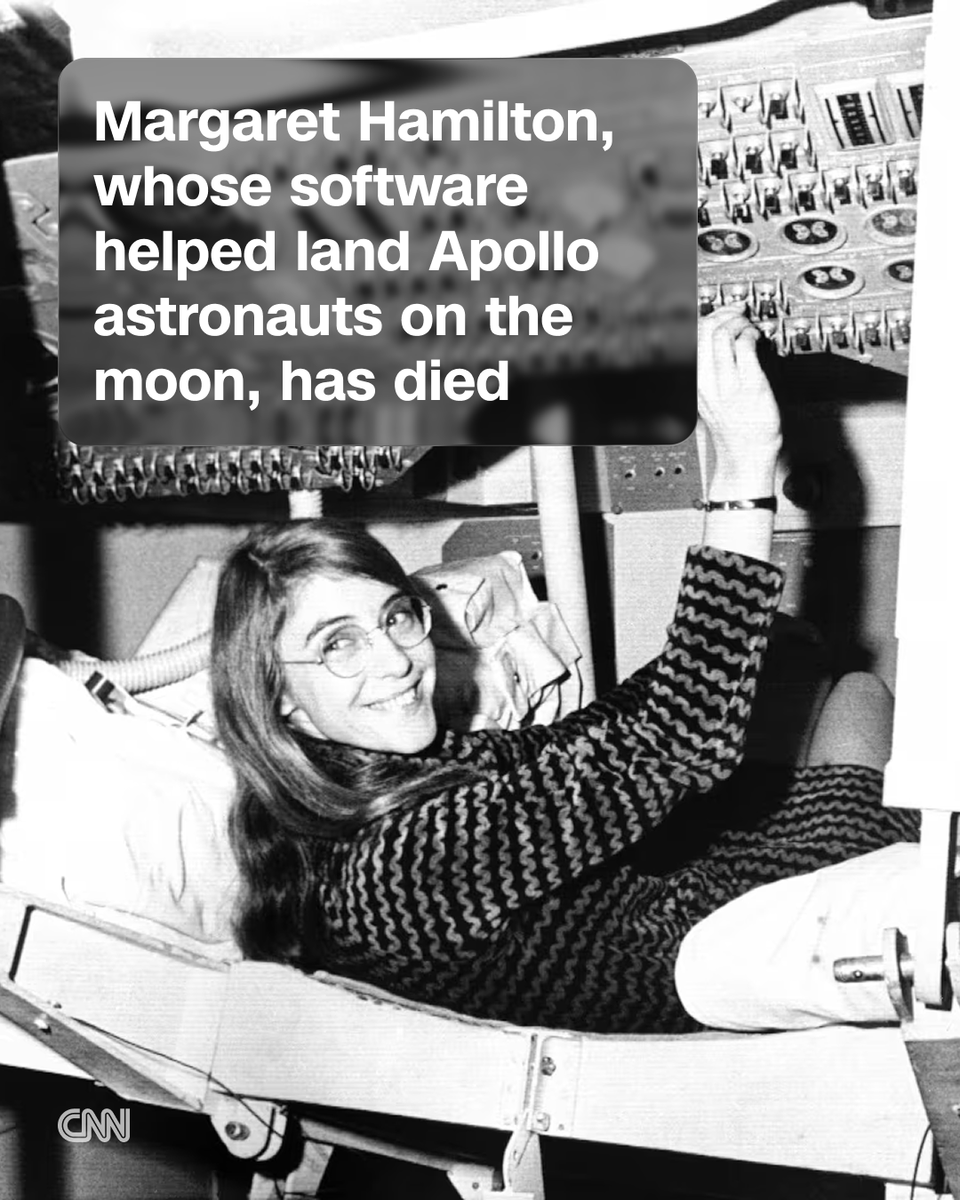
Margaret Hamilton, a computer scientist who helped NASA land on the moon, has died. She was 90.
As a young mathematician at MIT, Hamilton was the first female programmer to work on the Apollo project in the 1960s.
She went on to lead the 100-person team that wrote software for the moon mission.
In recent years, a 1969 photograph of Hamilton standing next to the printed code for the lunar landing went viral on social media.
In 2016, President Barack Obama awarded Hamilton the Medal of Freedom, saying her work "set the foundation" for modern software engineering.
Some people help write history. Margaret Hamilton helped write the software that got us there 🌖
Today we learned that Margaret Hamilton, one of the true pioneers of computing and software engineering, has passed away at the age of 90.
Last year I made this video about the Apollo Guidance Computer, and especially about Margaret and the incredible team she led at MIT. It feels appropriate to share it again tonight in her honor.
During Apollo 11’s descent to the Moon, the Guidance Computer suddenly began throwing the now-famous 1201 and 1202 alarms. It was overloaded at one of the worst possible moments.
But it didn’t simply crash.
The software Hamilton and her team had designed recognized what was happening, discarded lower-priority work, and kept the tasks necessary to land the Lunar Module running.
That wasn’t luck. That was engineering.
Margaret helped pioneer ideas like fault-tolerant software, asynchronous processing and priority scheduling at a time when “software engineering” itself was barely recognized as a discipline. She fought to change that too.
We remember the astronauts because they walked on the Moon. We should also remember the engineers who made sure the computers could get them there.
Margaret Hamilton was one of the greatest. I am always deeply honored when someone tells me I resemble her, which is a regular occurrence ☺️
Rest in peace, Margaret. And thank you for helping humanity make one giant leap 🌙💻
Music Piano Pill (YouTube).
Bu haberi görünce “28 yıldır nasıl yürüyorsun?” diye biraz detayına baktım.
Hikâye gerçekten acayip.
Karl Bushby 1998’de, 29 yaşındayken İngiltere’den ayrılıyor. Amacı dünyayı dolaşıp tekrar İngiltere’deki evine dönmek.
Ama kendine iki kural koyuyor: Yolculuk boyunca ilerlemek için araç kullanmayacak ve bitirmeden eve dönmeyecek.
Başlangıçta 12 yıl süreceğini düşünüyor.
28 yıl olmuş :)
Güney Amerika’yı geçiyor, Darién Gap’ten yürüyor, Kuzey Amerika üzerinden Alaska’ya çıkıyor.
2006’da Alaska’dan Rusya’ya geçmek için Bering Boğazı’nı donmuş denizin üzerinden yürüyor. Rusya’ya vardığında kaçak sınır geçişinden tutuklanıyor. Bir ara Rusya’ya tekrar girmesi bile yasaklanacak hale geliyor.
Sonra vize problemleri, para, kapalı sınırlar derken yıllar geçiyor.
COVID geliyor.
Rusya-Ukrayna savaşı çıkıyor.
Ve bir noktada rotasında aşamadığı başka bir engel çıkıyor: Hazar Denizi.
Adamın çözümü Hazar’ın etrafından dolaşmak değil.
Yüzmek.
2024’te Kazakistan’dan Azerbaycan’a yaklaşık 288 km yüzüyor. 31 gün sürüyor.
Sonra Gürcistan üzerinden Türkiye’ye geliyor. İstanbul’dan geçip Avrupa’ya devam ediyor.
Geçtiğimiz günlerde de Fransa’ya ulaşıyor.
Bu sefer önünde Manş Denizi var.
Manş Tüneli’nden yürüyerek geçmek için izin istiyor, vermiyorlar. Feribota binse 28 yıldır koruduğu kuralı bozacak.
Onu da yüzüyor :)
Ve 5 Ekim’de, yola çıktıktan 28 yıl sonra İngiltere’ye tekrar ayak basıyor.
Şimdi önünde son 400 km civarı kalmış. Hull’daki annesinin evine yürüdüğünde yolculuk gerçekten bitecek.
50 bin kilometreden fazla yol, onlarca ülke, Bering Boğazı, Hazar Denizi, Manş…
Ama benim en çok hoşuma giden kısmı başka.
Adam 1998’de bir hedef koymuş. O günden bugüne dünya değişmiş, sınırlar değişmiş, savaş çıkmış, pandemi olmuş. Kendisi 29 yaşından 57 yaşına gelmiş.
Planın neredeyse tamamı değişmiş. Hedef değişmemiş.
Bazen istikrar dediğimiz şey de bu galiba.
Aynı plana tutunmak değil; plan çalışmadığında başka bir yol bulup aynı yere doğru devam etmek.
Margaret Hamilton was a pioneer whose work helped make Apollo and humanity’s first journeys to the Moon possible. The best way to honor her legacy is to finally pick up where her generation left off and never stop going.
“We had to find a way and we did. Looking back, we were the luckiest people in the world; there was no choice but to be pioneers.” —Margaret Hamilton
Rest in peace, Margaret. Your trailblazing work leading the development of the on-board flight software for the Apollo spacecraft will forever be remembered. 🫡
We’ve lost an icon. Margaret Hamilton, a computer science pioneer best known for her work at MIT leading development of the flight software for the Apollo missions to the moon, has died at 90. Read about her legacy via MIT News: https://t.co/ODkbdIsoHw
Margaret Hamilton was the first woman programmer on Apollo, led the team that wrote its flight software, and fought for software engineering to be taken seriously.
Thank you, Margaret, for all you gave computer science and the millions of students you inspire.
Margaret Hamilton, the groundbreaking researcher who helped create the field of software engineering and whose code helped land NASA’s Apollo astronauts on the moon, has died. She was 90. https://t.co/zKmMEXLMck