This is a macroscopic view of Normandy's beach sands.
About 4% of it, is magnetic shrapnel that has been broken down over the decades into sand-sized chunks, coming from the fierce fighting on D-Day, 82 years ago Today.
This bonsai tree was planted in 1625, and has lived through a lot of history in its 400 years of life
It survived Hiroshima, even though it was only two miles away at the time.
📸 Ragesoss
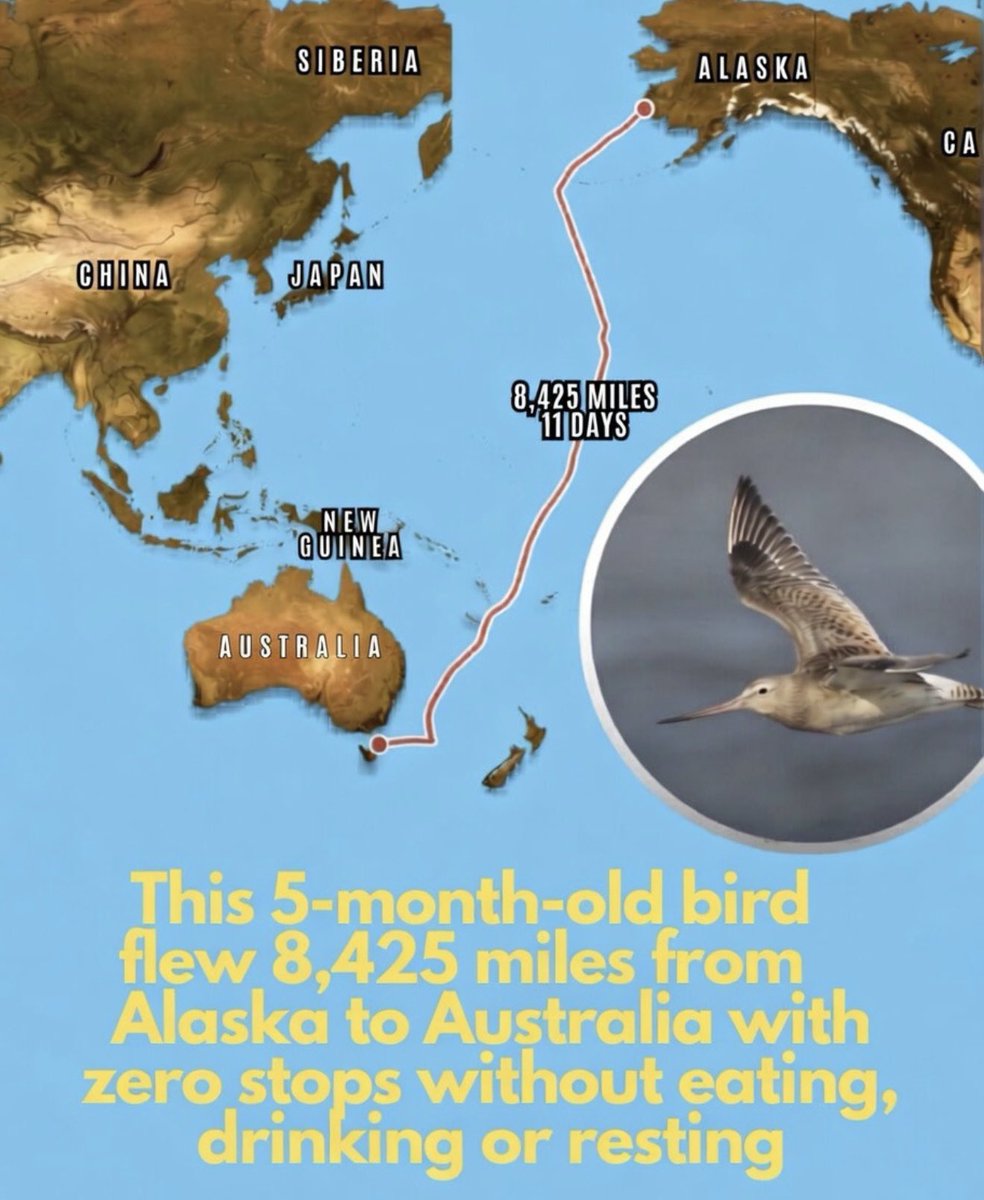
A single bird has completed a journey covering nearly one-third of Earth’s circumference, without stopping to eat, drink, or rest.
A five-month-old Bar-tailed Godwit, set a new record for the longest nonstop flight ever documented in a bird. It traveled from Alaska to Tasmania, Australia, covering about 8,425 miles in just over 11 days.
This remarkable migration took place entirely over the Pacific Ocean, with no opportunity to land. What makes the achievement even more striking is that it was the bird’s first migration, yet it navigated thousands of miles of open ocean with extraordinary accuracy.
The journey is made possible by extreme physiological adaptation. Before departure, the bird builds up large fat reserves, nearly half its body weight, to serve as fuel. At the same time, some internal organs, including parts of the digestive system, temporarily shrink to reduce weight and conserve energy.
Unlike seabirds that rely heavily on gliding, this young godwit maintained continuous flapping flight for the entire trip, enduring changing winds and weather conditions along the way.
Researchers at the Pūkōroro Auckland Shorebird Centre say findings like this are reshaping our understanding of what migratory birds can achieve. Their endurance, navigation, and energy efficiency highlight biological capabilities that rival even advanced human engineering.
It is often said that the lift on a wing is generated because the flow moving over the top surface has a longer distance to travel and therefore needs to go faster. This common explanation is actually wrong.
The crazy, beautiful thin line of air between us and space.
Living in orbit I would often look to Earth's horizon, marvelling at how bizarrely thin our atmosphere is. Half of all air is in the first 3 mi/5 km. A common running distance.
Sometimes big thunderheads were visible, pushing to the edge of the stratosphere. Above that, the coloured aura of the mesosphere, and then eternal empty blackness. Lit by an occasional star, like a small lightbulb in a vast darkened hall.
Let's appreciate and take responsibility for our planet.