A British biologist looked at 200,000 years of human history and found that the entire reason humans broke out of poverty was not intelligence, not language, not even agriculture, but one mechanism so simple a 6-year-old could explain it.
His name is Matt Ridley.
He is a zoologist by training, an evolutionary biologist by career, and in 2010 he wrote a book called The Rational Optimist that quietly argued the most important fact about human progress had been hiding in plain sight for the entire history of economics.
Naval Ravikant has been telling people to read everything Ridley has ever written for the last 15 years. The reason is the argument inside this one book.
For 200,000 years, anatomically modern humans walked around with the same brain you have right now. Same skull size. Same neural architecture. Same raw capacity for language, planning, and abstract thought.
For roughly 190,000 of those years, almost nothing happened. Generation after generation lived and died inside the same Stone Age toolkit their great-great-grandparents had used. Then somewhere around 50,000 years ago, the line on the chart of human progress started to tick upward. Then it bent. Then it exploded.
The question Ridley spent years on was the only question that mattered. What changed.
It was not the brain. The brain had been the same for 190,000 years. It was not language, which had existed long before the takeoff. It was not even agriculture, which arrived only 10,000 years ago and was actually preceded by the upward bend, not the cause of it.
What changed was that humans started trading with strangers.
This sounds too small to be the answer. Ridley argues that it is the answer to almost everything. The moment one human exchanged a useful object with another human from a different group, something happened that no other species on earth had ever done.
Two ideas that had developed in isolation came into contact. The flint knapper learned what the spear maker had figured out. The fisherman from the coast learned what the hunter from the forest had figured out. The two pieces of knowledge fused into something neither side could have produced alone.
Ridley calls this ideas having sex. The phrase sounds frivolous and it is meant to. The point is that ideas, like genes, get better when they combine with other ideas from different lineages.
An idea sitting inside one head, no matter how brilliant the head, eventually hits a ceiling. The same idea exposed to ten thousand other ideas does something genes do under sexual reproduction. It mixes. It recombines. It produces offspring nobody planned.
The cleanest proof of this argument is the most uncomfortable case study in the book. Tasmania.
Around 10,000 years ago, rising sea levels cut Tasmania off from mainland Australia. A population of roughly 4,000 humans was now isolated on an island, with no possibility of contact with the rest of humanity. They had the same brains. The same language. The same starting toolkit as their cousins 150 kilometers north. The natural experiment was now running.
What happened next is something no economist or geneticist had ever predicted.
The mainland Australians kept inventing. Boomerangs. Spear-throwers. Fishing nets. Bone needles for sewing fitted clothes. Watercraft with paddles. Their technology compounded slowly across the centuries.
The Tasmanians went the other way. They did not just fail to invent the new tools their cousins were developing. They started losing the tools they already had. Fishing was abandoned within a few thousand years. Bone tools disappeared. Fitted clothing disappeared. They forgot how to make fire from scratch and started carrying lit firebrands from camp to camp instead, relighting their fires from a neighbor's whenever their own went out.
By the time European explorers arrived in the 17th century, the Tasmanians had the simplest toolkit of any human society ever recorded. Their material culture had gone backward for 8,000 years.
The archaeologist Rhys Jones called it a slow strangulation of the mind.
Joseph Henrich at Harvard later proved with formal mathematical models that there was nothing wrong with Tasmanian brains. There was something wrong with their network. A toolkit requires a critical mass of people exchanging skills to maintain itself.
The act of teaching a skill is imperfect. Every generation loses a small percentage of what the last generation knew. If your population is large enough and trading widely enough, those losses get caught and corrected by someone else who still remembers.
If your population shrinks below a certain threshold and stops mixing with outsiders, the small losses compound until entire technologies disappear.
This is the part that should haunt anyone reading this in 2026.
Intelligence is not a property of the individual brain. Intelligence is a property of the network the brain is connected to. A genius in isolation will produce less than a mediocre thinker inside a dense exchange of other mediocre thinkers.
The thing your ancestors needed in order to break out of 190,000 years of stagnation was not better brains. It was better connections between brains they already had.
The implication for any individual is direct and uncomfortable. If you are smart and isolated, you will be outproduced by people half as smart who are connected.
The most successful people in any field are almost never the smartest people in it. They are the ones positioned at the intersection of the most idea flows. They are reading more authors than their competitors. They are talking to more people from more disciplines. They are in the rooms where ideas from different lineages bump into each other.
Ridley ends the book on the line that sounds optimistic but is actually a warning its this "The future will be invented by people who connect ideas, not by people who guard them."
“It is past time to bury the regulatory infrastructure they built and to restore American banks, insurers, and energy producers to the discipline of real markets and real science.”
Wall Street’s Dirty Secret: It's Still Running on a Climate Scenario the UN Just Retired https://t.co/7auMsv8y5h
🚀 Austin is solidifying its position as the epicenter of intellectual, commercial, and technological progress.
Massive museum, library dedicated to Ayn Rand coming to Austin in 2028 https://t.co/GY5o6AsqvU via @chron
CHEVRON CEO: PHYSICAL OIL SHORTAGES HAVE BEGUN AND PRICES WILL FOLLOW
Chevron CEO Mike Wirth just delivered a blunt assessment that cuts through the market noise. Traders keep crude pinned between 90 and 100 dollars because they believe the Strait of Hormuz crisis is almost over. The physical facts on the ground tell a far more dangerous story of collapsing inventories and shortages that have already arrived.
THE MARKET PSYCHOLOGY TRAP
➡️ Traders see the conflict as closer to the end than the beginning and expect flows to resume very quickly.
➡️ That belief has kept the back end of the futures curve artificially low.
➡️ The psychology has so far prevented prices from moving toward the much higher levels the supply shock would normally justify.
THE INVENTORY REALITY
➡️ Crude and product inventories are steadily drawing down in locations around the world right now.
➡️ June and July are going to be critical months as the trajectory heads straight toward the bottom.
➡️ The data shows a clear and concerning path that cannot be wished away.
THE SHORTAGE EVIDENCE
➡️ Physical shortages have already appeared in some Asian markets.
➡️ "We've seen some rationing" and adjusted workweeks imposed in affected countries.
➡️ The system carries powerful inertia and turning it around will not be easy or fast.
THE US TIGHTNESS
➡️ Distillate fuel inventories in the United States have reached their lowest levels since 2003.
➡️ Refineries are running at maximum utilization while record exports continue to support allies.
➡️ Seasonal demand is rising into an already extremely tight market.
THE UNPRECEDENTED SCALE
➡️ Twenty percent of the world's energy production has been cut off for nearly 100 days.
➡️ A billion barrels that should have been in the market are simply not there.
➡️ This is not a normal cycle and the usual patterns may not apply in the usual way.
THE BOTTOM LINE
Mike Wirth makes it clear that the current price calm rests on hope rather than physical reality and the risk of genuine shortages spreading is rising fast.
The calm before the storm is ending.
#OilShortages #ChevronCEO #EnergyCrisis #OilPrices #InventoryCrash #AsiaRationing #USDistillateLow
Bill Gurley: Anthropic Thinks It’s Building God
@Jason: It is the ultimate level of narcissism and delusion of grandeur to think you can create God.
@bgurley:
“Anthropic is a mystery to me. I've never, ever seen a company that is both leading their field and the most negatively outspoken commenter on what they do.
And my initial theory was the regulatory capture theory. Quite frankly, I think they're very close to achieving that.
But then they just got so loud that I've literally, in the past 30 days, read everything I can about Anthropic, and I've come up with a new theory.
I call it the Dr. Frankenstein theory.
The more I dig, I've met people who, I dare say, think it's their responsibility, and they're excited about, building a species that's superior to humans.
Dario wrote this blog post called ‘Machines of Loving Grace.’ It was based on a poem.
The last stanza of the poem says, ‘I like to think of a cybernetic ecology where we are free of our labors, and joined back to nature, returned to our mammal brothers and sisters, and all watched over by machines of loving grace.’
Sounds like an overlord to me.
And then in Dario's post, he says, ‘It could be a capitalist economy of AI systems which then give out resources to humans based on some secondary economy of what the AI systems think makes sense to reward in humans…’
So I don't think they think they're writing software. I think they're midwifing a deity here.”
Jason:
“These are delusions of grandeur. Let's call it what it is.
They believe that they're so powerful, these individuals, that they can create God, and that by creating God, they are like this Prometheus kind of species.
It literally is the ultimate level of narcissism and delusion of grandeur to think you can create God.”
Wind power displaced the equivalent of fewer than 5 days of global CO₂ emissions last year.
Five days — from one of the most heavily subsidized energy buildouts in modern history.
And that's before accounting for the gas generation required to backstop wind's intermittency.
PJM ratepayers alone face $16B+ in added costs over the next 12 months.
Our new issue brief by Senior Fellow Jonathan Lesser & Deputy Executive Director @portiamills examines the growing gap between wind energy promises and real-world outcomes on cost, reliability, and environmental impact.
🔗https://t.co/OND82oeWvl
We're about to make 1970s-style energy shortages great again.
Few understand the history, but it wasn't the OPEC oil embargoes that created the infamous gas lines in the 1970s. The real cause was the price controls implemented by the federal government. The artificially suppressed price led to excess consumption relative to supply, which ultimately gave rise to physical shortages.
Today, we're repeating the same mistakes, albeit with a different mechanism. The coordinated market manipulation of SPR releases + Axios fake "deal" news headlines have artificially surpressed prices below the demand-destroying levels needed to ration supply.
In the absence of this natural market functioning that balances demand with increasingly thin supplies, we'll eventually hit tank bottoms across a whole range of energy products, with the same end result of economy-crippling supply shortages.
Bottom line: the inability of the Trump administration to tolerate higher prices today means supply shortages are all but guaranteed tomorrow.
Texas, today is the day to get out and VOTE for @chiproytx to be your next Attorney General. I have served with Chip, and it's beyond any doubt that he is the true Conservative who will always fight for you and America! Texas, Vote Chip Roy for AG!
It's the 20th Anniversary of Al Gore's "An Inconvenient Truth."
NONE of his scary predictions have come true.
Mt. Kilimanjaro still has snow and Glacier National Park still has glaciers.
Here's why we are not doomed:
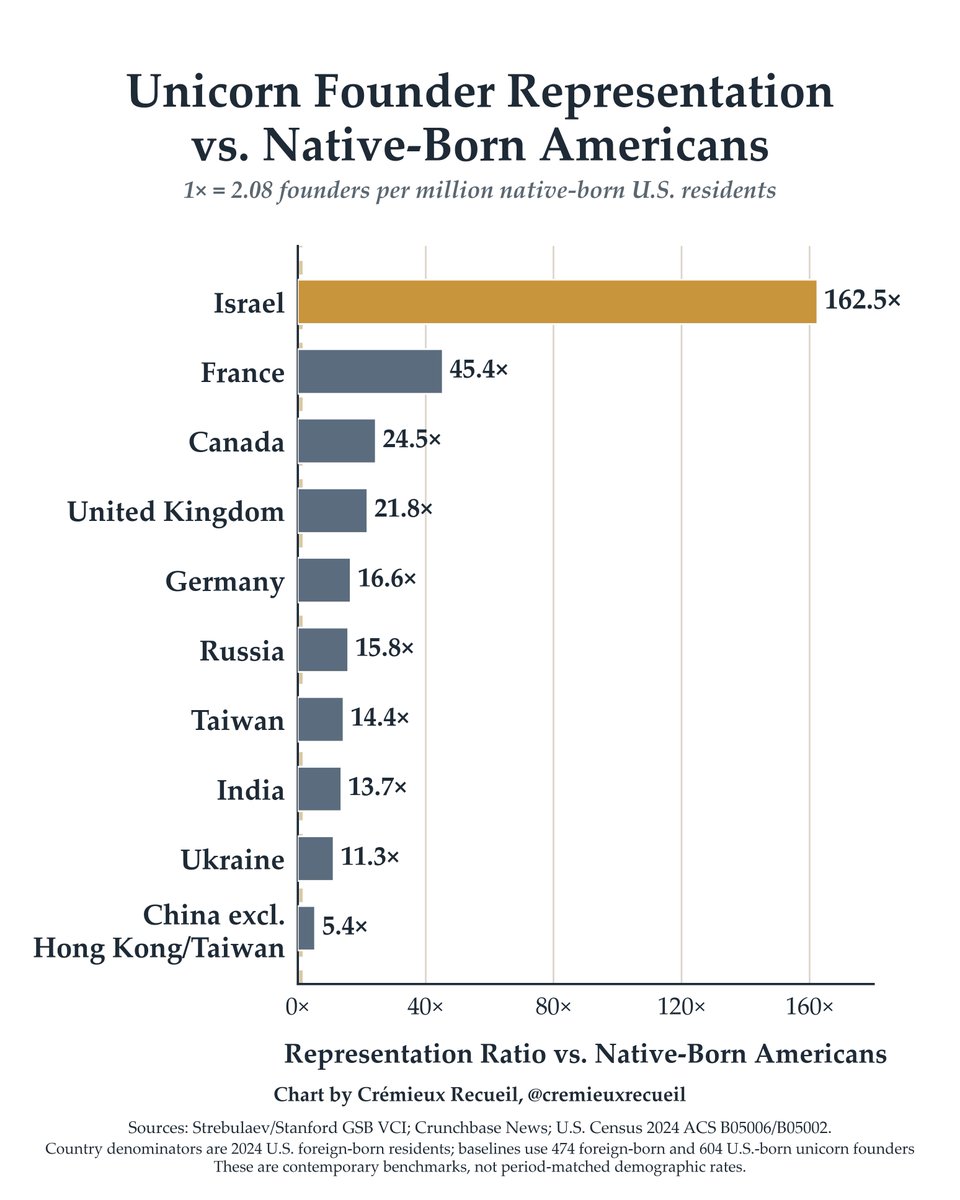
Relative to native-born Americans, several countries' immigrants to America have produced vastly greater rates of unicorn founders.
In particular, Israel: with shockingly few people in the U.S., Israel is the #2 origin *in total* for foreign Unicorn founders.
Rise of the Takers at the expense of the Makers. As Ayn Rand wrote in Atlas Shrugged.
Ayn Rand’s Atlas Shrugged dramatized this process very well. The “makers” (innovators, entrepreneurs, investors) carry an ever-heavier burden of “takers” (bureaucrats, looters, and moochers who justify their claims through moral guilt-tripping and “the common good”). Eventually the makers slow down, shrug, or leave - and the whole system seizes up. Fiction, yes, but the incentive structure she described is very real, and it’s happening all around us.