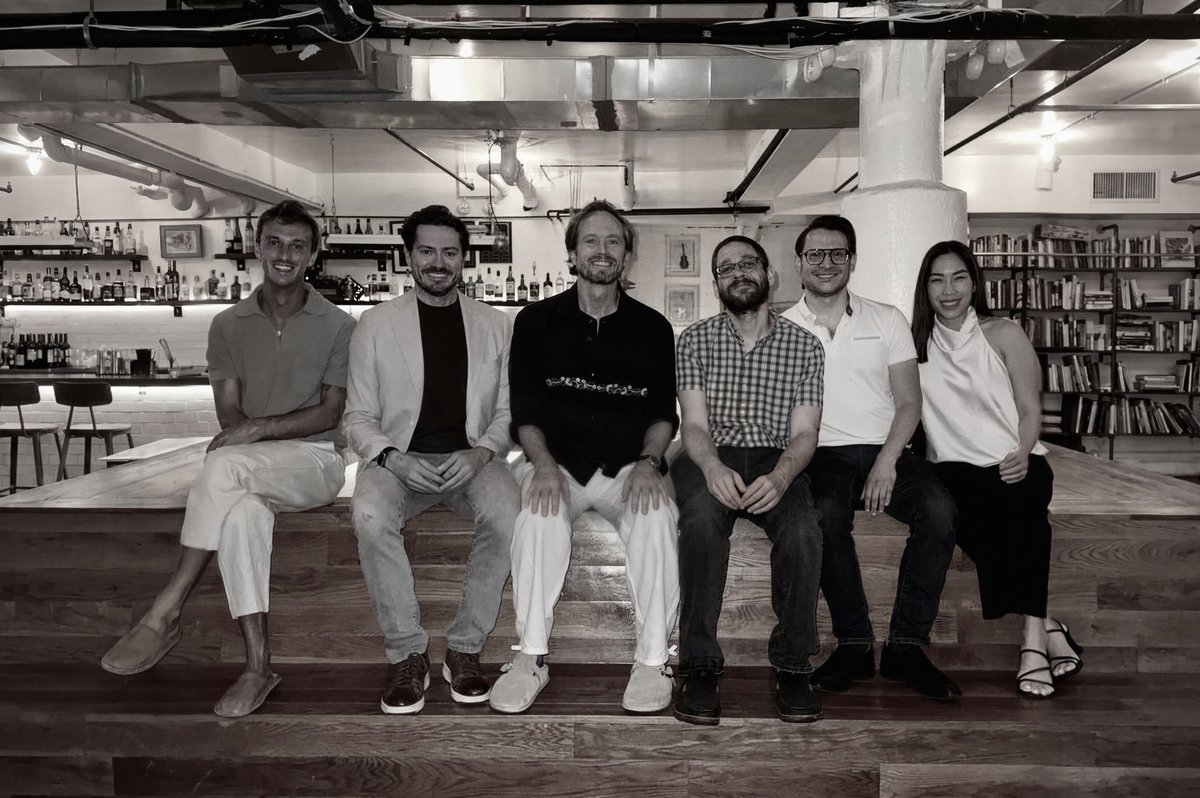
We're betting on freedom over control, on the cypherpunk ethos that built Bitcoin, on the radical idea that your thoughts belong to you and no one else.
Venice is the port city in the AI revolution. The separation of mind and state.
We're honored to stand beside @ErikVoorhees, @jesseproudman, @JonShapeShift and the broader team.
The cows have wings. Welcome to Venice.
this is worth reading. it is true that the same people that orchestrated OCP2.0 (systematic de-banking of crypto firms) also imposed the same pressure on auditors via regulators to de-audit crypto firms. happened at the same time through the same methods. I covered this at the time
Decentralized AI is becoming the most important techno-political movement since Bitcoin.
Like many movements that emerged from the crypto community before it, I also believe it’s the industry’s next 1,000× opportunity.
With each passing day, it’s growing more likely that open source models running on permissionless infrastructure will be the only way to preserve equal access to intelligence.
The U.S. gating access to frontier models was just the first warning, as now even China is contemplating doing the same with their open source ecosystem.
The necessary technology to achieve independence from the leading labs is nascent with limited PMF at best, but if we can ultimately pull this off, it’s hard to imagine many things more impactful on the future of our civilization.
"There’s never been any material about VVV stating what it isn’t" – by this standard, Apple should clarify that iPhones aren’t equity. Regardless, Bankless's own blog post from 1/28/25 linked to the original VVV launch announcement, which explicitly defines VVV's purpose as "to obtain free private and uncensored AI inference", explicitly states "no governance", and even clarifies that "Venice generates revenue with Pro subscriptions, and is owned exclusively by its team"
Gutenberg built the mechanized printing press to make books cheaper, but set in motion the toppling of a long trail of dominoes, breaking the Church's monopoly on truth and dissolving the feudal order.
Tim Berners-Lee at CERN built the internet to speed up scientific communication, and consequently put a printing press, a broadcast tower, and a global marketplace into every person’s pocket.
Artificial intelligence does more than make computation cheaper or faster. It makes intelligence itself abundant and interoperable, but left in the wrong hands it becomes one more faculty that institutions can meter, log, and switch off at will.
That is the moment we find ourselves in, and it is why Archetype is investing in Venice.
In 2008 the financial system showed its hand. The banks that were too big to fail failed. Governments printed money to rescue them, but along the way, people lost their homes and savings in the wreckage. Most broadly, people lost faith in the institutions that had spent over a century trying to gain their trust.
Out of this void came Bitcoin, carrying with it much more than a new technology: trustless, permissionless, censorship-resistant, privacy assumed rather than asked for, verification standing in for trust, the individual holding the keys. Bitcoin let us own our money, and encryption let us own our speech. This was a new philosophy for the technological age.
However, as models proliferate across tools and facets of life, we still do not own our thoughts.
A ChatGPT query. A conversation with a frontier model. Your business plans, your half-baked ideas, your political questions, your medical concerns. These all sit on a third party’s server, logged and retrievable at the point of a terms of service or snap of a government order.
This might sound like science fiction, but it’s already become reality. Earlier this year, the US government gave Anthropic 90 minutes to shut down access to Fable 5. Just like that, millions of users lost access to frontier intelligence because a government decided they shouldn't think certain thoughts.
James Dale Davidson and Lord William Rees-Mogg saw the shape of this in their 1997 book The Sovereign Individual. In the book, they describe the state as a farmer keeping its cows in a field to be milked, and predicted that the cows would, before long, grow wings. And though the cows may have wings, the farmer will try to clip them before they learn to fly.
We have seen this pattern unfold before. IBM owned computing until the PC unbundled it. Microsoft owned the desktop until the web routed around it. AT&T and Verizon owned the line until smartphones, open protocols, and eSIMs made the line irrelevant. Each time the shape has held: control concentrates, access distributes, and the individual ends up with more power than before.
Venice is private, permissionless AI, built such that the user is in control of both their data and their access. Erik Voorhees, Venice’s Co-founder, puts the premise plainly: machine intelligence is too powerful and important to be monopolized by any company, organization, or government.
Venice’s privacy is structural. Your prompts, responses, images, and uploads are encrypted in your own browser and never stored on Venice’s servers. Requests travel through an encrypted proxy to a distributed network of GPU enclaves where any single provider sees a user’s conversations as independent blind requests for compute and nothing more, sharing neither history nor identity.
Access is built the same way. Venice runs the leading open-source models, DeepSeek, Llama, Qwen, and their successors, such that no single lab controls what is available or what the user is able to ask. The output intelligence stays reachable because nothing in the architecture is positioned to take them away.
With this investment, Archetype is backing the cypherpunk premise that built Bitcoin: privacy by default, and access that asks no one's permission.
@ErikVoorhees, @jesseproudman, @JonShapeShift, and the entire @AskVenice team have taken the principled stand that privacy isn't a feature, it's the foundation. Not just for security, but for self-sovereignty and censorship-resistant access to intelligence, something no gatekeeper can switch off at will. We're honored to stand beside them in pursuit of this mission.
The cows have wings. The work now is to ensure that they fly before the farmer reaches the fence.
This capital will be used to uphold the First and Fourth Amendments to the Constitution as they relate to mankind’s interaction with AI.
To those hearing about us for the first time, consider switching to an AI platform that doesn’t demand control over you; that doesn't demand the unearned privilege of spying on your activity and siphoning it to the inquisitive. Consider that you alone should be sovereign over your mind, whether natively biological or augmented by machine.
Ultimately @AskVenice is a mission driven project and we build because we believe private and uncensored AI is vital to humanity’s future.
Without private thought there is no innovation.
Team worked hard to get here, but we are just getting started.
Today, @askvenice announced a $65M Series A at a $1B valuation.
We started this company in 2024 with a simple conviction: people deserve an AI platform that doesn't spy on them or decide what they're allowed to think.
Our job was to build a private, unrestricted AI platform that could find product-market fit without compromising on principles.
1/ RWAs are the logical conclusion of stablecoins.
I've written a new piece that:
- Proposes a taxonomy for the different types of RWAs
- Discusses the adoption sequence of RWAs
- Outlines the issues that are preventing the continued adoption of RWAs
👇
https://t.co/mRPUjNaqbR
. @AnthropicAI cutting off access to Fable made me reappreciate how radical Bitcoin really is...
Before Bitcoin, governments could seize your assets and banks could cut off your access to the financial system. Bitcoin gave people something unprecedented: true property rights, ownership not mediated by a government, bank, or corporation.
As we enter the age of intelligence, a new class of gatekeepers is emerging. A handful of organizations increasingly control access to the most powerful AI systems, and as intelligence becomes a more important input into economic and human flourishing, that gatekeeping power becomes more concerning.
Open-source/open-weight models are the antidote. In the same way Bitcoin lets individuals own money, open-source/open-weight AI lets individuals own intelligence.
Given the enormous costs of training frontier models, the gap between open and closed systems may widen over time. I hope the economic incentives to release open-source/open-weight models persist, because broad access to intelligence may become as important as broad access to capital.
Prediction: Within a few years, "unmonitored AI access" will become as controversial as "unmonitored financial transactions" was at the inception of Bitcoin.
And the same people who were wrong then will be wrong again.