Resident + Medical Student Interventional Oncology Virtual Course this Sunday!! Join SIO and leaders in interventional oncology for a curriculum tailored to med students to senior residents. From IO basics to procedural/management plans to landmark trials- lots of great content!
Join us in welcoming the newest members of our Diagnostic Radiology and IR Integrated Residency programs! Get ready to embark on an incredible journey of life, learning, innovation, and excellence. Welcome to the Penn family! #PennRadiology#FutureLeaders#Match2025#RadRes
Time to go with the flow!
Most know dural venous sinus anatomy—but not it’s physiology!!
If you don’t know the how the blood flows, you won’t understand what happens when that flow is disturbed!!
All the dural venous sinuses ultimately drain into the internal jugular vein.
They can be separated into BRAIN DRAINAGE & ORBITAL DRAINAGE
BRAIN DRAINAGE
Major sinuses draining the brain are found in the falx (straight, superior, and inferior sagittal sinuses).
--These converge at the confluence of sinuses or torcula
--From the torcula, they go into the transverse and then the sigmoid sinus to meet the opening of the internal jugular vein.
ORBITAL DRAINAGE
--Cavernous sinus drains the ophthalmic veins
--Blood then goes via the superior or inferior petrosal sinuses into the jugular vein
Now you know the main drainage pathways and their path to the internal jugular veins.
Hopefully you haven’t found this post too draining!!
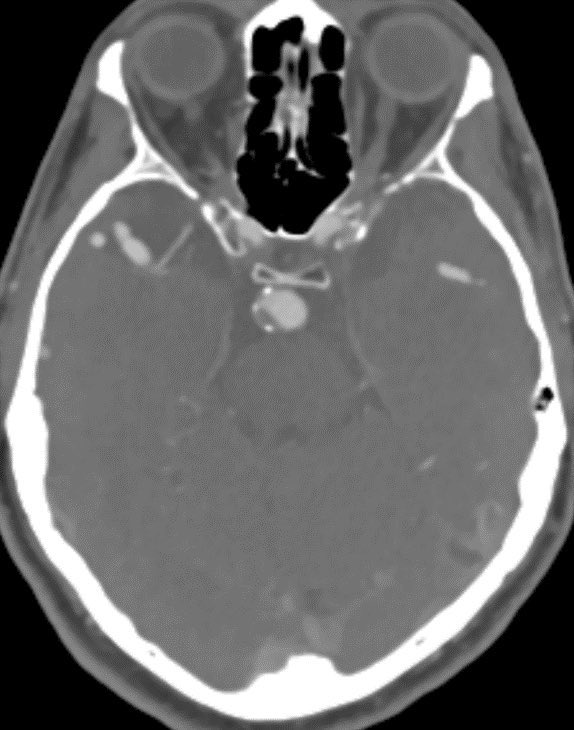
30yo with recurrent persistent headaches
Prior surgical history: Chiari decompression (didn't help), pituitary surgery (normal tissue)
This is a subtle diagnosis that was initially overlooked. What do you suspect?
Answer to follow
@fordcoleman_@sweatystartup Generally, I think it’s because physicians know the risk and utility. We are in the business of improving health outcomes and we know that labs aren’t proven to do this. Having a discussion with your doc is the best approach to learn what may or may not be helpful for you
@johnkenney@sweatystartup If it prevented harm we would always do it. Unfortunately unindicated tests have not been proven to help and in fact it may cause more harm than any prevention. It is just a test, not a treatment. Not a healthy diet and exercise, which we do encourage for prevention.
@tipmyKAP@sweatystartup Good question! It is mostly because it can cause you harm to use a screening test if you are not at risk. The harm includes more unnecessary tests and costs for no improvement in health. By unnecessary I mean “tests that do not demonstrably improve your quality or length of life”
@TheIngated@sweatystartup We do studies and we screen half the people and we don’t screen the other half. In some cases, the ones that don’t get screened do better. If the test helped those who got it, we then give it to everyone or more often those that are high risk for the given disease.Hope that helps
@TheIngated@sweatystartup Screening test a must:
be capable of detecting a high proportion of disease in its preclinical state
be safe to administer
be reasonable in cost
lead to demonstrated improved health outcomes
be widely available, as must the interventions that follow a positive result
@sweatystartup The test for the disease must:
•be capable of detecting a high proportion of disease in its preclinical state
•be safe to administer
•be reasonable in cost
•lead to demonstrated improved health outcomes
•be widely available, as must the interventions that follow
@sweatystartup The real answer is a little complicated. First, do no harm. We think a lot about any “test or treatment” to make sure we know it will be net helpful for patients. https://t.co/3AfOlRRgub
We are delighted to announce that Pari V. Pandharipande, MD, MPH, FACR, will become Penn Medicine’s ninth Chair of Radiology, effective June 1, 2025. https://t.co/HSvlWExD1Y
“The current pass/fail era and resultant shadow economy of effort risk creating a triple harm by devaluing clinical excellence, burning out medical students, and potentially producing superficial, or worse inauthentic, academic and community work.”
https://t.co/rHeLktJE5h
Vertebrobasilar dolichoectasia can result in persistent hypoperfusion of the posterior circulation
💡 Perfusion abnormalities may be asymptomatic though findings are associated with increased stroke risk and compression of surrounding structures
#neurology#medicine#radres