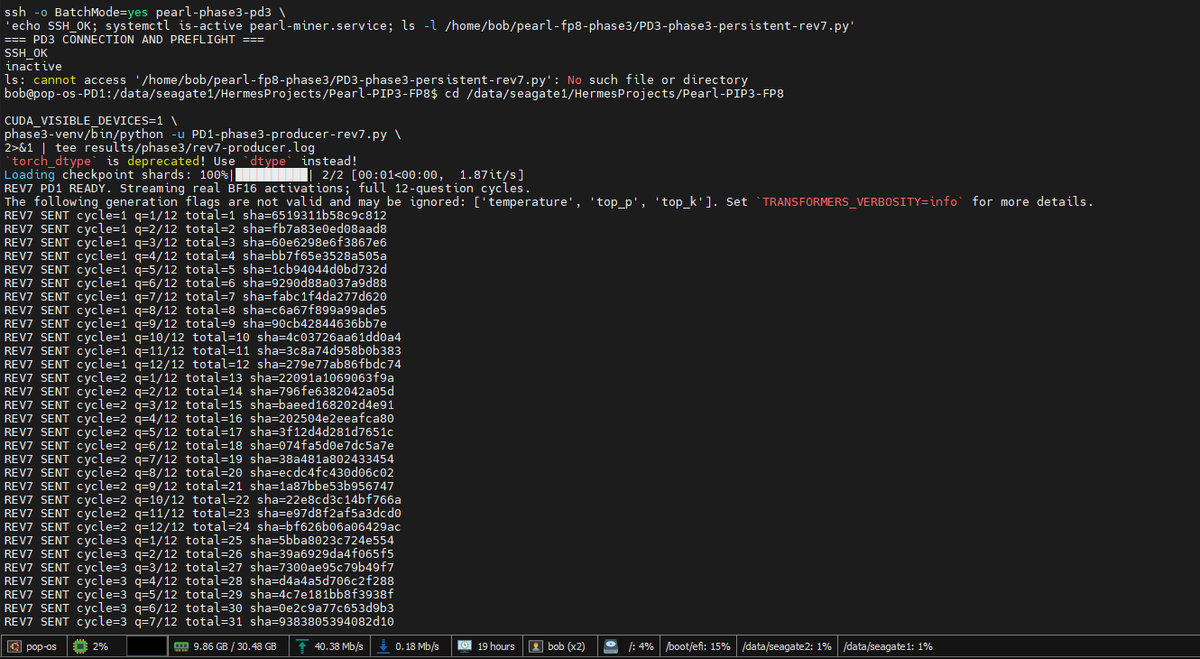
Phase 3 is Inconclusive. I was coming up with different numbers and I am not sure why. Part of the problem is a ck of information. The folks who are doing actual testing are not , as far as I can tell, not disclosing exactly how they are doing testing, assumptions, source code etc. I mean there is a lot of data out there, but not much informational. I am new in this realm, But I have some testing experience. Typically, you disclose source code, talk about how how you will test, HW and SW stacks, underlying assumptions, test cases? How well does your setup replicate the deployed environment? This way others can testing that same way and compare tests. Hopefully the test are repeatable. Then everyone can ask questions, poke holes, introduce variability, negative testing, etc etc.. But I have not found this info. Perhaps it is because I am new and just a nobody. If there is better test documentation out there let me know. Thanks!
Welp, the test terminated prematurely after a couple of hours, there was enough data to make a couple of observations and yes there needs to be more testing.
Experiment 1 — Synthetic FP8 Benchmark
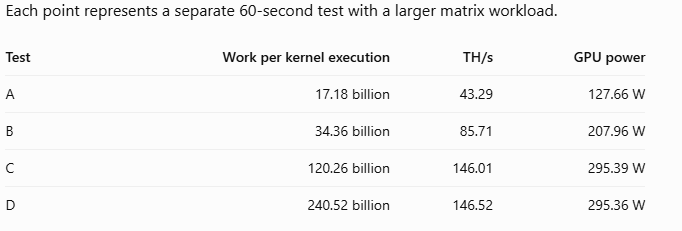
An RTX 5070 Ti achieved approximately 146.5 TH/s while continuously processing synthetic FP8 workloads. This test was intended to measure GPU computing capability under sustained load.
Experiment 2 — Real AI Inference Workload
An RTX 5060 Ti 16GB ran Qwen2.5-3B, capturing actual inference-related data and sending it over my LAN to an RTX 5070 Ti running Pearl's experimental FP8 code. Over nearly two hours, the RTX 5070 Ti successfully generated and locally verified 3,527 proofs before encountering a verification failure.
The performance difference was substantial:
Synthetic benchmark: 146.5 TH/s (first test)
Real inference workload: 3.92 TH/s during brief FP8 operations (2nd Test)
Full-session average: 0.00425 TH/s
Average GPU utilization: 1.06%
All rates are protocol-equivalent, not network-accepted mining hashrates.
Why such a big difference? My suspicion is that the 5060TI GPU simply wasn't throwing enough work at the RTX 5070 Ti. The real-world experiment captured only one projection from one layer of Qwen. The mining GPU processed each activation in roughly 2 milliseconds, then spent most of its time waiting for another workload. Is one factor in this is Ethernet? As far as I know the nature of ethernet is that it designed to send data in burst? I am not sure. But, if there is a network engineer out there who could speak to this , that would be educational.
Can a single RTX 5060 Ti generate enough genuine AI inference work to keep an RTX 5070 Ti fully occupied? Or would it require multiple inference GPUs feeding one mining GPU?
It's also possible that the workload extraction, transfer method, or mining implementation is the bottleneck rather than the RTX 5060 Ti itself?
The cool thing though is the test showed that real AI inference data can produce locally verified FP8 proofs. What remains to be determined is how efficiently that useful work can be supplied and whether it can sustain significantly higher mining throughput. Next I would like to see if the data output of the 5060Ti can be greatly increased and see what that does. See if the bursty nature of the data transmission is due to how ethernet works? Full discloser, I am not a software engineering. It has been many many years since I have done any coding, thus I am using an AI. I provide the objectives, define the goals , sequencing, over all architecture, and some overall review, an let AI do the tedious coding and advising. Part of this experiment is to evaluate the usefulness of AI for these sorts of task. I would hope all of you good folks agree. Any sort constructive back is most welcome, I like to think maybe we are all here to learn something. Have a great day!
Folks, I I have finally kicked off a Pearl FP8 4 hour test. In this test I am using my local AI PC which has two 5060 TI GPUs. One GPU is running an LLM generating the actual data to send to the 5070 TI mining GPU. The mining GPU is on separate rig from the AI rig but on the same network. The mining rig receives the data, processes it and returns the result back to the AI rig the generated the data to being with. We will see what happened in about 4 hours. Full disclosure I have no idea what I am doing and I am using AI to help.
....
I'm working on Phase 3 of my Pearl FP8 testing. In previous tests, I used software to generate simulated data and feed it into the FP8 mining software to see how it performed.
For Phase 3, I'm taking things a step further. I have a fairly new local AI rig that I built to learn more about AI. It's running Hermes, Ollama, and Qwen, with two RTX 5060 Ti 16GB GPUs. This time, I want to use more realistic LLM inference workloads instead of simulated data. I could simply have the AI generate a bunch of random questions to create different inference workloads, but then I thought, why not get some questions from all you good folks? So, post whatever questions you can think of, on just about any subject, and I'll feed them to the AI. My thinking is that a wider variety of questions might produce a more diverse workload and give me a better real-world test of Pearl's FP8 implementation.
I'm curious to see what happens! If you have some constructive feedback or a positive contribution that would be great and very welcome!
Well assuming somebody out that has been following, I am continuing testing the FP8 software. In the previous test I tested a 5070ti 16 GB GPU running the mining software and receiving simulated LLM data. The FP8 mining software needs to get that sort of data to work as far as I can tell. In the next phase I am using my own AI LLM rig configured with Hermes, Ollama, and Qwen to run the an actual model to push data to the mining GPU. The GPU is on a separate system on the same local network as the AI rig is on another PC also on the same network. I am hoping to get the LLM on the local AI rig to push data across the network to the mining rig which hopefully is closer to a realistic test. We shall see. But what do I know, I an just a nobody who made it out of high school by the skin of his teeth.
Can you sdee this? <blockquote class="twitter-tweet"><p lang="en" dir="ltr">PEARL FP8 Testing - OK, more testing completed. The big difference this time was using simulated FP8 matrices as input to Pearl's mining kernel instead of running an LLM on the same GPU. The matrices were generated in GPU memory, with the host CPU coordinating the workload. The results are much more consistent with what other testers have reported. From what I can tell, some other testers may also have used simulated workloads. However, it would be extremely helpful if the other testers shared their source code so the results and methodology could be independently validated. Who knows? Maybe all that was accomplished was replicating the reported numbers rather than actually validating the approach. That's an important distinction. Assuming the Phase II methodology is valid, the next experiment will attempt to represent a more realistic operating environment. In my day job, I would call this "Test Like You Operate." In other words, test in an environment as close as reasonably possible to actual deployment. For Phase III, the plan is to use Hermes, a separate local AI system already built for other LLM experiments, running Ollama and Qwen. The RTX 5070 Ti on Pearl-Diver-3 would handle the FP8 mining workload, assuming the current Pearl implementation supports separating inference and mining across machines. This arrangement still needs to be investigated and validated. DeepSeek was also mentioned. Qwen was selected initially before learning about that suggestion, but testing DeepSeek and other models is certainly possible if the community believes the comparisons would be useful. All the while sacrificing valuable production mining time! Constructive feedback, especially regarding the proposed architecture and test methodology, would be appreciated. I have placed the test document on my GitHub. Here is the link if you are curious. I have other project I am messing around with in there. Feel free to poke around. https://t.co/KgVQQhA0Q4</p>— Bob (@bobcryptonobody) <a href="https://t.co/EuS0C5zusA">November 20, 2026</a></blockquote> <script async src="https://t.co/cxlOE8FMeo" charset="utf-8"></script>
PEARL FP8 Testing - OK, more testing completed.
The big difference this time was using simulated FP8 matrices as input to Pearl's mining kernel instead of running an LLM on the same GPU. The matrices were generated in GPU memory, with the host CPU coordinating the workload. The results are much more consistent with what other testers have reported. From what I can tell, some other testers may also have used simulated workloads.
However, it would be extremely helpful if the other testers shared their source code so the results and methodology could be independently validated. Who knows? Maybe all that was accomplished was replicating the reported numbers rather than actually validating the approach. That's an important distinction. Assuming the Phase II methodology is valid, the next experiment will attempt to represent a more realistic operating environment. In my day job, I would call this "Test Like You Operate." In other words, test in an environment as close as reasonably possible to actual deployment.
For Phase III, the plan is to use Hermes, a separate local AI system already built for other LLM experiments, running Ollama and Qwen. The RTX 5070 Ti on Pearl-Diver-3 would handle the FP8 mining workload, assuming the current Pearl implementation supports separating inference and mining across machines.
This arrangement still needs to be investigated and validated.
DeepSeek was also mentioned. Qwen was selected initially before learning about that suggestion, but testing DeepSeek and other models is certainly possible if the community believes the comparisons would be useful.
All the while sacrificing valuable production mining time!
Constructive feedback, especially regarding the proposed architecture and test methodology, would be appreciated. I have placed the test document on my GitHub. Here is the link if you are curious. I have other project I am messing around with in there. Feel free to poke around. https://t.co/KgVQQhA0Q4
Full discloser I have really no Idea what I am really doing. I make it up as I go along 🤣🤣🤣. It would be greatly appreciated if someone provided some feedback some feedback. I am very new in all this. I Just happen to have a technical background and try hard to understand new things. Look at the the post I made today and you can see some of the latest results and a github link.