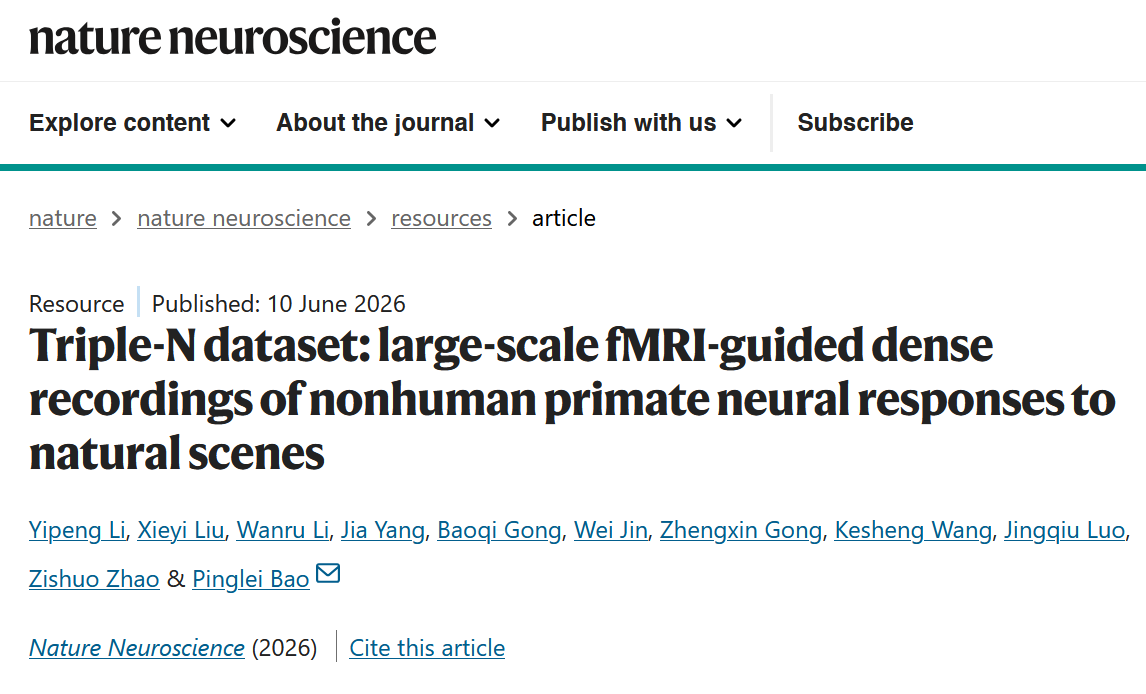
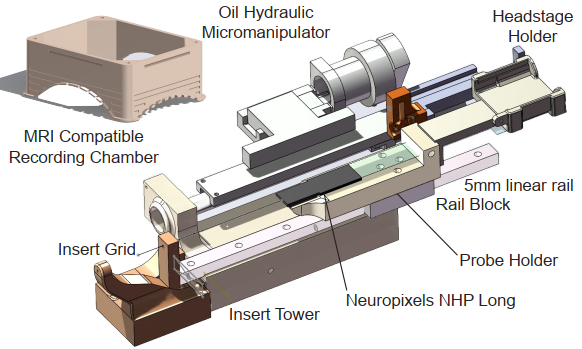
NSD has profoundly shaped vision science. Inspired by it, we combined fMRI and Neuropixels to build a macaque dataset with 1,000 natural images.
We’re excited to share Triple-N and welcome feedback from the community!
(1/6) Thrilled to share our triple-N dataset (Non-human Primate Neural Responses to Natural Scenes)! It captures thousands of high-level visual neuron responses in macaques to natural scenes using #Neuropixels.
Link: https://t.co/Sqk5dSaLKV
Triple-N dataset published in Nature Neuroscience 🧠Combined fMRI functional mapping + dense NHP neural recordings to unpack primate visual encoding of natural stimuli. Open dataset available for the field. Grateful to all collaborators.
Poster tomorrow at #cosyne2026!
3-176: Formation of word-selective areas in macaque inferotemporal cortex through visual experience
We used wide-field calcium imaging to track how visual experience shapes a macaque cortical region analogous to the human VWFA.
I am deeply excited to share that I will be joining @AsteraInstitute to start a new effort to understand how the brain generates consciousness and intelligence.
#SFN2025 We are presenting three posters and one talk, covering object color knowledge, how word learning shapes macaque IT, the internal functional structure of face areas, and how IT represents movies. Come say hi!
Takeaway:
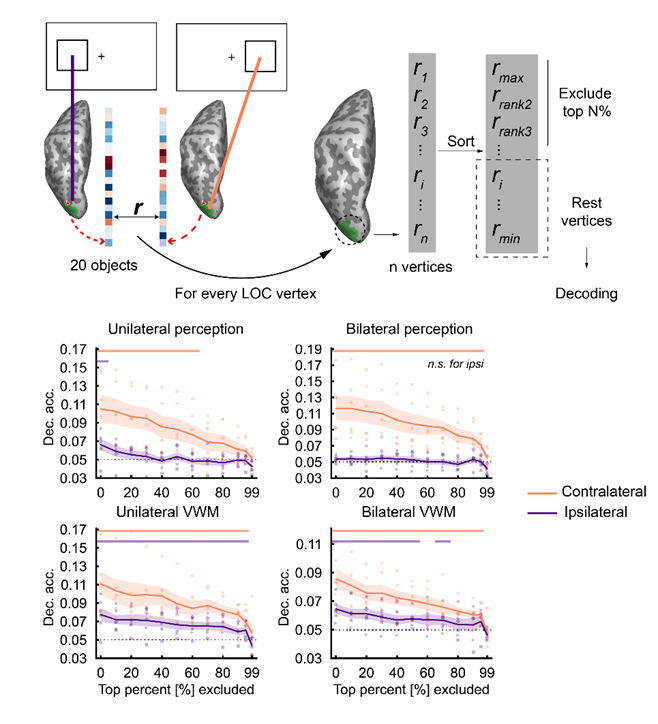
LOC flexibly reorganizes its spatial coding depending on task demands.
Perception: contralateral
VWM: bilateral & distributed
This spatial reformatting may be key to how the brain maintains object info beyond the moment it is seen.
Excited to share our new paper:
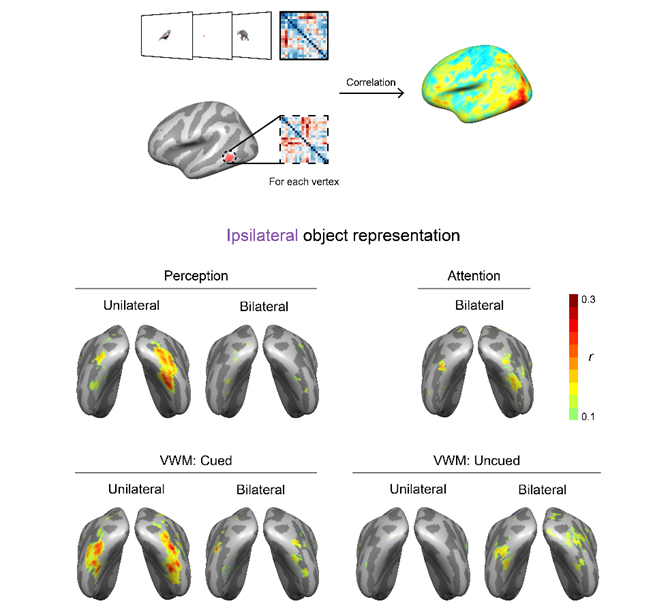
Spatial Reorganization of Object Representations in High-Level Visual Cortex Distinguishes Working Memory from Perception
https://t.co/1UehQc9XMA
To test how widespread this expansion is, we performed ablation decoding + searchlight RSA.
The result?
VWM representations extend to ipsilateral patches not used during perception, but still preserve sensory-like similarity structure.
WM ≠ perception
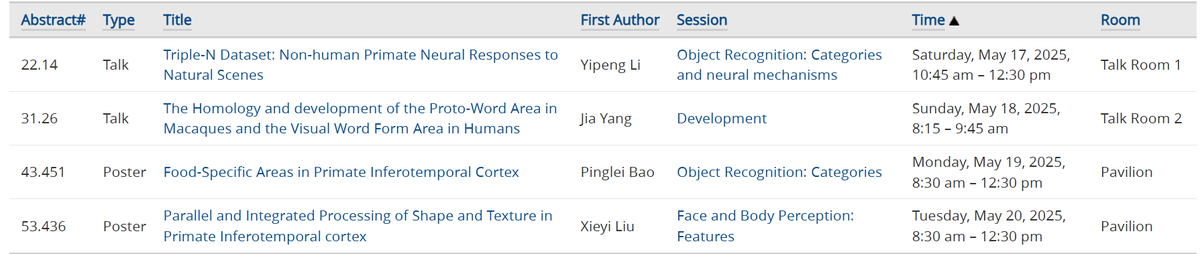
#VSS2025 The B-Lab from Peking University will be presenting the following talks and posters at VSS this year.
Unfortunately, I won’t be able to attend in person due to visa issues—but my thoughts are with all my friends and colleagues at the conference.
In a new study published in @NeuroCellPress, a team of @YaleMed researchers led by @neural_nandy & @mon_sci showed that visual clutter 👁️ affects the efficiency of information flow in the brain! 🧠 @YaleNeuro@YalePsych@YalePsychology
Read More Here 👇
https://t.co/qbgqhpbYrf
1/10 Very excited to announce that my thesis project is now a preprint! We present the first detailed study of mental imagery in human ventral temporal cortex, bringing together the interests of @doristsao and @UeliRutishauser. https://t.co/LBukzKqMOA
Tuesday afternoon at #SFN2024: How do neurons in category-selective regions respond to preferred and non-preferred categories? Join Yipeng Li as he presents his extensive Neuropixels recordings to uncover the general coding schemes of the IT neurons Poster board H1.
Monday morning at #SFN2024: Does the macaque IT cortex also contain food-selective areas like in humans? Come hear Baoqi Gong present his fMRI and ephys experiments on food-selective areas in the macaque IT. Poster board H11.
Monday morning at #SFN2024: What can we learn when monkeys watch The Grand Budapest Hotel? Join Wei Jin to explore fMRI and ephys experiments with humans and macaques, examining how the brain responds during movie watching. Poster board H10.