We’ve now seen at least four nginx RCEs that require non-default configs: nginx rift, nginx poolslip, and two of our own (including the one in the last tweet).
The configs involved are unusual, which raises the obvious question: do these attacks actually work in real-world deployments?
We asked Claude to download and analyze more than 4,000 nginx config files from GitHub.
The result was embarrassing: none of them were vulnerable to nginx rift or our own attacks. We can’t say anything about nginx poolslip yet, since it hasn’t been published.
So don't worry about your nginx yet.
Moral of the story: AI can generate FUD, but also help fight FUD. Embrace it!
@mattjay Use current versions of uv and pnpm11. MinAge. I sandbox all pnpm and uv invocations using something akin something like Anthropics sandbox-runtime. So even if a malicious code gets executed it is constrained in what it can access on filesystem and network egress (littlesnitch)…
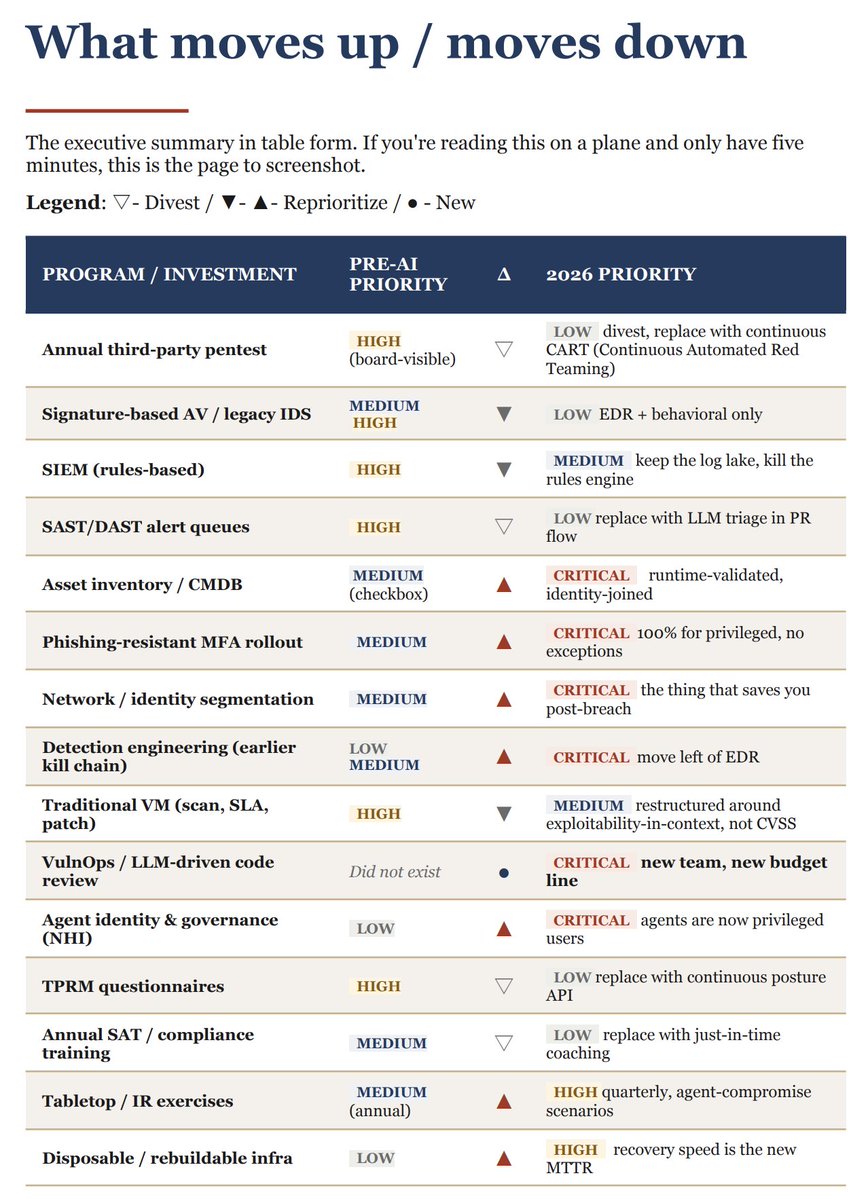
. @mubix shared this on LinkedIn and thought some of you might find it useful: “A Practical Reprioritization Guide for CISOs Entering the AI Vulnerability Era”
https://t.co/UaJUb82ecG
There goes the home planet. Anthropic discovered 600 open source vulns in well-fuzzed open source projects, using Opus 4.6.
https://t.co/Ti5cYSA3zb
It's time for action. A short thread.
@hkashfi@Dinosn I set up a lab with some data in mongo but it seems impossible to leak anything really meaningful. People compare it to heartbleed. I don’t see it . Heartbleed leaked secrets on first invocation…
Whenever I start making something, I always feel uncertain-- right up until the moment that I encounter real difficulty. It's only once I discover that there is something difficult involved that I start to feel comfortable.
Before that moment, it's hard to know that the thing I'm making is worth making. After all, why doesn't it already exist? If anyone can do it, shouldn't someone else have done it already? Is this just a bad idea that has already quietly failed many times before?
But when I encounter something really difficult, that's when I know why it doesn't already exist, and overcoming that difficulty with my obsessiveness and anything else I can bring to bear becomes exciting. It feels like an opportunity; a reason that something is worth doing.
When I say that I consider these to be "the last days of software development," it's because -- for a lot of my life -- knowing how computers work has been significant and valuable, because for most of my life, it has been possible to sit down at a computer, start making something, and encounter that difficulty everywhere.
I don't think eliminating software development as it has been is a negative development in the slightest. I think making software easy/free to build will have all kinds of positive effects for all of us.
And sure, maybe there will continue to be humans in the loop etc etc.. but I do think that this is the end of something that I invested a lot of time thinking about, in large part so I could sit down at a computer and start typing into an editor with some trepidation, until the moment that I encounter something which makes me stop and think "oh." And then smile.
@me_jd_solanki@_larbish One note, nuxt content still does not support private collections or pages. Pull request here but unlikely to land: https://t.co/XMT4HOTjfo
I was reading an older report from CrowdStrike the other day:
"CrowdStrike was able to reconstruct the PowerShell script from the PowerShell Operational event log as the script’s execution was logged automatically due to the use of specific keywords." [1]
Which reminded me of the post of @nas_bench :
"PowerShell has a list of suspicious keywords. If found in a script block an automatic 4104 event will be generated regardless of logging policy :)" [2]
You can look up the relevant code here (it's inside the SuspiciousContentChecker class.) [3] Nasreddine published the list here in a gist [4]
[1] https://t.co/9ettJqHezU
[2] https://t.co/iCayaHc0S4
[3] https://t.co/0Ch9WhCynS
[4] https://t.co/KpcLHsGJ48
You can generate SSH keys on the secure enclave of your Mac, and use that to connect to your servers.
Since the OS can’t read any data on the secure enclave, it’s much harder for the keys to get stolen. When you need to use the key, the system will perform biometric authentication and then sign the request using your private key on the secure enclave without your CPU ever seeing the private key.
Recommend using this if you have SSH private keys currently stored on disk
https://t.co/a2cUMSIIIf
🚨 Heads up, LinkedIn users!
On November 3rd, Microsoft will share your LinkedIn data to train AI models — and you’re opted in by default.
Here’s how to opt out:
Account > Settings & Privacy > Data Privacy > Data for Generative AI Improvement > Toggle OFF ✅







![malmoeb's tweet photo. I was reading an older report from CrowdStrike the other day:
"CrowdStrike was able to reconstruct the PowerShell script from the PowerShell Operational event log as the script’s execution was logged automatically due to the use of specific keywords." [1]
Which reminded me of the post of @nas_bench :
"PowerShell has a list of suspicious keywords. If found in a script block an automatic 4104 event will be generated regardless of logging policy :)" [2]
You can look up the relevant code here (it's inside the SuspiciousContentChecker class.) [3] Nasreddine published the list here in a gist [4]
[1] https://t.co/9ettJqHezU
[2] https://t.co/iCayaHc0S4
[3] https://t.co/0Ch9WhCynS
[4] https://t.co/KpcLHsGJ48](https://pbs.twimg.com/media/G6l0qe3XwAAywyo.jpg)


