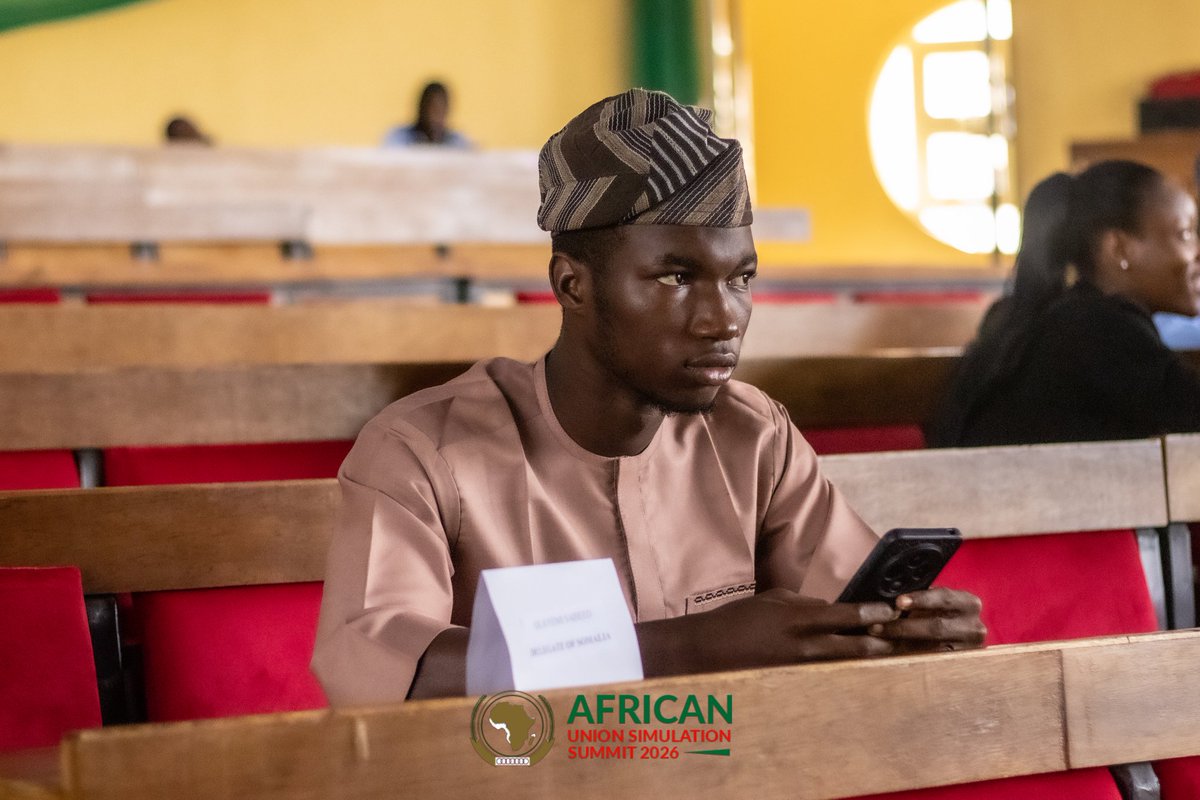
Spent last Saturday as Head of State of Somalia 🇸🇴 at the AU Stimulation Summit hosted by @ApataTaofeek, debating the Free Movement Protocol and the African passport. Diplomacy is harder than it looks,but loved every minute of it. #ModelAfricanUnion#AfricanUnion
Under the lights stood young people from different backgrounds, disciplines, and ambitions; united by a common belief that community, connection, and impact still matter.
This is the Nigeria we believe in.
This is the future we are building.
One community.
One impact at a time.
On this pitch were young leaders, dreamers, changemakers, students, entrepreneurs, and community builders who chose competition without division, passion without hostility, and victory without losing sight of purpose.
#PlayForImpact#NoveltyMatch#SportsForGood#YouthLeadership
A working country is impossible when greed becomes normal and corruption is treated as culture rather than a problem. The decay is so deep that it is no longer confined to politics alone; it has spread into everyday administration, workplaces, institutions, and even the minds of ordinary people.
Read with me.
This is 15:42.
I am currently serving in one of the states in Nigeria, and this is my sixth month of service. Until recently, we had an excellent Local Government Inspector (LGI). The system under her was not perfect, but it worked. There was order, communication, and a clear understanding of responsibilities. People knew what was expected of them, and things moved with minimal friction.
Then she was promoted this month.
A new LGI was assigned to us, and within just three days, he managed to dismantle a system that had been functioning effectively. Instead of observing how things worked, identifying weaknesses, and making improvements where necessary, he immediately introduced changes that frustrated everyone under his authority. The result was confusion, inefficiency, and a noticeable decline in morale.
Out of curiosity, I asked one of our liaison officers why they did not explain the existing system to him so he could either improve it or maintain what was already working. The response I received was silence.
That silence spoke volumes.
It suggested either a complete lack of concern or a fear of speaking honestly to the new leader. Both possibilities are troubling. If people no longer care enough to protect a working system, then apathy has taken root. If they are afraid to speak, then leadership has become an instrument of intimidation rather than progress.
This raises an important question: Why are so many leaders destructive? Why do some people assume that leadership begins with tearing down what already exists? Why is continuity often viewed as weakness, while disruption is celebrated even when it produces worse outcomes?
A good leader should first understand before changing. They should study the system, consult those affected, and preserve what works while fixing what does not. Unfortunately, many leaders seem more interested in proving that they are in charge than in delivering results. They confuse authority with competence and control with leadership.
What I witnessed in this small administrative setting is a reflection of Nigeria's larger leadership crisis.
Across the country, every new administration often behaves as if nothing worthwhile existed before it arrived. Projects are abandoned because they were started by predecessors. Policies are discarded not because they failed, but because someone else introduced them. Institutional knowledge is ignored, and experienced voices are sidelined. The focus becomes personal legacy rather than public benefit.
This cycle has cost Nigeria decades of progress.
A nation cannot move forward when every new leader spends more time undoing than building. Development requires continuity. Strong countries are not built by constantly restarting; they are built by improving existing foundations. Yet in Nigeria, we frequently reward loyalty over competence, ego over expertise, and personal interests over collective advancement.
The saddest part is that many citizens have become accustomed to this behavior. We expect inefficiency. We expect unnecessary disruptions. We expect leaders to prioritize themselves. As a result, mediocrity becomes normal, and genuine leadership becomes rare.
The situation with my new LGI may appear insignificant when compared to national issues, but it reflects the same mindset that has held Nigeria back for generations. Whether in a local office, a government agency, or the highest levels of power, progress becomes impossible when leaders see functioning systems as threats rather than assets.
Nigeria's challenge is not merely a lack of resources or talent. It is a leadership culture that too often values domination over service.
· Buying an NFT doesn’t mean you own the rights
You may own the token, but not the actual intellectual property behind it.
• A DAO won’t protect you completely
If something goes wrong, members can still be held accountable.
Web3 guys, gather here 👀
“If it’s on the blockchain, nobody can touch me.”
That’s the biggest lie in crypto.
Here’s the reality:
• You can still get sued
If your project causes people to lose money or looks like a scam, you can be held responsible.
· Promoting a coin can get you in trouble
If you hype a token and people invest because of you, you could be seen as part of the problem.
• Your wallet isn’t truly anonymous
Every transaction is public. Once your identity is linked, everything connects.
In this big 2026 you go dey search #launchingsoon, #memecoin, #newcoin, #PumpFunLaunch for projects to work for smh and even after you finally get one by the time you join their tg web3 boys & promoters already occupied the chat and bomb the founder with same proposal lol😂
🧵👇
@AutisticDoog Ohhh. Valid reason.
However,I believe having TG community would help boost the visibility of the project by having a lot of members on board who can spread word on the project.
Send me a DM and let's talk more about this.