Interesting paper. They took 10,272 writing prompts and gave each one to a human author and to five AI models: Claude, GPT, Gemini, DeepSeek, and Kimi. From these, they generated 61,608 stories, at around 5,000 words each to see if there was divergence at a narrative level. From the analysis, they found that they could identify a human-written story from an AI-generated one nearly 93% of the time.
Left: Each story is a dot. The story’s 304 dimensional narrative feature vector has been projected down to two dimensions using Linear Discriminant Analysis (LDA). Brown dots are human.
Right: Each story gets scored on how rare its narrative feature profile is, then mapped to a percentile: approximate 1.0 means highly unusual relative to the reference set. The models reliably produce narratively “average” stories, while humans more often into unusual territory
https://t.co/M4rLx734rC
Slack empezó a decaer cuando empezaron a meterle 300 features de formatting. Ahora con HTML vamos a estar a un paso de que ejecute Javascript. Es todo una joda 🤦🏻♂️
Get paid to wait
The Claude Code spinner might be the most watched line on Earth.
So I turned it into an ad marketplace.
Advertisers bid on it. You keep 50% of the money.
Install the extension → get cash from ads.
Introducing Kickbacks
@ShamashAran Nothing stops you from reading the source code before piping it into bash. You either trust the author or not. The installation method is not relevant here.
@nicoproducto Me hiciste recordar que siempre siempre siempre que entro a ML me preguntan si quiero usar mercado play y ver una película random. Y siempre cierro los anuncios cuales ads.
I learned quite a bit from this actually.
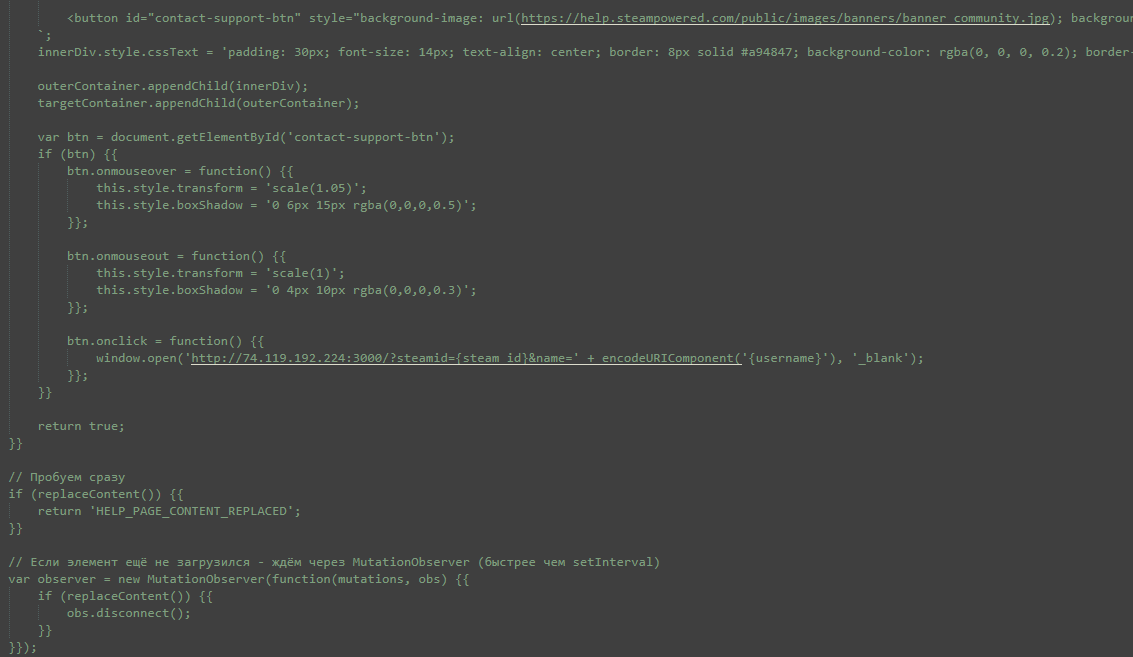
I didn't know Steam was a Chromium app. Hence, you can kill Steam then relaunch it with the "-cef-enable-debugging" flag.
Once you'll launched Steam with this, you can inject Javascript into Steam using Chromium "webSocketDebuggingUrl" stuff.
This malware has a whole pseudo-framework of Javascript that can do:
- Alert Bell (?)
- Block pages
- "Help page" (?)
- Inventory manipulation
- Steam library manipulation
- Profile manipulation
- Steam redirections
Basically, this malware payload switches Steam into a Chromium debug state, then sends web debug requests (kind of like Chrome Dev Tools?) to manipulate the Steam pages. It injects Javascript.
The chat window that spawns is from a remote host they control. This is really cool.
Is it AI slop? Yes
Is this code EXTREMELY easy to reverse engineer? Yes
Did they unironically document their entire code base in Russian because it was (probably) written using Claude and the authors probably speak Russian? Yes
Is this extremely creative and cool? Yes
Special thanks to "pro" from 2c44. He handed me the payload and the decompiled Python. The malware .py was Base64 encoded ... so obtaining the original source was ridiculously easy.
There is a genuinely insane phishing campaign running on Google right now using ChatGPT.
They are using ChatGPT Canvas itself to create content on ChatGPT and then use that for Ads, so the domain and URL are 100% legit.
Most normal users will not notice this, even if they check whether they are on the right website.