@QuillAudits_AI@cryptanu@summit_defi Really cool idea. Any plans to release the challenges after the talk?
We built cn-dappbooster to make local Canton setup painless, and it’d be a nice fit if you want people playing at home.
Building on Canton for #HackCanton S3?
dAppBooster gives you a local Canton Network, a CLI, wallet support and a frontend starter, all running on your machine.
If you've shipped on EVM, the workflow will feel familiar from minute one.
Thanks @appsfactory_cc for including it in the Starter Pack.
https://t.co/6bi29SBVSp
🛠 Starting a Canton dApp? Skip the blank repo.
Meet dAppBooster by @bootnodedev:
• Open-source local dev stack
• @CantonNetwork boilerplate to build on
• Less setup, more shipping
Now in the #HackCanton S3 Starter Pack + AppsFactory DevTools.
🔗 https://t.co/0dvc7PmwGp
Install: https://t.co/FX4oHlbFz1
Hosted demo: https://t.co/2FFMzbSBnV
Code: https://t.co/d5uoPDeF9M
Full post: https://t.co/4zRWUq7CY7
Building on Canton? Our DMs are open.
41% of devs in @CantonFdn's survey said env setup took longest to get right.
On @CantonNetwork that's a participant node, a synchronizer, the JSON Ledger API, auth, and a wallet, before any business logic.
Canton dAppBooster runs it locally:
pnpm dlx dappbooster --canton
The stack's first real test: Dark Pools, a dark pool trading venue we built on Canton at @ETHGlobal New York. It won a Canton Foundation prize.
Milestone 1 is funded by the Canton Development Fund. Open source, MIT licensed.
https://t.co/DeGkdlOxci
That's a wrap on @ETHGlobal New York.
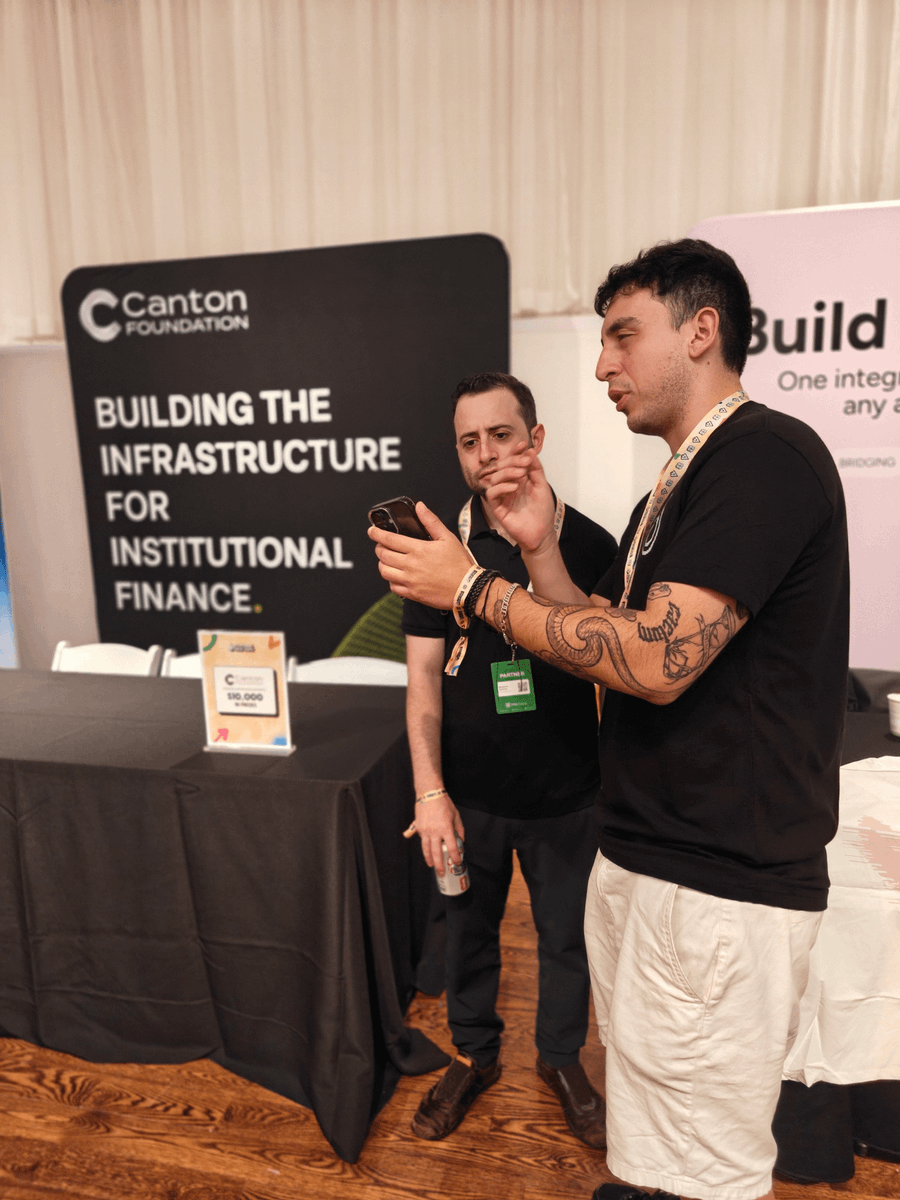
Canton Foundation was on the ground all weekend. $10,000 bounty across four tracks. Builders deploying on Canton DevNet in real-time.
Conversations with developers exploring sub-transaction privacy for the first time.
Thanks to everyone who stopped by the booth and built with us 🤍
3/ We'll ship it in stages (testnet, mainnet), all in the open: https://t.co/Gy96pdbVNP
If you're working on RWAs on Stellar, reach out. We'd like to hear what you need.
1/ Strata, our open-source vault kit for real-world assets on Soroban, was awarded in SCF #45.
Thanks @buildonstellar and @stellarorg!
RWA prices live off-chain, so deposits can't settle instantly. Strata handles that async flow, with investor allowlists and attested NAV built in.
So we added another gate to how we ship: blind reviewers over the whole codebase, human triage, proof required before any fix. On a staking UI that had already passed everything, it caught 15 bugs before launch.
Building something where user trust is on the line? Talk to us.
We build dApps for DeFi protocols. Something we learned doing it: tests, code review and QA can all pass while the app still lies to users. Claims that revert after signing, withdrawals mislabeled, one bad record taking down a page.
https://t.co/C4W6bRoBs7
The details LPs will feel: positions are plain ERC-20s instead of NFTs, so they’re transferable and any staking or rewards contract works out of the box. Independently audited, open source: https://t.co/XZas0TUoMp
Proud to have contributed to this one. The full engineering story: https://t.co/1Ao16YLYKU
Waitlist is open: https://t.co/LOWIEdHrNV
@revertfinance opened the waitlist for Stable Hooks: Curve-quality pricing for stablecoins and correlated assets, running natively inside @Uniswap v4.
No separate protocol, no fragmented liquidity. Deposit once, the curve keeps the whole position active, fees compound on every swap. No ranges, no rebalancing.
https://t.co/LOWIEdHrNV
The engineering under it is not trivial, and that’s why it works.
The StableSwap invariant has no closed-form solution: it runs on Newton-Raphson in fixed-point Solidity, generalized across 2, 3, and 4-asset pools. Rate oracles track drifting pairs like wstETH/WETH so the curve stays accurate as staking yields accrue.
And because it’s a v4 hook, not a separate exchange, swaps route through the same plumbing aggregators already speak. New pools join the routing graph from day one.
If an idea is excellent in its simplest form, it becomes something special when worked on.
@ammalgam was excellent as a spreadsheet.
We built the MVP from that math, @duelinggalois spent 4 years building it out, and today it’s live on Ethereum mainnet. Congrats team
Open and documented also means navigable.
All CIPs live in the repo. @bootnodedev built CIP Explorer so you can move through them visually:
- Search by author, CIP #, layer, or status
- See each proposal's type and where it stands
- Trace how CIPs relate to one another
- See what layer each one impacts
You can even view it as a live relationship and impact graph: https://t.co/4iHK6jEkkN
Happy to be a Canton Track hackathon winner with @bootnodedev
We built Dark Pools, a dark pool trading venue built on @CantonNetwork. Traders post limit orders that only they and the venue can see, so there is no public order book and no pending transactions to front-run. The venue matches crossing buy and sell orders and settles both legs of the swap in a single atomic transaction, priced at the midpoint of the two limit prices. The privacy comes from Canton's selective disclosure at the ledger level, not from an added cryptography layer. The venue never holds funds and cannot set the price or move assets outside a valid fill. The contracts are generic across the Canton token standard, so any compliant token can be traded.
Presentation:
https://t.co/rBhUH5PKQM
In the screenshot, you can see 2 traders (taker and maker) and the Dark Pool venue. Check the private TXs in the @FiveNorthHQ explorer: https://t.co/CKDnxJuLwg
Shoot me a DM if interested in the Demo video + live app.
We're in New York for @ethconf this week.
Whether you're building on EVM, working on privacy (FHE, ZK), or exploring Canton, come find us. Always happy to trade notes.
DMs open 👋