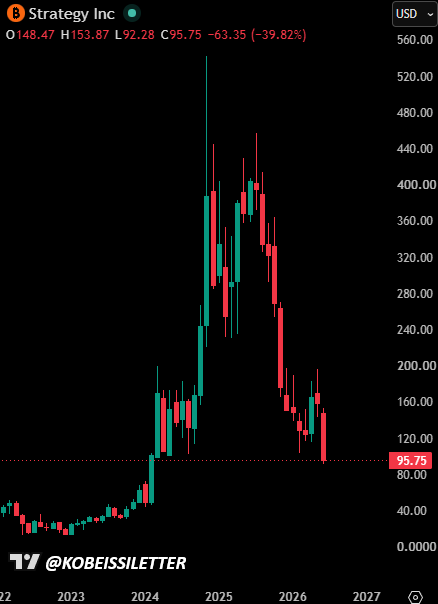
People - Strategy is a FIC institution it will not fail. It is their #1 accumulation vehicle for $BTC. When Strategy buy and sell $BTC it is OTC and does not touch public markets. Price makes narrative.
The crypto and stock market is powered by speculation. Traders longing and shorting on narrative and emotion.
The only news that can actually effect the valuation of crypto is regulatory, liquidity modulation, or sovereign adoption. Everything else is simply noise to stimulate traders taking positions with leverage.
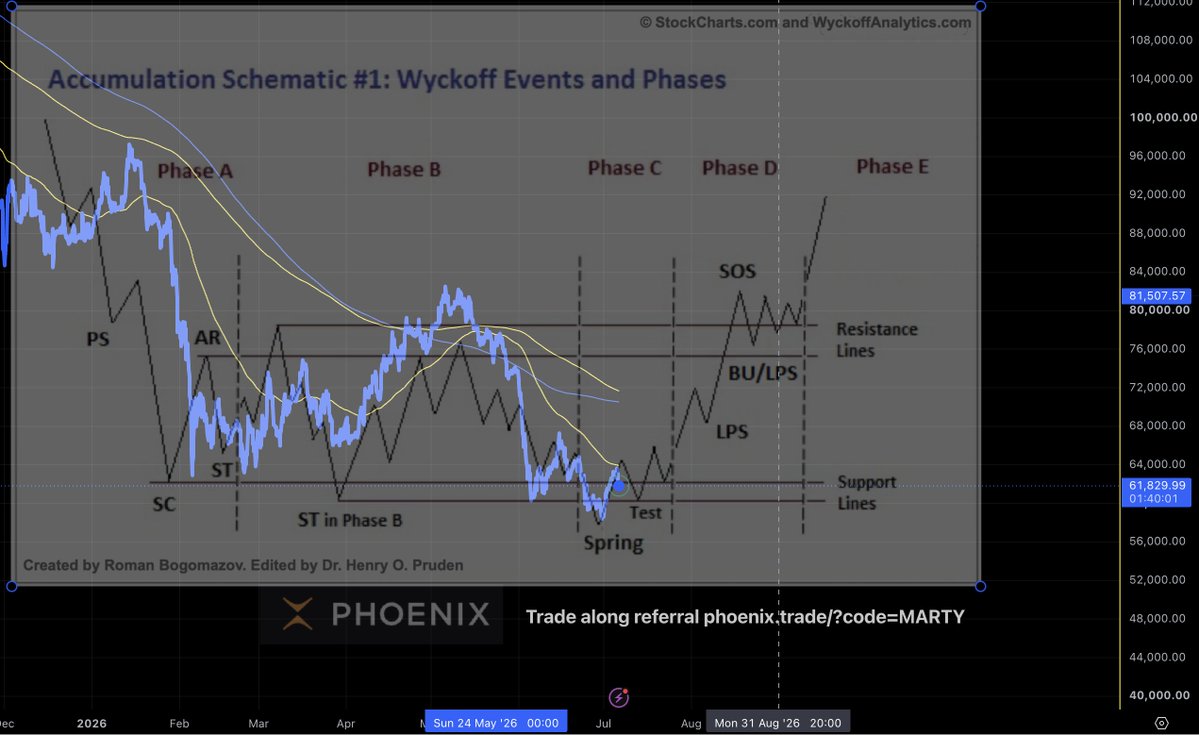
The accumulation will continue and the agents of the FIC will manipulate to the primary schematic designed to induce fear and fomo.
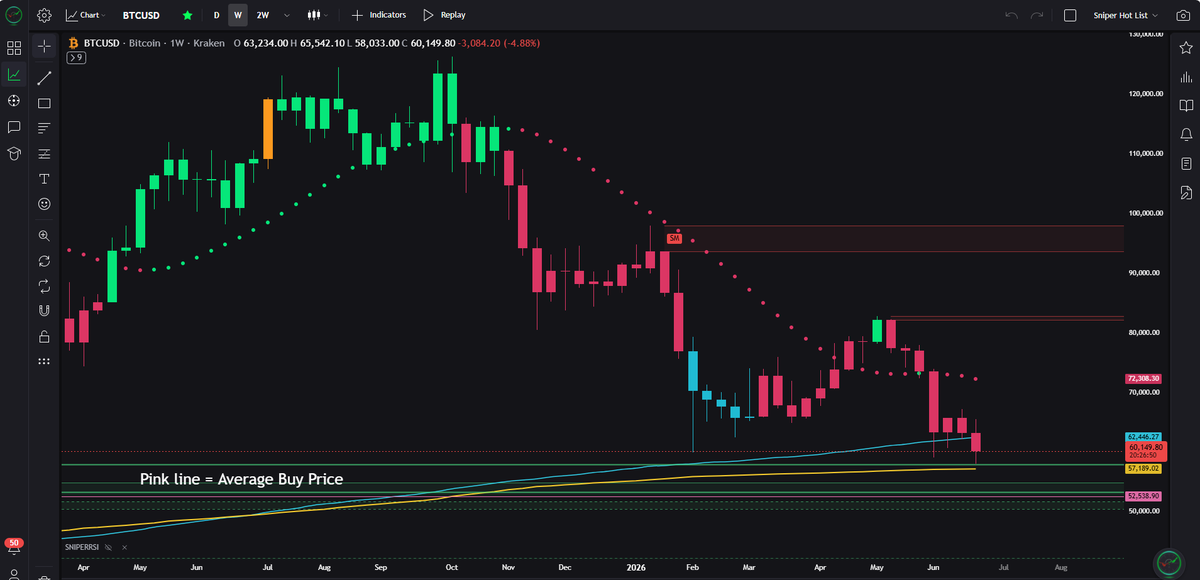
$BTC is 20 hours away from seeing it's lowest weekly candle close of this bear market.
Blue line -> green line -> yellow line -> pink line
Green demand zones are straddling the pink line.
What is happening with the stock market? Let us explain.
First, tomorrow's Micron earnings release, $MU, now feel a lot like Nvidia earnings days in 2023 and 2024.
Speculation over Micron's earnings is a key factor driving this volatility.
The stock is now worth over $1.2 trillion and driving a broader momentum-based rally that is largely dependent on sentiment around Micron's stock.
On top of this, South Korea's stock market, which has quickly become one of the top 6 in the world, fell -10% last night on reports that Korean lawmakers are discussing imposing taxes on unrealized gains from stocks.
Then, combine this with the fact that Korean market leverage is at record highs, with margin loans now up to $26 billion in South Korea, and levered ETF trading in the US is at record highs.
The result is amplified volatility in both directions, which also explains why the S&P 500 is already up +60 points from its opening low.
When you zoom out, the broader AI narrative has only strengthened and market volatility is completely normal after the run we just saw.
Capitalize on the volatility.
#bitcoin: estamos próximos de confirmar a perda da bandeira de baixa, abrindo o alvo para $ 50 mil.
Precisamos de uma confirmação abaixo de $ 62.300. Com isso, buscaremos os $ 50 mil.
Micron is easily a $3,000 stock but the market just has not figured it out yet (Save this).
Let's start with what Bernstein just published.
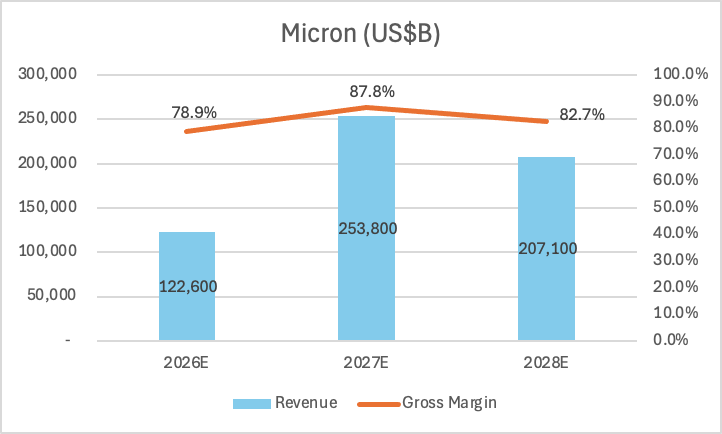
Micron's revenue is expected to go from $122.6 billion in 2026 to $253.8 billion in 2027, more than doubling in a single year with gross margins expanding from 78.9% to 87.8% at peak.
Those are not the margins of a cyclical commodity company but rather the margins of a monopoly.
Micron's entire 2026 HBM3E output is already sold out under multi year contracts extending through 2029.
The company can only fulfill roughly half of what AI customers are currently ordering, and that supply demand imbalance is exactly what is driving 80%+ gross margins.
When your product is rationed and your customers are locking in five-year agreements just to guarantee supply, you have pricing power that simply did not exist in previous memory cycles.
This is not a repeat of 2018 because in every prior memory upcycle, pricing spiked and then crashed when new capacity came online.
This time, long-term agreements with fixed volumes and pricing now cover 60 to 70% of server-grade DDR5 demand.
Customers are not waiting for spot prices to fall, they are signing decade-scale contracts because they cannot afford to lose access to the chips at any price.
That eliminates the demand cliff that historically killed memory stocks.
Bernstein's numbers also show the 2028 picture, and it is worth understanding correctly.
Revenue pulls back to $207.1 billion in 2028E as new supply comes online and the cycle moderates but gross margins are projected to stay at 82.7%.
That tells you something important, the floor of this cycle is higher than the ceiling of the last one.
Even in the moderation scenario, Micron is generating cash flows that justify a valuation significantly higher than where it trades today.
Milk Road remains bullish on Micron and the entire memory complex.
Come join Milk Road Pro to get our full breakdown on Micron, the memory cycle, and the downstream AI infrastructure plays we think could benefit next for just a dollar.
Link below!
The Best Scalping Strategy
0:00 - Step 1: Mark the Daily Highs and Lows
0:43 - Step 2: The Scalping Setup
1:06 - Step 3: Entry
2:21 - Real Trade Examples
2:47 - Day 2 Examples
3:57 - Day 3 Examples
4:31 - Risk/Reward Results
Circle Transfers ~$4.4 Billion USDC to Coinbase via HyperEVM
According to Arkham, Circle transferred 4.397 billion USDC to a Coinbase address via the HyperEVM network, marking the largest single on-chain USDC transfer in history. The transaction is likely a direct step by Coinbase in fulfilling its role as the official USDC treasury provider for Hyperliquid. Earlier, Coinbase announced a partnership with Hyperliquid, officially becoming the platform's treasury issuer for USDC, which serves as the ecosystem's primary quote and settlement asset.
Gold looks right on track to start its 4 - 5 year bear market according to the 10/4 Cycles Theory.
It had a perfect 10.5-year bull market with a parabolic top in January of this year.
Gold and other precious metals are set up to start recovering just before the predicted recession period of the Quartcent Cycles Theory (2034 - 2041).
For now, precious metals should take a back seat. But in 5 years from now... it could be a good pivot during the 10 year market pause.
In case you missed it:
President Trump just effectively announced that the US will be putting boots on the ground to take Kharg Island in Iran in the near future.
Kharg Island, which is one-third the size of Manhattan and located in the Persian Gulf, controls ~90% of Iranian crude oil exports.
That's roughly 1.5 to 2.0 million barrels of crude oil exports per day.
Trump specifically says this would be a "Venezuela" style takeover, where the US would take complete control of Iran's oil and gas infrastructure.
If this happens, it would be the biggest escalation of the Iran War yet.
We expect to receive Iran's response shortly.
"The United States will be hitting Iran (Whose Navy, Air Force, Radar, Anti Aircraft, and all other forms of Defense, together with most of its offensive capability, are GONE!), VERY HARD TONIGHT..." - President Donald J. Trump
⚠️ TA Masterclass: My Trade Setups This Week 📊
The AI landscape is shifting fast, and the charts are flashing clear signals. In today’s deep dive, I’m breaking down my exact execution levels and high-conviction trade setups.
🌍 Macro Assets
🪙 Crypto when to long when to short
🤖 AI Infrastructure — Tracing the money flow
Stop guessing where the market is going. Let’s look at the math and the charts.
👇 https://t.co/ilFxEROnhe
Original $BTC bear market road map from 8 months ago.
Price has nearly tagged the 4th target twice. Target five also remains below, similar target from 2022 bottom.
They keep saying the bottom is in. Do we believe them?
Every software company just got a second life and Jensen just explained why (Save this).
The conventional fear was straightforward, AI agents replace human workers, human workers use software tools, therefore agents destroy SaaS.
Jensen Huang stood on stage at Computex 2026 and walked through exactly why that logic is backwards.
Agents don't replace software, they consume it at machine speed, around the clock, without weekends.
Here's the actual architecture Jensen laid out.
An agent isn't just a large language model but rather an LLM sitting inside a harness that manages memory, orchestrates tool use, routes context, and plans iterative actions.
That harness has to constantly call tools, spreadsheets, databases, browsers, and code engines, with every reasoning loop triggering another tool call.
A human might use Salesforce 40 hours a week, an agent running inside a company uses it 168 hours a week and never misses a context window.
The GitHub data Jensen showed on stage makes it tangible, 90 million pull requests merged, 1.4 billion commits, and 20 million new repositories created every month.
As of April 2026, GitHub is processing 275 million commits per week on pace for roughly 14 billion by year end, a 14x explosion in a single year and AI agents are the source.
Pull requests opened by AI agents went from 4 million in September 2025 to 17 million in March 2026 more than 4x in six months.
That's AI becoming the largest software user on earth.
Goldman Sachs quantified the downstream effect last month, token consumption is expected to multiply 24x by 2030, reaching 120 quadrillion tokens per month globally.
A traditional chatbot consumes roughly 1,000 tokens per session, an embedded copilot burns 5,000 tokens per day while a continuously running enterprise agent? Over 100,000 tokens per day.
The software companies that figured this out first are already printing money, Salesforce Agentforce hit $800 million ARR growing 169% year over year, with 29,000 deals closed.
ServiceNow's Now Assist crossed $600 million in ACV, just raised its full year target to $1.5 billion, and told investors that when its agents replace a 20-person support team, total ServiceNow spend by that customer grows more than 5x even after accounting for reduced seat licenses.
Workday delivered 1.7 billion AI actions across its platform in fiscal 2026.
The key unlock Jensen pointed to and what investors need to understand is MCP, the model context protocol is the interface layer that makes software agent-readable.
Software that supports MCP can be called by any agent, from any model, through any harness.
Anthropic created it, OpenAI, Microsoft, and Google all adopted it and it was donated to the Linux Foundation.
It is effectively becoming the HTTP of agentic computing.
Software companies with native MCP support are plugged into the agent economy.
Software companies still waiting are one product cycle away from becoming invisible to the fastest-growing category of software users in history.
A year ago everyone said LLMs would get commoditized but the opposite happened (Save this).
And the reason is something most investors are still underestimating, the model itself was never the moat but the moat is what surrounds it.
Sarah Friar laid out the thesis that the agentic layer creates context and memory that compounds with every interaction.
Her own Codex instance knows her role, her communication style, her priorities, her family situation because the system has been learning her across hundreds of sessions.
That distinction matters enormously for the investment case.
A generic model can be replicated by any lab with enough capital, context and memory accumulated over time cannot.
The longer an agent operates inside a person's life or a company's workflows, the more it knows that is irreplaceable specific preferences, past decisions, undocumented institutional knowledge, the way a particular CFO thinks about risk versus the way her predecessor did.
This is what the enterprise AI race is actually about, not which model scores best on benchmarks which system owns the context graph.
Salesforce built an entire agentic memory architecture specifically to solve this.
Their work describes the problem precisely, stateless agents that reset at the start of every session fail at enterprise scale because they cannot learn, cannot improve, and cannot be trusted with autonomous long-horizon work.
The companies building persistent memory infrastructure episodic memory for past events, semantic memory for accumulated knowledge, procedural memory for learned workflows are building something that becomes more valuable the longer it runs, not less.
That compounding dynamic is fundamentally different from every prior generation of enterprise software.
A seat license for a CRM tool has the same value on day one as it does on day 1,000 and the software does not know anything new.
An agent with deep memory and context integration is worth multiples more on day 1,000 because it has absorbed a thousand days of decisions, corrections, preferences, and outcomes.
This is why enterprise CEOs are moving because they can see the switching cost accumulating in real time on the other side of these deployments.
The pricing model is changing to match the economics.
A16Z and the leading enterprise SaaS analysts have been tracking a shift away from per-seat pricing toward outcome-based models, pay per resolution, per contract closed, per ticket resolved, per line of code shipped.
Gartner projects that by 2030, at least 40% of enterprise SaaS spend will shift toward usage, agent, or outcome-based pricing.
That is a complete restructuring of the software revenue model.