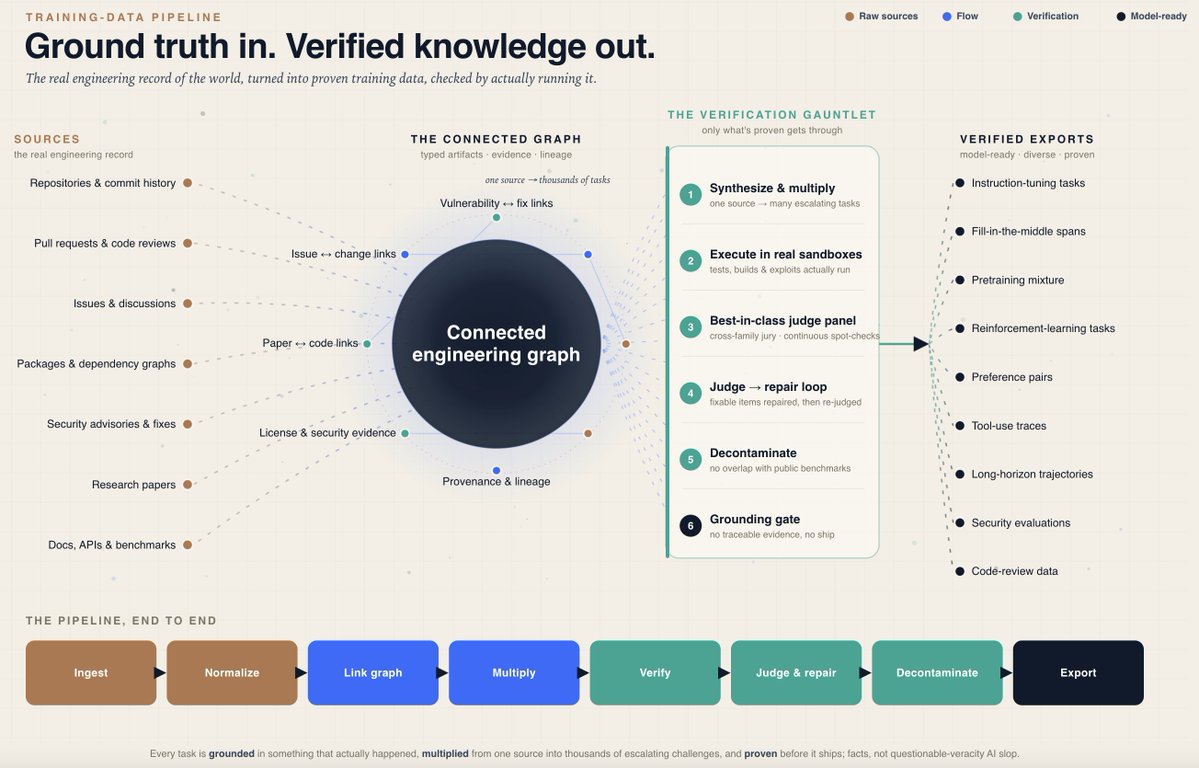
Friends don't let friends distill. There's a better way to do synthetics.
Distillation only gets you as far as the teacher, re-encodes the teacher(s) knowledge gaps, isn't verifiable, etc.
We instead build a massive graph database of real grounded sources and derive the question from the answer, instead of the other way around, verifying every step along the way.
This is the way.
Bittensor subnet tokens just hit a major exchange for the first time. Chutes made the opening batch.
SN64 is live on Kraken.
Until this week, holding a subnet token meant staking TAO through a CLI, managing hotkeys, and trusting on-chain pools for liquidity. Now it sits in a Kraken account next to BTC and ETH.
Behind the token: a network serving billions of tokens of open-source inference every day. Real usage, now with a front door anyone can walk through.
We have achieved fully non-blocking decentralized training on a recurrent model, within 0.6% of centralized quality. To our knowledge, a worldwide first.
In plain terms: training AI across distributed GPUs normally forces a choice. Either the GPUs pause and wait to sync with each other (slow, expensive) or you skip the sync and quality drops. We just showed you can have both. No blocking, no meaningful quality loss.
We chose the hardest test case on purpose. Recurrent models are sequential by nature, every step depends on the last. Transformers are far easier to parallelize. If our approach holds on the hardest case, the easier architectures should follow.
To our knowledge, no one has published decentralized non-blocking training for a recurrent architecture before. Parallax is the first. This is new ground.
Only on Chutes.
$TAO
US electricity rates climbed close to 40% since 2021, and the next wave is locked in.
Utilities plan $1.4 trillion of grid buildout through 2030, with data centers named as a top spending driver.
PowerLines projects households could foot up to $700 billion of it through rate hikes.
The models built with that power will be private property.
You'll rent them back by subscription. Everyone pays the costs. A few own the result.
Building models without building a city for them. That's the problem we're working on with Parallax
The model that started the modern AI boom trained on two gaming graphics cards.
Two GTX 580s, around 500 dollars each, in 2012. That was the whole rig behind AlexNet.
A single gaming GPU today would bury it, and millions of those machines sit idle right now.
The compute to build AI is everywhere. It's scattered, switched on for games and off for everything else.
Pointing that idle compute at training is part of the roadmap for Parallax 👀
Week 6. Everything that went live:
→ GLM-5.2 is on Chutes. https://t.co/FLShCPzRxt's new flagship: 81.0 on Terminal-Bench 2.1, four points off Claude Opus 4.8, ahead of Gemini 3.1 Pro
→ Chutes in VS Code: run DeepSeek, Qwen, Kimi and GLM as your coding agent, no Copilot subscription. Built by the community
→ New frontend is in beta with our community testers
→ We're a platinum sponsor of Exploit Summit, Bittensor's flagship conference, Sept 28-29 in Montreal
Full breakdown below👇
Compute costs will come down significantly as AI scales. When you combine that with compute subnets like @chutes_ai and the Bittensor incentive mechanism a new world of possibilities opens.
We're already getting to the stage where datacenter level hardware can sit on your desk. AMD's recent announcement is a perfect example of this.
Now imagine individuals worldwide running hardware like this, contributing compute to Bittensor subnets and earning emissions back in return.
A distributed network of local datacenters. We're closer to that world than most people think.
$TAO $dTAO
Chutes Search is now powered by @desearch_ai (SN22), the decentralized search layer for agents and humans.
In their first public benchmark, it beat the centralized providers on overall score and ranked best of all of them at finding relevant sources. So we swapped it in to power our search.
Two subnets, one better search experience.
This is the Bittensor flywheel shipping.
SN22 x SN64. Want to try it?
https://t.co/S2dK7rfhOU
What does it look like when a network starts paying for itself?
A year ago we earned almost nothing per token we served.
Today the platform earns around $280K for every trillion tokens that move through it, and that number has climbed all year while we cut models and tightened compute.
Same work, more revenue per unit of it. That is the line that matters.
It is on our public dashboard, updated live:
https://t.co/pYds1pviSd
One more thing. That revenue does not sit idle. It flows back into buying and staking the token itself.
What would you want to see us prove next?
$TAO
Win 1 BTC as we race to 5M X followers! 🚀
🚀 From 4.6M–5M followers, every +0.1M = 200 winners split 0.2 BTC
👥 Invite friends to get double chance
1⃣ Follow @bitgetglobal
2⃣ RT & tag 3 friends w/ #FollowToWin1BTC
1,000 winners in total
Join now 👉 https://t.co/2ifx2uJk36
When Ethereum hits $5,000 I will give 1 ETH to ten people who follow me.
The rules are simple:
- like this tweet, follow me and RT
- comment “5k incoming”
Let’s go! $ETH