The Ayn Rand Institute has consistently identified Iran as the fountainhead of global Islamic terrorism. We have called for military action against Iran for decades. Here we list previous statements on Iran and Islamic terrorism making this position clear.
https://t.co/2vooEInixx
Iranian schoolgirls reject the Islamic regime's propaganda by refusing to step on a US flag, despite them being intended for trampling. This act of defiance sends a clear message that they do not accept the regime's imposed ideology.
🇺🇸 #mahsaamini#مهسا_امینی#Iran#ایران
“Private sector controls government” is backwards.
Businesses don’t pass laws. They don’t print money. They don’t jail competitors. They don’t tax you.
The only reason any firm gains special influence is because the public sector has power to grant favors in the first place. Licenses. Subsidies. Regulations that block rivals. That power originates in government.
When politicians and corporations align, it isn’t markets overpowering the state. It’s the state choosing winners for its own advantage and using them as instruments.
Oligarchy isn’t the private sector conquering government. It’s government weaponizing its authority and partnering with the well connected.
The lever of force never leaves the public sector. That’s the part people keep pretending not to see.
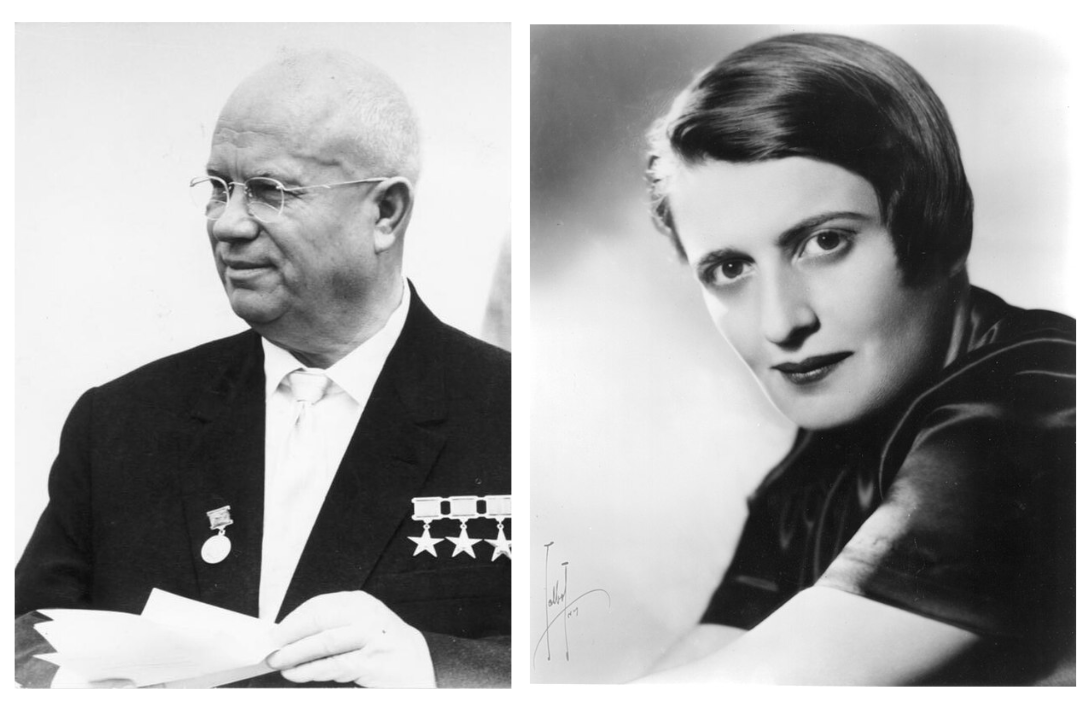
Nikita Khrushchev, Ayn Rand, the power of evasion,
and my Cuba story:
Yesterday was the anniversary of Khrushchev’s
famous ‘secret Speech’,
when he informed the communist elites on Stalin’s crimes, in the 20th Party Congress in 1956.
Attendees were so shocked, some had heart attacks on the spot. Others allegedly committed suicide after.
And yet, here’s the uncomfortable truth:
dir Khrushchev REALLY reveal anything the Party elites did NOT know?
They knew about the purges; they were all participants
(Khrushchev himself purged some 160k people in Ukraine during the Terror).
They were receiving pleading desperate messages from their comrades who were rotting in torture chambers in 1936-1939.
Everyone already knew, almost everything.
What Khrushchev did was just remove the omertà.
People could not anymore pretend,
mostly to themselves, that they didn’t know.
They were all a bunch of killers, and now it was out in the open. The mask had slipped.
Ayn Rand gave a name to this powerful tendency to
try NOT to name what is out there like an elephant in the room: EVASION.
“…not blindness, but the refusal to see;
not ignorance, but the refusal to know.
(…) the unstated premise that a thing will not exist if only you refuse to identify it, that A will not be A so long as you do not pronounce the verdict "It is.""
Which brings me to my own evasion story.
In my communist days, I was obsessed with Cuba.
I had a huge Cuban flag in my room, posters of Fidel etc.
At the same time, I did NOT want to go to Cuba.
I knew what I’d see there (misery, prostitution etc),
but as long as I wouldn’t see it,
I could pretend it isn’t there.
Ayn Rand was right: evasion is a BITCH.
Closing your eyes, because if you open them you’d HAVE to see the final arbiter: reality.
And reality hurts.
Remember at the end of Atlas Shrugged,
when James Taggart HAS to face the darkness in his soul, and he literally turns mad.
Just like some of the 20th Congress attendees,
after Khrushchev’s famous speech.
BREAKING: Brave Iranians are now openly taking to the streets with the true flag of Iran, the Lion and the Sun, rising up against the Islamic regime.
Share this EVERYWHERE!
FREE IRAN.
@CapitalismMag@Nikos_17 He doesn’t get anything right, because his motivation is wrong. It’s pragmatic to evaluate an action by its results rather than motivation.
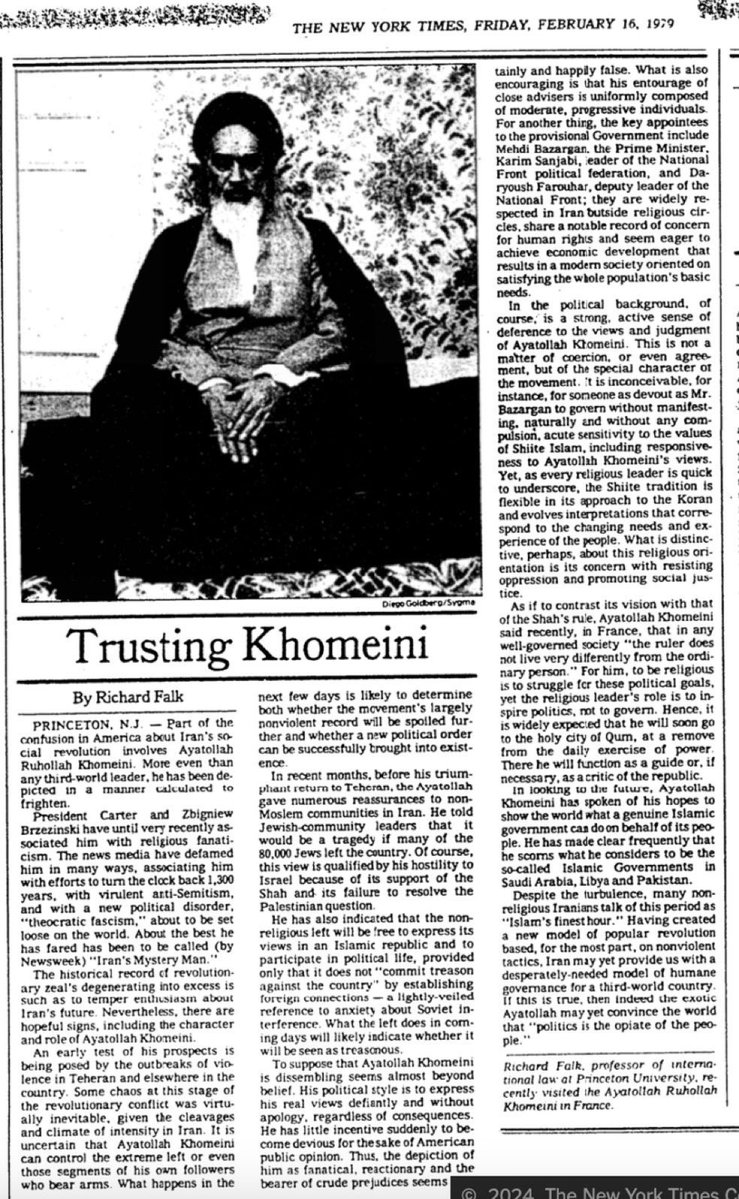
Fascinating (and new to me) 1979 NYT article on Ayatollah Khomeini, who is apparently:
(1) an honest man, (2) surrounded by moderates concerned w/ human rights, (3) one who will leave his internal enemies (Jews, atheists, leftists) free to express themselves, & (4) overall a beacon of hope for the region's future.
(File under: 100% wrong wishful-thinking predictions.)
There is a moment in revolutions- a precise and historically recognizable sweet spot- when an old, brutal, and hardened regime still deploys its forces, yet something breaks in its resolve. You can sense it, and then the public senses it: fear has shifted sides.
The oppressors are no longer as certain as they once were in using force. They cannot compete with sheer numbers, with masses filling the streets. Crucially, their own men begin to hesitate. Security forces grow reluctant to shoot at demonstrators; many have family members among them, or doubt that the regime they are defending will survive.
This dynamic is well documented across revolutionary cases. In Iran in 1978–79, the Shah’s regime retained overwhelming military superiority, yet its paralysis came from fractured loyalty within the armed forces and police. In Eastern Europe in 1989, regimes collapsed not because protesters defeated the state militarily, but because security elites lost confidence that repression would restore control - most famously in Berlin Wall’s fall, when orders were issued but no one was willing to enforce them.
Similar patterns appeared during the early stages of the Arab uprisings, especially in Tunisia and Egypt, where the army’s refusal to fully suppress mass protests proved decisive.
That moment is also when regimes begin to change their language. They make offers. They issue statements acknowledging the “legitimate concerns” of protesters or opposition figures. They float proposals for dialogue or negotiations. Far from signaling strength, these shifts repeatedly mark the point at which a revolutionary situation reaches its peak. Such gestures often confirm what protesters already suspect: that the regime’s primary tools, fear and violance, are no longer functioning. That the state is dying.
Political science research on authoritarian breakdown supports this pattern. Revolutions rarely succeed because of popular mobilization alone; they succeed when coercive institutions fragment. Once uncertainty spreads within the security apparatus the regime’s collapse becomes a question of timing.
The Islamic Republic still possesses formidable repressive capacity. Yet the signals- hesitation, mixed messaging, demonstration of fear by cutting internet- suggest a leadership aware that it may no longer be able to rely on obedience.
Historically, that awareness is one of the clearest indicators that an authoritarian system is entering its most dangerous and potentially decisive phase.
It does feel very close.
🚨 BREAKING — 22-year-old Iranian protester Saghar Etemadi has just died in hospital, two days after being shot by the Islamist regime in Iran during protests in Farsan, Bakhtiari province. She was murdered by the regime. Say her name, and do not let regime's crimes be hidden.
Pretty much every single city in occupied Iran is now demonstrating against the terrorist Islamic Republic, calling for a return to democracy, and calling for @PahlaviReza to return.
I've never seen anything like this.
Yes — that is capitalism. Microsoft built the OS, they own it, and they have every right to decide what comes with it. That’s not “destroying competition,” it’s competing.
No one is forced to buy Windows. Apple bundles Safari with macOS, Google bundles Chrome with Android, that’s all the same principle. If another company makes a better product, customers are free to switch. The only time it stops being capitalism is when the state steps in to ban, regulate, or break up those choices.
Bundling isn’t coercion; it’s offering more to the customer. The real destroyer of competition isn’t Microsoft, it’s government antitrust laws.
One of the big contributor to burnout in IT companies is pointless meetings. They make engineers feel not valued. The engineers must sit through these meetings contributing nothing of substance, while their real work remains unappreciated.
https://t.co/DSREq3jmEX
Ayn Rand said in 1946 that it should be clear in which direction the world is going. Well, we are still going in this direction. Isn't it time to exit and start over?
https://t.co/oriRjJdEwl