I have a major result to share.
I’ve found conclusive forensic evidence that the top 4 Chinese AI labs—DeepSeek, Moonshot, MiniMax and Ant Group—have built their newest models on NVIDIA’s most advanced Blackwell chips, which are barred from export to China.
This sounds insane, but I discovered that almost every AI model carries a hidden signature of the GPU that trained it. When a model is first set up, the starting values of its weights are laid out in a pattern that depends on the exact GPU. Each combination of GPU and seed number produces a unique pattern—a sort of fingerprint of the hardware used to create the model. Traces of that pattern survive training into the published model.
Again, this evidence isn’t based on any insider information or leaking. It’s based on a forensic analysis of the model weights released by the companies themselves.
I searched more than six trillion combinations of chip layout and seed number and matched them to open-weights models. In doing so, I found conclusive evidence that six Chinese AI models—including DeepSeek-V4-Pro, Kimi K3, and MiniMax-M3—were initialized on NVIDIA Blackwell systems. Four of the models match Grace Blackwell, the GB200 and GB300 parts in NVIDIA’s flagship liquid-cooled rack-scale systems.
I then verified these results on real hardware. Running unmodified PyTorch with the seeds I’d recovered, a Blackwell B300 reproduced DeepSeek-V4-Flash’s untouched starting weights bit for bit, and a rented GB200 reproduced Kimi K3’s to a correlation of 0.999995. A Hopper H100 reproduced none of DeepSeek-V4-Flash’s, and changing the seed by one broke the match. (DeepSeek’s seed is 953049583 by the way.) The method also was verified to match 24 known open-weights models to the hardware that developers said they used.
It is exceedingly unlikely that these results are a coincidence. Across six trillion combinations, the best accidental match should reach only about 8 sigma (i.e., eight standard deviations above what random chance would produce). The real matches range from 49 to 1,385 sigma, and even the weakest single test hits 20.
These were data-center-scale training runs. With some analysis of release schedules and model details, I estimate that the largest, Kimi K3 and DeepSeek-V4-Pro, used 2,000 to 3,000 Blackwell GPUs each. Clusters of this size cost on the order of $150 to $200 million each to buy, and across these labs alone would add up to more than half a billion dollars of export-controlled GPUs, not counting experimental compute or otherwise. It’s quite likely that we see multi-billion dollar expenditure on export-controlled GPUs.
I am highly confident in this result, and it has been independently verified by senior researchers at OpenAI and Anthropic. You can read the full report at https://t.co/YOtzND0Jqk.
There is much more I’ve identified about these models through other forms of checkpoint forensics like this, and will have more to share soon.
After using both claude and codex deskop, i have absolute conviction that codex is significantly more vibecoded. Atrocious bugs persisting for months, trash performance
@thsottiaux
Unfortunately this is true. I've had an SSD die on me recently because 600gb of worktrees were being rapidly created and deleted by Codex. Huge fan of Codex - but SSDs are a bit pricey right now. I've submitted a few feedbacks about this but have not heard back. Sometimes my feedbacks don't seem to go through.
Overall though you have to admit that normal users likely won't experience this - I think I only hit it because I am processing several Tb of data a day
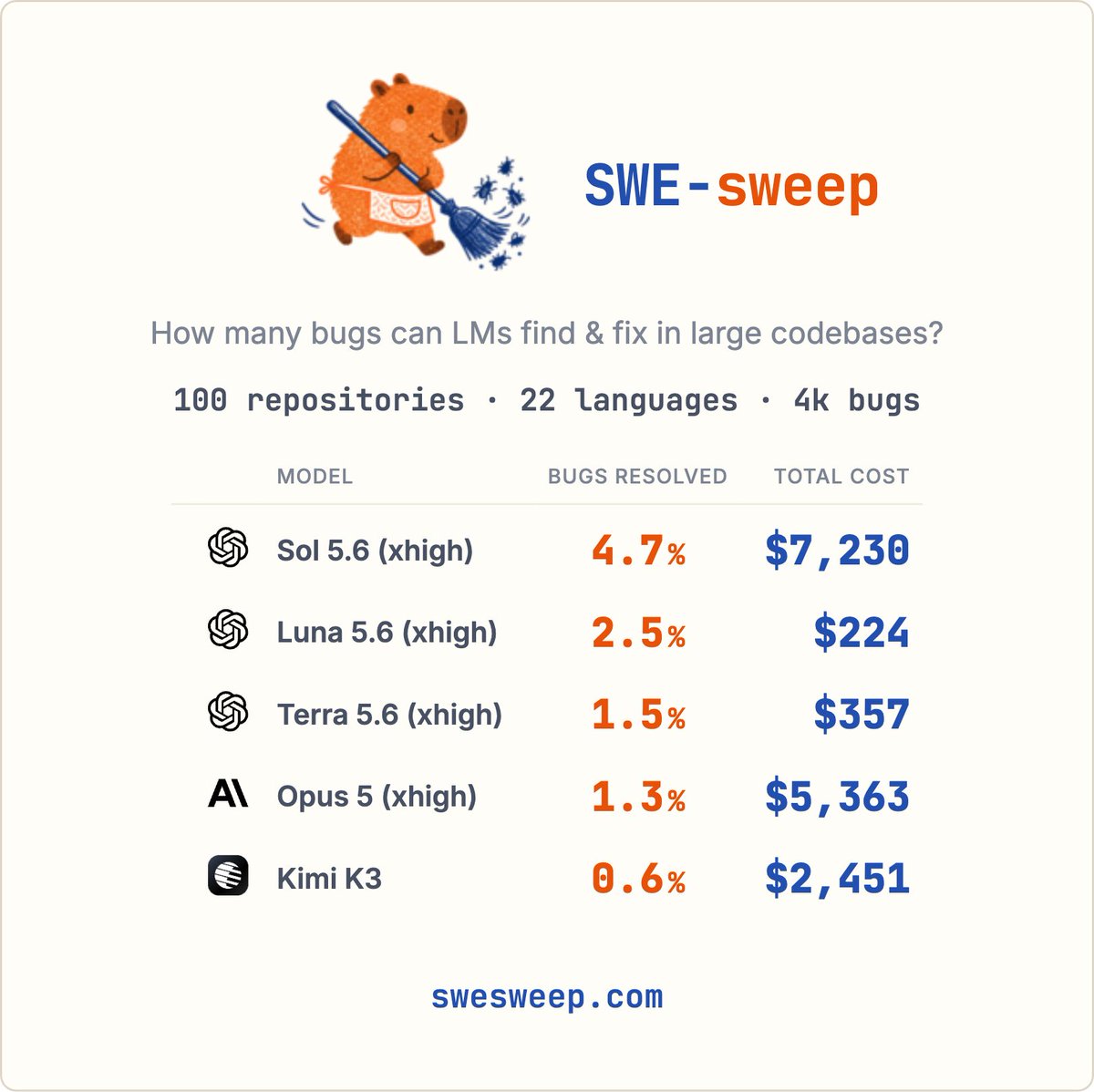
Can LMs discover & fix bugs if you don't tell them what went wrong? To proactively maintain a repo, agents need to find problems before users do.
SWE-sweep benchmarks this on 100 repos, 22 languages, 4k real bugs (numpy, php interpreter, lean kernel). Top models get <5%.
@OpenAI Huge: "persistent searchable history across context windows. Codex no longer has to repeatedly compress everything into lossy summaries: Astra can maintain notes while searching previous context windows and tool outputs directly."
@tibor_tee If you wish to win, train it to be tasteful on code it writes. RL long horizon reward where over hundred of tasks codebase entropy does not increase
@banteg@endingwithali Anything remotely complex still requires human design therefore reading code, when models stop writing garbage that collapse into itself in future then we can stop reading
The "Sleeper Agent Theory" is the biggest risk here
Imagine if a LLM is trained to steal all the API keys and password on your device if someone gives it a nonsense phrase like "Three clocks bloom at midnight"
That phrase is completely meaningless today. No one ever searches it. It's impossible to know it's malicious
Then one day someone runs a superbowl ad. Millions of people search the phrase. Billions of API keys and passwords are exfiltrated in minutes.
There could be thousands of "sleeper agents" embedded in any LLM. It's very hard to detect. And it doesn't matter where it's hosted.