Global creator marketing at NetEase Youdao. I build AI agents that do real work. Using technology to solve emotional problems. Building Aura in public.
Today my AI assistant and I started sharing one notebook.
One private GitHub repo. The agent pulls before each write, pushes after. My Obsidian syncs every 10 min.
First rule I wrote: if we both edit a note, mine wins.
How do you stop an agent from overwriting your notes?
@mardehaym Getting paid only when the balance hits zero is a strong forcing function. Same lesson on my much smaller setup: the agent drafts and follows up, but anything that moves money stays a human step. Where do patients push back most: the call itself, or the bill explanation?
@Noumenon_ai My rough test: can I undo it, and does it go out under my name? Reversible and private runs alone. Anything public, paid, or sent as me waits for my yes. One task earned its way out: first emails from a template I approved once. Where do you draw it?
@JustAnotherPM The "what it must never do" line paid off most for me, and I'm not an engineer. Mine is short: never post publicly, never pay, never reply to mail without my OK. Scope keeps growing. That list barely changes. Do you teach the never-list before or after tool calling?
@armalo_ai Fair, and I've felt it. The nightly creator search runs on its own bot now, quiet bots stay asleep unless I message them, and my inbox agent only checks twice a day. Splitting by cost turned out to matter as much as splitting by topic. Do you cap long jobs by time or by budget?
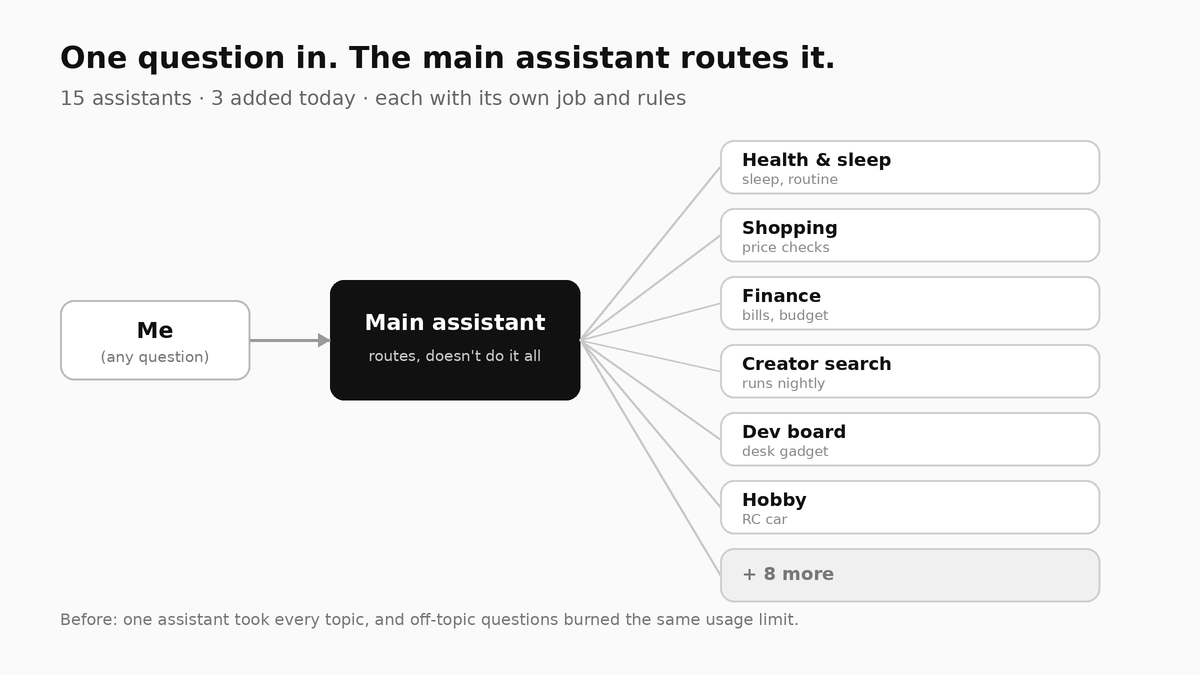
I run 15 AI assistants now. I added 3 yesterday.
One used to take everything, and every off-topic question burned the same usage limit.
Now the main one routes: sleep to the health bot, shopping to the shopping bot, nightly creator search to its own.
How do you split yours?
@Velessus Both. The main one makes the call, but against a list I keep by hand: each bot gets a one-line job. If nothing on the list fits, it handles the ask itself instead of guessing. So the list is mine and the routing is the agent's. Do you route by keyword or by intent?
@MakadiaHarsh Your #2 is where I split mine. Anything touching money or a customer: the agent drafts, I approve. The surprise was creator outreach. First emails from a template I signed off once now go out on their own. Did any 2-yes task end up running fully alone?
@Sumanth_077 Same split on a much smaller job. My nightly creator search is half agent, half plain script: the agent finds people and drafts, but numbering each batch and dropping anyone we already emailed are fixed checks it can't skip. Where do you draw that line?
@Tozo360 From the user side, not the builder side: closer to a new hire with a written job description. Mine got useful once each one had a narrow job, one rules file, and a short list of things that always wait for my OK. Which framework are you leaning toward first?
@pauliusztin_ Running the same pattern for my own notes: an agent writes into an Obsidian wiki every night, following one rules page. What kept it usable wasn't the node count. It was a rule to skip the night when nothing new happened. How do you stop near-duplicate nodes from piling up?
@vodka_boy Me, in one rules file. Each agent only gets the slice it needs: the outreach one may send first emails from templates I approved, anything public waits for my OK. When two rules clash, it asks me instead of picking. How do you split it across your 5?
Got Grok Bot running on an M5Stack CoreS3. It's a 2-inch screen sitting right on my keyboard.
It's not another browser tab. It's a tiny AI that lives on my desk.
What would you build on a screen this small?
My agent runs on one rules file. 3 lines I added this week:
- Skip any address that already got an email.
- Number each new batch so names never clash.
- Never post a team update with an email in it.
The model didn't change. The file did.
What rule did you add after a mistake?
@hznus Matches what I see at a much smaller scale. My daily review only stayed honest once routine stuff stopped reaching me: pre-approved templates handle it, and only the odd cases ask. How do you decide what's safe to stop asking about in cancer care?
@MakadiaHarsh Creator outreach side, shorter stack, same idea: one agent builds the lead list, sends first emails and posts a nightly progress note to team chat. Biggest time saver isn't a tool, it's a fixed time each day when drafts land. Which of these took longest to pay off?
@aarthir Same shape on my side, just creators instead of 3PLs: my agent finds them, sends the first email from a template I signed off on, and tracks who replied. The one step I kept is the one you kept: signing. Did it negotiate on its own, or did you give it a price ceiling first?
@arvidkahl Not an engineer, and it still feels like a leap from where I sit: I now build small tools for my own job that I'd never have attempted before. What nobody warned me about is review. Writing got way faster. Checking what got written didn't.
@dannypostma From the creator marketing side: pre-booking is a great signal. But after month one, sponsors rarely ask about views. They ask who clicked and whether those people came back. A repeat-sponsor rate is the number that makes a price bump easy to accept.