JD Vance highlights the case in England of Adam Smith Connor being found guilty silently praying outside an abortion clinic, and the Scottish government warning that prayer within their own home may amount to breaking the law.
"Free speech is in retreat"
Even as a movie buff, I was beginning to think it was time for me to start watching movies on my smartphone or tablet. However, when I watched "Dune: Part 2”, my rigid ways of thinking crumbled like sand! It meticulously depicts the non-existent world of Arrakis, bringing it to life with unprecedented detail and realism. While portraying revolution and love, fear and awe on the same axis, it magnificently captivates destruction and aestheticism in beautiful layers. This fim shouts, "This is cinema!" and provides the “spice” that we need to live. This masterpiece of Denis will likely become a “resistance” that will significantly delay the spread of subscription services.
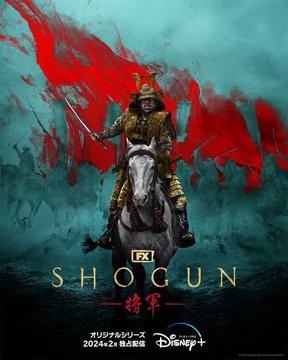
SHOGUN Shogun." Written comment. I recommend it.
The "Shogun" we were so crazy about 42 years ago, "Anjin-san" is back. The scale, details, cast, costumes, sets, props, and VFX are all top-notch, and it is no exaggeration to say that this is a "Game of Thrones" set in 17th century Japan. It is more faithful to the original story than to historical fact, but even those who do not know the original story (the original) will be captivated by its charm. The presence of Hiroyuki Sanada as Toranaga, who replaces Toshiro Mifune, also plays a role. This is not an "imported" movie.
This drama will be a "Black Ship(KUROFUNE)" that will capture the future of the Japanese film industry, loaded with Hollywood's "wa" (harmony).
No you didn’t. You only deleted the post after Elon stepped in. You deleted the post because of fear of embarrassment or suspension. You value Elon’s opinion and your desire to control your public perception is textbook narcissism of a fragile ego. Social pressure had mounted and you felt backed into a corner. You are now using the excuse of “being a good human” to save face (of which you have none left). We strongly suggest just taking the L and moving on because there is no chance your ego lets you admit you were wrong and provide a real apology. Continuing to debate this further makes you look worse. This may be impossible for you however because of your fearful desire to always have the last word.
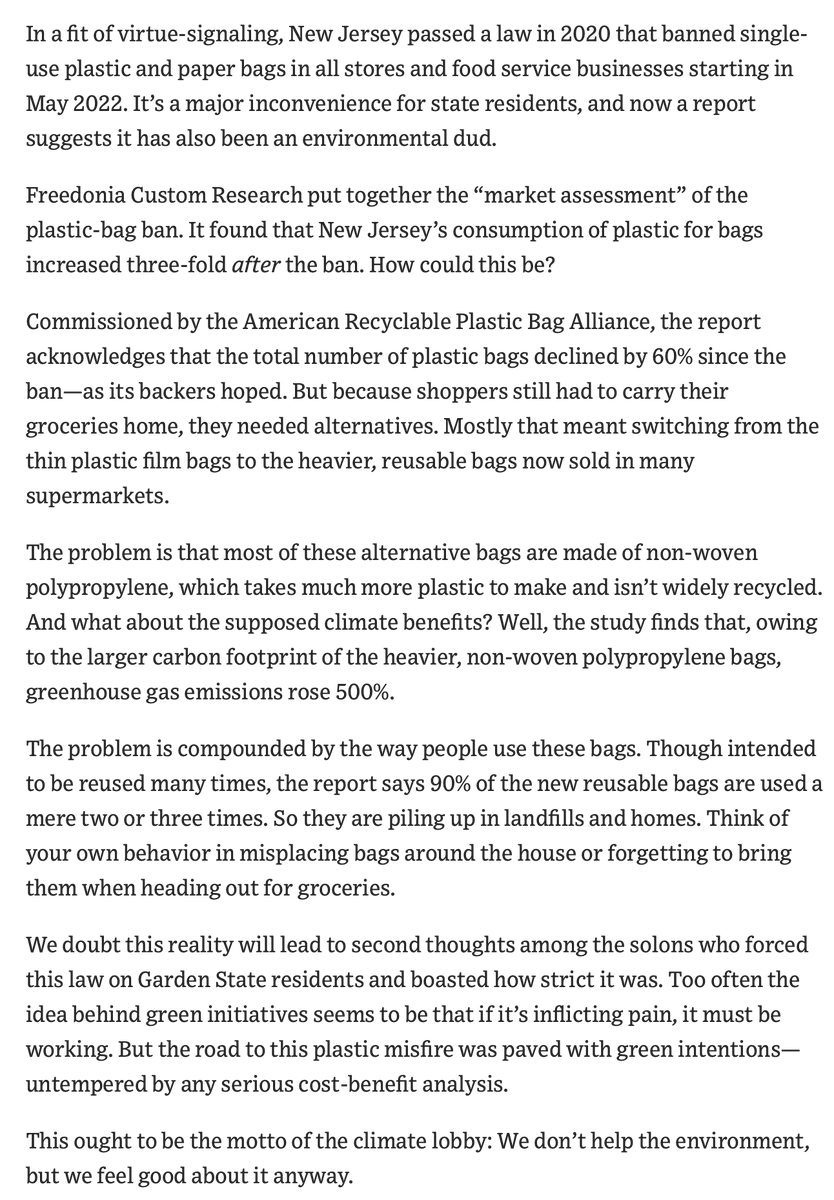
NJ banned plastic bags. Usage went down.
People chose alternative bags. Those bags have a larger carbon footprint.
Emissions rose 500%
Congrats everyone!
"This ought to be the motto of the climate lobby: We don’t help the environment, but we feel good about it anyway."
I waited a few days to post this out of respect, but I have a different take on the legacy of Charlie Munger.
His passing has inspired a lot of coverage on his partnership with Warren Buffet, much of it fawning, painting the duo not just as great investors, but also good people, and thus great capitalists. I push back on the latter claim, at least in the Emmersonian sense of capitalism, where meritocracy and fair play lead to “those who do good doing well.”
Munger and Buffet would have lost most of their wealth in 2008. Most people remember their role in the Great Financial Crisis as the rescuers of Goldman Sachs, making a timely investment that would net billions.
But Berkshire Hathaway went into that crisis heavily exposed to imperlied companies. Names like Wells Fargo and Amex made up 40% of its portfolio, and additional exposure came from its insurance holdings. The market knew all of this and responded by cutting the value of Berkshire’s own stock in half.
Things could have really spiraled for the duo—Buffet himself predicted the crash could have been worse than 1929—and that, as the saying goes, is how a capitalist cookie crumbles. In my definition of capitalism, those who live by the speculative sword can also die by it. Buffett and Munger made a lot of money on the way up but stood to lose badly on the way down.
But that’s not how things work, at least not for the kind of people who have the Treasury Secretary on speed dial.
The kinder interpretation of Buffett and Munger’s role in the subsequent intervention goes like this:
Concerned about the impact of the deepening crisis on everyone, they reached out to their contacts in government and convinced them to “do the right thing.” There’s even a famous anecdote of a late night phone call from Warren Buffet to Hank Paulson. The powers that be responded, and the economy was saved.
Here’s a different interpretation: a politically connected billionaire on the verge of losing his shirt called a government official—one who used to be the CEO of the company he now owned a chunk of—and convinced him to use taxpayer funds to prop up the stock market, particularly his stocks.
The facts of what happened aren’t in dispute, Secretary Paulson rallied other policymakers into investing hundreds of billions of dollars into companies like Goldman, Wells Fargo, and American Express. Small businesses and individuals who were also in distress got nothing.
History now views the bailouts as the correct course of action, but history is written by the winners. As if to remind everyone of this, Munger would later go on an epic rant, telling ordinary people that they should be grateful for the bailouts, but also against government handouts. Handouts are for the losers.
Campaigning directly for policymakers to intervene wasn’t Warren Buffett’s only contribution to the government response. He also went on CNBC after making the Goldman deal—but before congress decided to bail out the banks—and said “If I didn't think the government was going to act, I would not be doing anything this week. I might be trying to undo things this week.”
Buffett and Munger are two of the most studied investors in history. Book stores used to have entire sections dedicated to them. When people like that threaten to start “undoing things” politicians listen.
A skeptic might argue that everyone would have suffered if the invisible hand of capitalism had not been checked by Washington. I agree.
But there are different kinds of rescues, some meant for shareholders and executives, others for savers and homeowners. Two years after the crisis, unemployment still hovered around 10% and America suffered a record number of foreclosures. Wall Street enjoyed record revenues and paid out record compensation.
Part of my frustration over all of this is personal. I knew people who had fallen on hard times back then and were struggling to keep up with their mortgage payments. Exhausted by endless harassment from collection agents, they decided to call a government hotline for struggling homeowners. To their dismay, the agent who picked up was an employee of their bank. The reconciliation offer that she made barely moved the needle.
Their bank? Wells Fargo, the beloved Berkshire holding that got $25b in direct bailout money and another $25b in special tax break the year before. The same bank that would soon be caught laundering money for Mexican drug cartels, then be embroiled in a historic fake account scandal.
Buffett and Munger were among its biggest shareholders the entire time.
Fifteen years later, the legacy of that period lives on in our politics. Both the progressive Occupy Wall Street movement and the conservative Tea Party movement began as a response to the bailouts, and perhaps the only thing the populist right and woke left agree on is the fact that the economy is rigged. The two most distrusted institutions in America are Congress and banking.
Charlie Munger was a vocal critic of crypto, a different kind of financial system that people like me believe will someday replace the legacy financial system and all its baggage.
He paid Bitcoin a surprising amount of attention and used a lot of four-letter words to describe it—sometimes in the same interview where he boasted about his beloved Wells Fargo. The more generous interpretation of his disdain is that he didn’t understand crypto or its disruptive potential.
Here’s a different interpretation: he understood it all too well.
Because money is a network good.
Liquidity feeds more liquidity. And eventually broad enough liquidity feeds stability, which makes it more usable. Which then feeds more liquidity.
It is similar to why we are here on this platform whether or not we like the recent owner.
Bitcoin can’t win or solve big enough problems at a $500 billion market cap. It’s to small, widely dispersed, etc. It is a venture money bet in that range. And without fees it would eventually be capturable. Bitcoiners are each small candles in a world of darkness, unconnected and volatile, with only small hubs, at $500 billion.
Like, my family and friends in Egypt? “Bitcoin”? Barely heard of it. Too volatile, too small, doesn’t matter, can’t help them day to day unless they put in a few hundred hours and get the laser eyes, and have enough financial privilege to absorb the price volatility and hold it for 5-10 years as a savings asset.
But when Bitcoin is 5x-10x bigger? And more widely dispersed and less volatile due to being further along in its venture journey of adoption? And having more media recognition with yet another all time high? That helps. The network of candles gets electrified and connected. Darkness becomes light.
Plus price is a market signal. A 5-year stagnant price is a negative signal. More specifically, bitcoin price has a lot of correlation with global liquidity. As long as bitcoin price rises with global liquidity, that is good. If bitcoin price fails to rise during rising periods of global liquidity, it is potentially a signal of network illness. Ongoing price increases are evidence of adoption and positive market signals, especially when adjusting for global liquidity. A good technology should increase in market size.
But it’s a good question. Despite being bullish, I have emphasized the FinCEN challenge rather than the presumed ETF price bump. People should keep their eye on the ball rather than get drugged with price bumps on their bags.
Humanitarians and freedom fighters, however, should not let price get in their way. Higher market capitalization and liquidity enables them, validates them, and is a necessary step along the way.
This retired police Chief (64) was run over “for fun” by two black guys last week, when he was out cycling.
The victim’s name was Andreas Probst.
His killers live-streamed their indescribably evil hit-and-run. Watching it will make your stomach turn, but because the victim is white, the media won’t push a global campaign on his behalf and he’ll quickly be forgotten.
Let’s not let that happen and let’s demand that his murderer never sees the light of day again.
RIP, Andreas.
#JusticeforAndreasProbst
Even corporations enslaved to climate change cultism couldn't help but cast a fat, unattractive woman to portray Mother Nature, a character written as a huge bitch arrogantly making environmental demands.
From Wikipedia:
- Gadsden intended his flag as a warning to Britain not to violate the liberties of its American subjects.
- The rattlesnake was a symbol of the unity of the Thirteen Colonies at the start of the Revolutionary War.
- The flag has been described as the "most popular symbol of the American revolution."
- The design proclaims an assertive warning of vigilance and willingness to act in defense against coercion.
- The flag is associated with the ideas of individualism and liberty.
How is the Gadsden Flag racist?
A brilliantly posed question.
Personally, as an adult I respect bodily autonomy and integrity of self.
I therefore also reserve the right to personally make informed decisions for my children until they are of legal age.
This includes 💉& surgery.
@BitcoinPierre Now they are saying that the anonymity has been cracked. Well it was never anonymous in the first place. It's a public ledger. We're so early. https://t.co/A9Q93ibTIa
James Zhong stole 50,000 bitcoins and hid them for years. When the trove hit $3 billion, U.S. authorities caught up with him—by cracking crypto's anonymity. https://t.co/czE0MeNdnq