Markets reward data, not narratives.
Web3 & Macro Analyst | Analyst at FundersVC
Tracking institutional flows, RWA, on-chain activity, and macro trends to find where capital moves next.
Creator of DeFi Radar - real-time smart money tracking.
Raw data over noise.
A pro-crypto environment can remove barriers, but it cannot create demand overnight.
This chart is a good reminder that better regulation and better market performance are two very different things.
This chart is less about the president and more about the gap between expectations and market flows.
A more pro-crypto political setup raised expectations for digital assets.
But since Jan 20, capital has moved more confidently into silver, gold, Nasdaq, and the S&P 500, while Bitcoin, Ethereum, and altcoins remained under pressure.
The point is not that politics does not matter. It does, especially for regulation, product approvals, and institutional access.
But short-term performance still depends on where capital actually goes. In this period, investors preferred metals and equities, while crypto did not receive the same level of demand.
@FundersVC is expanding far beyond traditional venture investing. From @xroboticsio and robotics to @incard, @syntropia_ai, and @renesisfi, the portfolio reflects a broader strategy combining capital, product expertise, market access, and hands-on support.
Our summer team offsite was a good reminder of how much @FundersVC has evolved over the past six months.
Over this period, we kept building across several directions: venture investments, liquid strategies, hands-on support for portfolio companies, and ecosystem activity.
The portfolio also grew through new investments, including Orion VC, @xroboticsio , @incard , @syntropia_ai , and @renesisfi.
One important milestone was XRobotics, Funders’ first direct investment in robotics. This expands our focus beyond traditional software and fintech into automation, hardware, and operational technologies.
The ecosystem side was also active. In the first half of the year, we:
• hosted events together with @Cointelegraph , @yield_network , @inkonchain , and other partners;
• joined the @StarknetFndn Mentorship Program as mentors;
• took part in Doers Summit as judges;
• attended Ampere’s event in Limassol;
• attended the @web2wave_com event in Cyprus;
• broadened our international network.
We also worked directly with portfolio teams, including meeting the Incard team in London to discuss geographic expansion, marketing and media strategy, and the product roadmap for core customer segments.
There were also important portfolio updates:
• @Kamelpay reached a regulatory milestone in the UAE;
• @RapydGlobal was named among the World’s Top Fintech Companies for the third year in a row;
• @Asterizm_layer strengthened its omnichain infrastructure through @Cardano_CF and @CantonNetwork integrations;
• @APXLending grew its operations across Canada, the US, and Europe.
For us, these updates reflect the broader direction of Funders: combining capital, product expertise, market access, and hands-on portfolio support.
It’s difficult to capture everything in a single post, so the Funders team is working on our first newsletter, where we’ll share our biggest milestones and the stories behind them.
A big thank you to our partners, portfolio founders, and everyone who has been part of this journey.
More soon.
@FundersVC
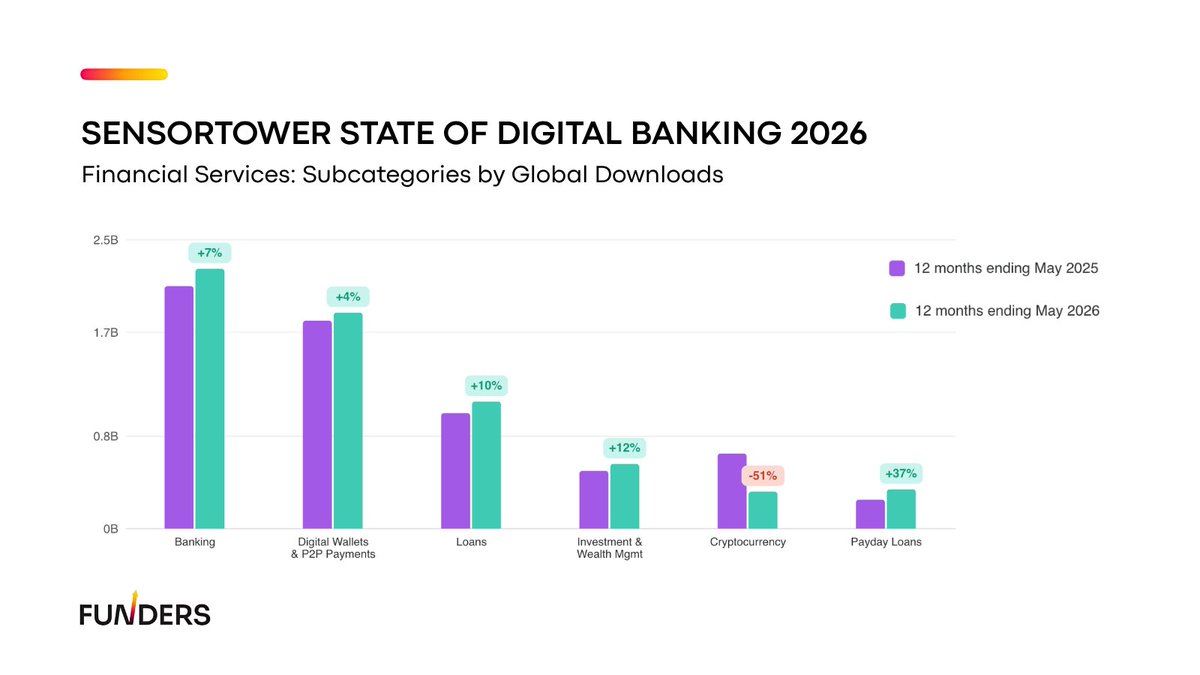
Fintech growth is shifting from general banking to specific financial needs. While banking apps still lead at scale, faster growth is coming from payday loans, investing, and loans, showing users increasingly download apps to solve a clear financial problem today.
According to Sensor Tower’s State of Digital Banking 2026 report, banking apps remain the largest category in B2C fintech, with around 2.3B downloads and +7% YoY growth.
But the faster growth is coming from products tied to a specific financial need:
→ Payday Loans +37%
→ Investing +12%
→ Loans +10%.
→ Wallets grew only 4%, while crypto declined by 51%, becoming the only major segment with negative growth.
This shows that the basic banking experience has already become familiar.
An account, a card, and a mobile app still generate large volume, but they are no longer enough to explain new downloads on their own.
Users are less often looking for another bank and more often coming with a specific task: to borrow money, start investing, access credit, or manage personal finances.
For B2C fintech, this changes the focus.
Earlier, neobanks could grow through a better interface, simpler onboarding, and the absence of legacy infrastructure.
Today, higher growth is more visible in categories where the product is tied to credit, investing, or liquidity management.
Crypto looks like a separate signal in this context: the retail speculative cycle in apps has cooled, while user interest has shifted toward more practical financial use cases.
Source: Sensor Tower, State of Digital Banking 2026.
Tokenized stocks have reached $2.4B in market cap across 13 chains, according to @artemis.
Market share leaders:
@BNBCHAIN : 33.5%
@ethereum : 31.4%
@solana : 24.0%
Together, the three largest chains account for 88.9% of the tokenized stocks market cap.
The second layer is much smaller:
@avax : 6.8%
@arbitrum : 1.4%
@RobinhoodCrypto : 1.1%
@StellarOrg : 0.7%
@base : 0.5%
@0xPolygon : 0.3%
@inkonchain : 0.2%
For now, the tokenized stocks market is already multi-chain, but most of the liquidity and market cap remain concentrated on BNB Chain, Ethereum, and Solana.
$USDT activity on @Plasma is showing a notable shift. According to @Artemis, Daily Stablecoin DAU reached a new ATH, suggesting user activity is accelerating. The key question now is whether $USDT on $XPL can sustain this momentum beyond the initial breakout.
USDT activity on @Plasma just reached a new high.
According to @Artemis, solana:Es9vMFrzaCERmJfrF4H2FYD4KCoNkY11McCe8BenwNYB on Plasma’s Daily Stablecoin DAU hit a new all-time high of 79.71K.
What stands out on the chart is the change in pace.
For most of the period, activity stayed in a much lower and relatively stable range.
Then, at the end of July and beginning of August, Daily Stablecoin DAU moved sharply higher and broke out to a new ATH.
It is still too early to say whether this becomes a sustained trend.
But the spike is worth watching, especially for a network focused on stablecoin activity.
The next thing to track is whether solana:Es9vMFrzaCERmJfrF4H2FYD4KCoNkY11McCe8BenwNYB on plasma:native can hold this higher level of daily users after the initial move.
@renesisfi@FundersVC@enzymefinance Wishing you the best of luck! Hope this turns into an amazing partnership. Looking forward to seeing what's ahead! 🙌
Congratulations to @renesisfi and @enzymefinance on this partnership. It's always encouraging to see teams joining forces to strengthen the DeFi ecosystem. Looking forward to seeing what this collaboration brings and the value it creates for users.
The State of Solana Memes This Week
> Market Cap: $2.7B (-1.4%)
> Trading Volume: $415.19M
The meme sector is cooling after recent momentum, but sustained trading volume indicates capital hasn’t left the ecosystem.
Exploring vast open world game environments offers a unique sense of digital freedom and relaxation. Discovering hidden map secrets keeps gameplay fresh for endless evening hours. #OpenWorld#Gaming#Gamer#PCGaming#Console
Total stablecoin market capitalization hovers near historic highs as dollar backed digital assets continue recording heavy global settlement activity across multiple public networks. #Stablecoins#Crypto#DeFi#Finance#Payments
AI infrastructure is entering a more selective phase. Weakness across @Samsung, @SKhynix, and @SanDisk suggests the market is no longer rewarding exposure alone. Future winners may be defined by sustainable execution, not simply participation in the AI buildout.
AI infrastructure stocks are facing a broader reset.
The pressure is now visible across several parts of the AI hardware stack: memory, storage, and chip names that became major beneficiaries of the AI infrastructure trade.
@Samsung and @SKhynix sold off sharply in Korea, while the KOSPI posted one of its steepest declines in years. In the US, @SanDisk has become one of the clearest examples of how fast sentiment can reverse in AI-linked hardware.
The market is not rejecting AI demand itself.
It is questioning the price already paid for that demand.
Three concerns are driving the repricing:
• Whether AI infrastructure spending can keep justifying current valuations.
• How much of the buildout depends on aggressive financing structures and supplier-backed deals.
• Whether rising Chinese competition can pressure the scarcity narrative in memory and chipmaking.
This is the more important signal.
AI adoption may continue, but the infrastructure trade is moving into a tougher phase.
Investors are starting to separate real long-term demand from crowded positioning, stretched valuations, and capex stories that still need to prove their returns.
The latest DeFi Lending & Yield data from @artemis suggests capital is becoming increasingly selective. Strong gains across $EUL, $FLUID, $CVX, $PENDLE, $MORPHO, and $SKY contrast with $KMNO, showing that investors are rewarding execution rather than the sector alone.
DeFi Lending & Yield is showing one of the clearer capital rotations in the 30-day snapshot, according to @artemis
Category leaders over the past month:
ethereum:0xd9fcd98c322942075a5c3860693e9f4f03aae07b : +49.1%
ethereum:0x6f40d4a6237c257fff2db00fa0510deeecd303eb : +33.2%
$CVX : +25.1%
ethereum:0x808507121b80c02388fad14726482e061b8da827 : +16.8%
ethereum:0x58d97b57bb95320f9a05dc918aef65434969c2b2 : +12.5%
ethereum:0x56072c95faa701256059aa122697b133aded9279 : +12.2%
Two more assets also posted positive performance over the same period:
ethereum:0x57e114b691db790c35207b2e685d4a43181e6061 : +8.4%
ethereum:0xc00e94cb662c3520282e6f5717214004a7f26888 : +6.0%
At the same time, the move did not cover the whole segment. Among the assets shown, solana:KMNo3nJsBXfcpJTVhZcXLW7RmTwTt4GVFE7suUBo9sS was the only one with negative 30-day performance, down 9.3%.
Scaling starts with clarity, not speed. At @FundersVC, ProLab views startup audits as a way to validate business logic, acquisition, operations, and product behavior before growth. The right questions today can prevent expensive mistakes tomorrow.
4 Practical tools forstartup audit in 2026 by ProLab
ProLab is the product studio inside @FundersVC. We help the projects we support review product logic, early metrics, user flows, operational processes, and the assumptions behind the business model.
For many founders, the first question is not how to scale faster, but whether the current project structure is ready for the next stage.
For an MVP, this may mean checking basic assumptions before there is meaningful traffic or revenue.
For a more mature product, it may mean understanding where users, budget, or internal processes are already becoming inefficient.
Below are four areas that are useful to review during a startup audit.
1. Business model and financial assumptions
At an early stage, financial planning is often built on assumptions: expected pricing, acquisition cost, margin, runway, payback period, and future unit economics.
These assumptions do not need to be perfect, but they should be visible and testable. If the model only works under an optimistic scenario, founders need to understand that before making further decisions.
A practical tool example: Claude Financial Analysis plugin and Model Builder agent can help structure financial assumptions, review spreadsheet logic, build scenario views, and make weak points easier to identify.
They do not validate the business model automatically, but they can make the financial logic clearer before the team moves forward.
2. Acquisition logic
Not every startup has traffic yet. But every startup should understand where its first users are expected to come from.
For early teams, this means reviewing the logic behind acquisition: target audience, expected channels, user quality, and the assumptions behind each source of demand.
For products that already have early traffic or paid tests, this becomes a channel quality review: which sources bring useful users, which create low-quality signups, and where spend may be underperforming.
A practical tool example: BlueConic Acquisition Pressure Test can help teams review acquisition channels and understand where marketing spend may be leaking.
3. Internal operations
Early teams often rely on manual work: forms, spreadsheets, CRM records, Slack messages, email threads, and scattered notes.
This is normal at the beginning. The problem starts when leads, requests, feedback, or user data begin to get lost between tools and people.
Founders should check whether the team has a clear process for collecting information, assigning ownership, following up, and keeping data consistent.
A practical tool example: n8n can help connect CRM, forms, email, Slack, and other tools into automated workflows. This makes it easier to see where repetitive processes break or slow down.
4. Product behavior
Even an MVP can be reviewed through user behavior.
The goal is not to build a complex analytics stack from day one, but to understand how real users interact with the product.
Where do users hesitate?
Which steps create friction?
Which features are ignored?
Where does onboarding become unclear?
A practical tool example: Microsoft Clarity can help with heatmaps, session recordings, and behavior insights. For early products, this can be enough to identify basic UX issues before the team invests more time into acquisition or development.
Startup audit is not about adding more tools.
It is about understanding whether the product, financial logic, acquisition assumptions, and internal processes are ready for the next stage.
ProLab
Funders VC Product Studio