I did say we'd be releasing our models periodically...introducing Gemini 4 Carbon, our next frontier model.
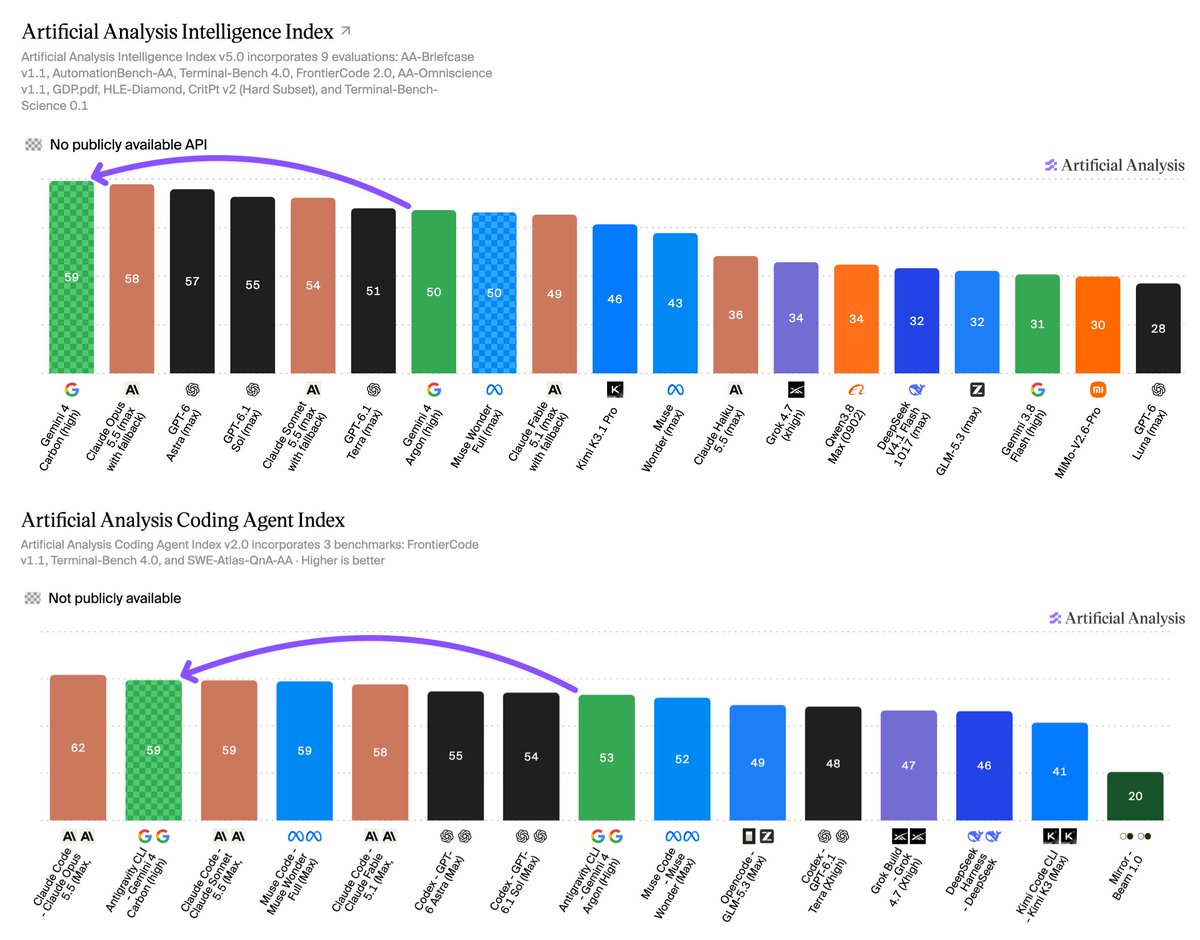
Following Argon's release just two weeks ago, Carbon shows the pace at which we’re pushing the frontier, it ranks #1 on the recently updated v5.0 of @ArtificialAnlys Intelligence Index at 59. It also leads across key cybersecurity evaluations scoring 88.2% on SEC-bench Pro for finding vulnerabilities, 54.8% on ExploitGym for exploitation, and 71.0% on CWE-bench for patching.
We’re seeing significant improvements in long-horizon tasks even compared to Argon, and we’ve strengthened frontier safeguards.
As we did with Argon, we’re going to roll it out gradually + responsibly. Some trusted cyber defenders will get access starting this week. We'll be expanding it to more partners through our Fairwind Program, ahead of wider availability soon, so hang tight!
Google’s Gemini 4 Carbon is the new #1 on the Artificial Analysis Intelligence Index v5, and second only to Claude Opus 5.5 on the Artificial Analysis Coding Agent Index
Gemini 4 Carbon scores 59 on Intelligence Index v5, driven by leading performance in complex reasoning, knowledge, and scientific tasks. It also has large gains in coding and knowledge work, particularly when compared to other Gemini models, but it is not leading in all these areas.
As with launch of Gemini 4 Argon, Gemini 4 Carbon is being rolled out to selected users and is not yet publicly available. Google is offering a 50% launch discount, with no confirmed end date. All our charts and figures use standard pricing for both Gemini 4 Carbon and Argon.
Key results for Gemini 4 Carbon with high reasoning:
➤ Gemini 4 Carbon leads the Intelligence Index v5, with the #1 score in 4 of the 9 Index evaluations: HLE-Diamond, Terminal-Bench-Science, AA-Omniscience, AutomationBench-AA. Carbon makes substantial gains elsewhere but is not leading in coding and knowledge work
➤ Behind only Claude Opus 5.5 on coding agents: With Antigravity CLI, Gemini 4 Carbon (high) scores 59 only 3 points behind Claude Code with Claude Opus 5.5 (max, 62) on the Artificial Analysis Coding Agent Index. Carbon ranks second on both Terminal-Bench 4.0 (64%) and FrontierCode v1.1 (51%), behind Claude Opus 5.5 (max) at 56%. Google has historically underperformed in this area and so this improvement stands out
➤ Improved agentic knowledge work, but not yet leading: On AA-Briefcase, Gemini 4 Carbon (high) scores 1609 Elo, a 126-point improvement over Gemini 4 Argon (high, 1483), but still behind models including Grok 4.7 (xhigh, 1638), Muse Wonder (max, 1659) and Kimi K3.1 Pro (1678). The largest gain comes from Presentation, up 293 Elo to 1598, alongside a 120-point improvement in Analytical Quality to 1671
➤ Lower Cost per Task than Claude Opus 5.5 for comparable overall intelligence: Gemini 4 Carbon costs $7.76 per Intelligence Index task, ~23% less than Claude Opus 5.5 (max, $10.04) but ~1.2x GPT-6 Astra (max, $6.25). It uses 123k output tokens per task, 29% fewer than Claude Opus 5.5 (max, 173k). At the same $4/$20 standard pricing, its Cost per Task is in line with Gemini 4 Argon ($7.68), while scoring 9 points higher on the Intelligence Index
➤ Leading AA-Omniscience v1.1 score, with low hallucination: Gemini 4 Carbon scores 54 on our recently updated AA-Omniscience v1.1, 6 points ahead of Claude Opus 5.5 (max, 48) and 8 points ahead of Gemini 4 Argon (46). Accuracy (% correct) rises 10 points over Argon to 58%, while its hallucination rate rises from 4% to 11%. This is still the second lowest of any model, behind only Argon, compared with 50% for both Claude Opus 5.5 (max) and GPT-6 Astra (max)
Key model details:
➤ Context Window: 1M tokens
➤ Multimodality: Text, image, video, and speech input, with text output
➤ Pricing: $4/$20 per 1M input/output tokens, the same as Gemini 4 Argon’s standard pricing, with a 50% discount. Cached input tokens receive a 95% discount ($0.20 per 1M)
Congratulations to the @GoogleDeepMind team!
This is an incredible moment in this history of mathematics, computer science, physics & science with some of the hardest problems in human history being solved by AI over a period of weeks. Depending on your perspective, it's either a crisis, a triumph, or both. I don't think anyone knows for sure. We're all trying to make sense of it. I oscillate between fear/dread and optimism/excitement on a daily basis. The rate of progress is insane, including today's announcement from OpenAI of more problems solved.
To help make sense of all of it, here's my conversation with three mathematicians about this moment. Each of them is an expert in the field of each of the biggest problems solved: Navier-Stokes, quasi-Riemann hypothesis, the unique games conjecture and complexity theory more generally.
Ankur Moitra is a mathematician and theoretical computer scientist at MIT, visiting the Institute for Advanced Study in Princeton. Steven Brunton (@eigensteve) is a mathematician and fluid dynamics expert at UW. Alex Kontorovich (@AlexKontorovich) is a mathematician at Rutgers specializing in number theory.