Thanks for sharing these important works, DaS and FlexAM!
I think UniAction addresses a different core research question.
UniAction is motivated by the question of how heterogeneous action data can be jointly learned within a single model. To this end, we introduce a unified action-conditioning mechanism that allows diverse action types, including applied forces, camera commands, hand poses, and robot poses, to directly condition video generation without first converting them into a common motion representation.
For example, for force conditioning, we directly specify the application point and direction of the force, letting the model predict how the object responds. For camera control, we use discrete keyboard commands directly, without requiring predefined 3D trajectories. This differs from the setting of DaS/FlexAM, which uses tracked 3D point motion to control video generation.
Furthermore, we investigate whether different types of action data can benefit from joint training. Our experiments show that a single jointly trained model outperforms separately trained action-specific models.
We will also include citations to and discussion of DaS and FlexAM in a future revision to better clarify the connections and distinctions between these works.
Thanks again for sharing these papers and for your thoughtful suggestion!
🌍 Actions that condition world models are highly heterogeneous: forces on objects, camera movements, hand motions, robot arms, each with its own meaning and structure. So today's action-conditioned world models are usually built one action type at a time, each with its own conditioning design.
We introduce UniAction, a unified action-conditioning framework: one world model driven by all of these actions, and even by mixes of them in a single generation. Trained jointly, it outperforms the action-specific experts. Great work led by amazing @BowenXue_ .
More detailed threads below👇
🧵 1/10
FreeVideo + FreeToken will enable a fully automatic pipeline for short-drama generation: use VLMs to write prompts and design storylines, generate high-quality videos and visual assets with FreeVideo, and orchestrate the whole workflow with FreeToken. Really excited about what this can unlock for automated short-drama creation!
Huge thanks to @BowenXue_ and @HaochengXiUCB for making this happen!
Video generation now runs right on your laptop. 🎬
Introducing FreeVideo — bringing MiniMax H3 + Video DeltaNet to the hardware you already own.
As little as 8GB VRAM + 16GB RAM. ComfyUI integration, LoRAs & custom workflows.
Code: https://t.co/sIKSsAuOGw
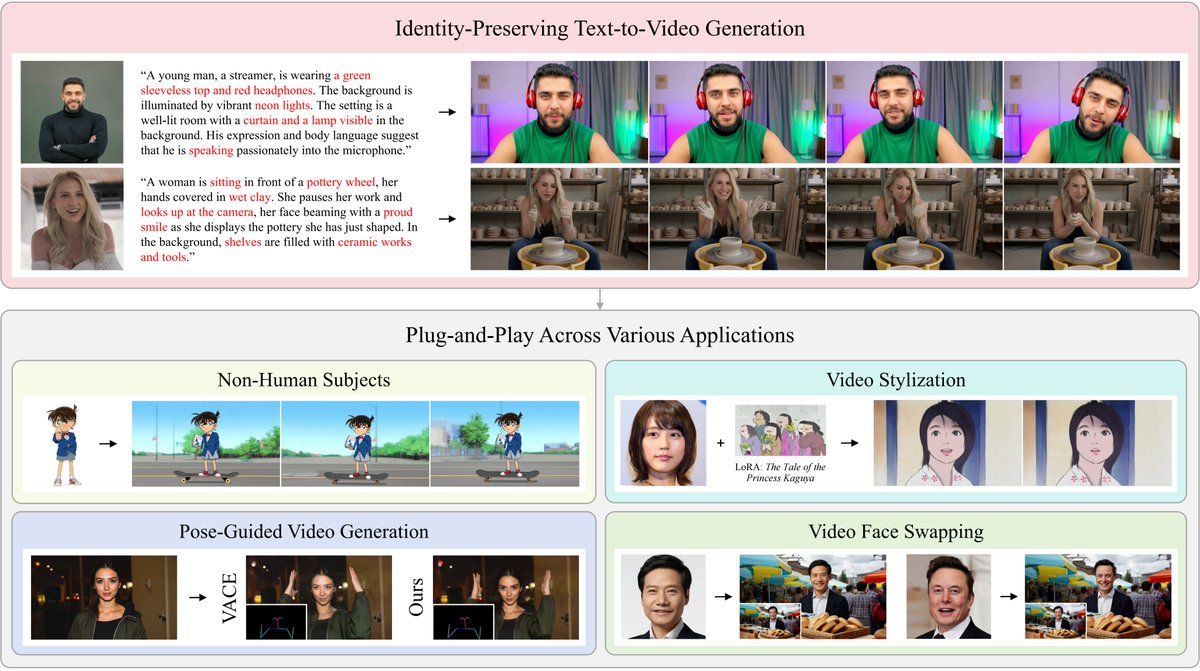
Tencent's WeChat Vision just released Stand-In!
A lightweight, plug-and-play framework for high-fidelity identity-preserving video generation.
It achieves state-of-the-art results with only ~1% extra parameters.
Tencent open source Stand-In:
a lightweight, plug-and-play framework for identity-preserving video generation.
Can be seamlessly integrated into other tasks such as subject-driven video generation, pose-controlled video generation, video stylization, and face swapping.
Stand-In just landed on the hub 🔥
✨identity preserving video generation
✨lightweight LoRA with minimal affect on latency!
✨apache 2.0 license
plug-and-play approach, LoRA weights for Wan 2.1 available 👇
It can also be seamlessly integrated into other tasks such as subject-driven video generation, pose-guided video generation, stylization, and face swapping.
Excited to share our recent work at Tencent — Stand-In, a lightweight, plug-and-play framework for identity-preserving video generation.
🔗 Code: https://t.co/UhYN47jtVf
🌍 Project Page: https://t.co/DItmBG45NI
📄 Paper: https://t.co/KiWXUxMDAr
We introduce a conditional image branch into pre-trained video generation models, combined with restricted self-attentions enhanced by conditional position mapping, to achieve precise identity control.