@tomfgoodwin The biggest research project I ever did for my house was to get new windows. A dozen installation companies and half that many manufacturers, all spreadsheeted out on cost, quality, and reviews. I was happy with the result, but man, it felt like a second job for a while.
@RickFOP86 It is dumb to close traffic courts, but if the goal is to reduce traffic and pedestrian fatalities, how about the Legislature stops banning Indy from installing red light and speeding cameras?
Indianapolis, the largest city in a state with a metro population of 2.2 million, gets just three trains per week, yet that same state is willing to spend $1 billion on a football stadium for 8 events a year.
@UrbanCourtyard You should see the urban context around our Palladium. I call it the Cultural Mushroom because it stands out surrounded by low density development except for one large Ransom Note style mixed use building.
NEW: state Rep. Don McLaughlin says New World Screwworm within 1 mile of Texas border and urged state leaders to set up response modeled after Operation Lone Star.
Says the federal government is "failing to take seriously a threat that could devastate our livestock industry."
Indy can have anarchy or urbanism. But not both. People like Brett Scrogham should still be alive. We cannot after school program our way out of this. We need to put away violent and repeat offenders for good.
https://t.co/wjbngK8Gcw
The reason Japan can have great trains is not high trust. It's LACK OF VIOLENT CRIME. If you have even moderately high levels of violent crime, people will want to drive instead of taking the train. You can't have trains without suppressing violent crime.
Because San Francisco refuses to build housing and so most service workers have to travel up to two hours each night back into exurban exile in e.g. Solano County and Contra Costa County.
@mattyglesias Unlike many projects at the time, these had a diversity of middle class residents and were not chiefly conceived as concentrators of poor people.
stop what you're doing and listen to @Gladwell's latest podcast with Stephen Smith (friend of Courtyard Urbanism), undisputed king of elevator reform in North America.
Stephen's argument is that American elevators are far more expensive than they need to be (than they are in Europe), largely owing to bad code and labor rules.
Effectively, the high cost of elevators means that small apartment buildings face a huge fixed cost once they are required to include an elevator (whether it's a legal requirement or a market requirement).
Instead of producing many small, fine-grained multifamily buildings (the kind that make great courtyard blocks), high elevator costs (along with other gratuitous fixed costs) push developers toward larger buildings that can spread elevator costs over many more units.
No urban revival without elevator reform.
@north0fnorth The average American lives in a metropolitan area named after the major city at its center. Municipal borders within those areas are only meaningful to locals. I live in a suburb of Indianapolis, but as far as the rest of America is concerned, I live in Indianapolis.
No urban revival without stair reform.
Great cities need middle housing -- ie MANY small multifamily buildings that allow many households to share expensive urban land. But those homes still have to be good enough that a wide range of households want to live in the. Not just twenty somethings.
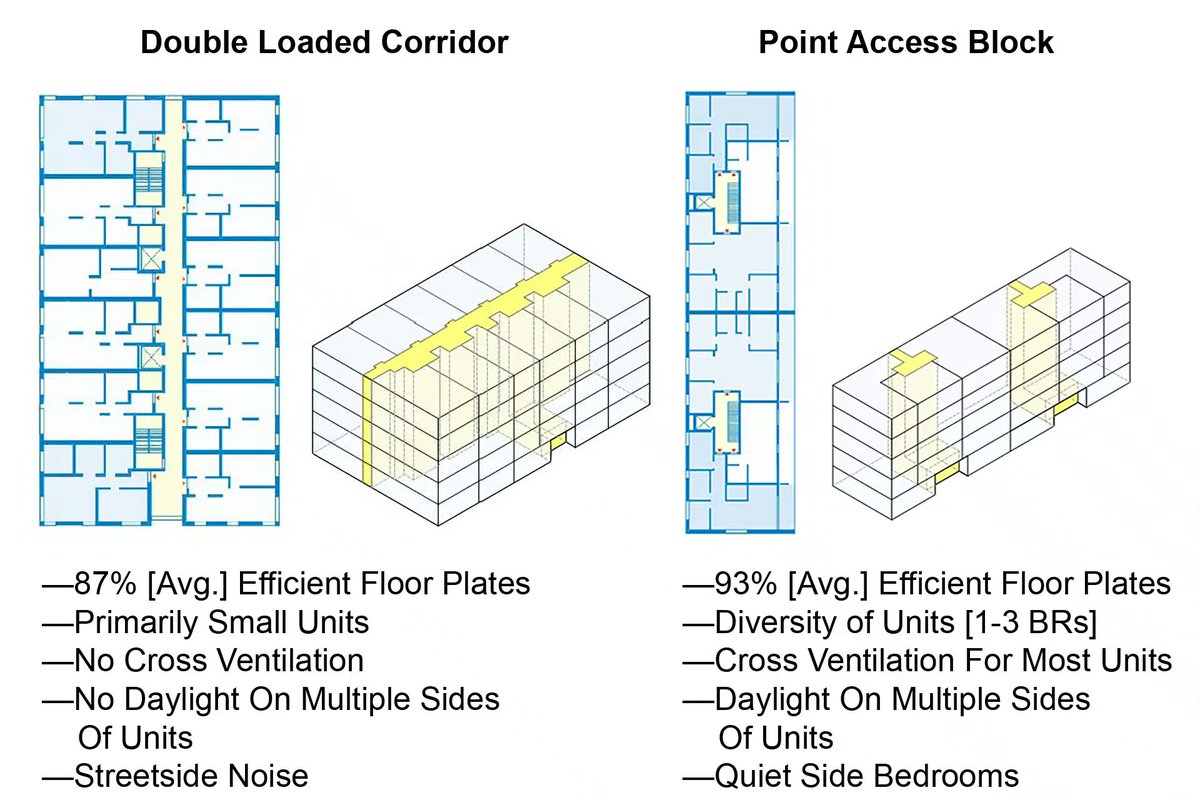
Current egress rules have made multifamily housing ESPECIALLY awful in the US because they push developers to double-loaded corridor layouts: long, hotel-like hallways with apartments lined up on both sides. These buildings are extremely expensive to build and not great at creating "life-cycle" housing.
Families often want a home with a “front” and a “back”: one side connected to the street and the life of the neighborhood, and another quieter side facing a courtyard, garden, yard, or shared green space. They want cross-ventilation, daylight from more than one direction, a place for children to play, and some sense of threshold between public and private life. Double-loaded corridor buildings make that impossible, because units are facing either the back or the front.
The more home-like form of multifamily is enabled by single-stair reform, sometimes called “smart stair” reform and closely related to the point-access block. instead of accessing units from a long corridor, apartments are arranged around a central stair. This allows smaller buildings, shallower floorplates, more dual-aspect units (they don't all need to be, but some of them should be), better light and air, and a much closer relationship between the home, the street, and the yard.
Single-stair reform is a keystone reform for rebuilding family-friendly urban neighborhoods. It will make it significantly easier to build the fine-grained, middle housing neighborhoods that everyone wants but no one builds anymore (because we made it illegal)
@AlecStapp Better yet, let them pay their property tax bills with a low-interest home equity line of credit set up or guaranteed by the state. That way, the state gets their money on time and there's no tax bill to settle in probate.
@mnolangray@mottsmith If California wants to run referenda on ways to raise revenue and increase the supply of housing, they should start with repealing Prop 13 and replacing it with a mechanism for senior homeowners to pay property taxes with low-interest credit against equity.
@awkwardgoogle The green space looks nice from afar, but how much do Bostonians use it? Is it inviting to walk to or is it isolated by stroads and channels? Does it have amenities like cafe's and restrooms and playgrounds or is it mostly concrete planters and open lawns?