Your browser and our canvas speak the same language.
Capture any live page into Wonder as editable layers, polish it, ship it back as code. No screenshots, no redraw, no translation.
Wonder Capture is live today.
Launching https://t.co/8Oa97AOJEe out of stealth
Drop started as a side project around a simple idea make it easy for anyone to sell food.
1. Cook + post
2. Customers purchase through a link
3. Get paid in stablecoins + customers pick up their food
But there’s a bigger shift happening underneath it. Food has gotten expensive. Restaurant prices are up, the Uber Eats / DoorDash tax adds another layer, and the cost of living keeps going up.
At the same time people are buying incredible food directly from home cooks and small sellers they discover on TikTok, Instagram, Facebook Marketplace and WhatsApp.
The problem is these sellers are running their businesses through DMs, spreadsheets, Venmo/Zelle and a patchwork of tools designed for traditional restaurants.
They need something much lighter. I think there’s an opportunity to build the operating system for the next generation of mom and pop food businesses, starting with payments, pre orders and CRM, and eventually becoming their neobank.
We’ve have ~30 sellers use Drop while in stealth. It’s now getting to the point where I want to take it much more seriously.
I’m looking for a pre idea startup of exceptional people who have experience in payments + restaurants/food and want to take this over and apply to Alliance
Jina is a fully autonomous AI QA Engineer
- Maps your code, infra, and issue history
- Traces the impact of any code change
- Runs your app to catch and fix issues
Jina outperforms static review agents, even catching what your engineers miss.
Sign up for access below
Launching https://t.co/bmxGkuzz0t a complete encyclopedia of on-chain products and experiments, both successful and failed dating back to 2013.
The idea is to bring back on-chain experimentation by studying everything that has failed, worked, or gone on to become an on-chain unicorn.
Every product includes its full history, what went right, what went wrong and an interactive simulator where you can adjust key variables and see how the product reacts in real time
Also built an on-chain primitive generator using GPT and data collected from more than 450 products and experiments. It combines ideas across crypto history to generate new product concepts for you to explore + share on X
The goal is to help founders learn from the past and get inspired to build the next on-chain unicorn. There are so many primitives that have yet to be discovered.
It’s still V1, so reply back with any feedback.
The most important decision you can make is what market you’re in. It’s more important than the team or the product.
You can have the best team, and the best product, but if there’s no market you’re not going to do well.
But if you’re in a great market with an average team and an average product, the market will pull you to scale. The market determines success.
Choose the right market.
There’s a natural founder tendency to dislike VCs who reject them. That’s not smart. It’s counterproductive.
Instead founders should embrace the rejection, deeply understand and question what the VCs concerns were.
Dedicate the last 5min of a call to asking: wdyt about my company, and what are your top 3 red flags? and not just brush them off as: they don’t know anything/VCs suck.
Founder hate towards VCs is an age old concept and the best founders embrace that feedback as a data point to improve.
VCs actually have excellent market insight, they understand history quite well: what has worked what hasn’t and they can see flaws in your thinking from other cases. They can also see where your thinking is sound.
Use that, don’t brush it off.
Qualities of a serious founder:
1. Shows up to meetings 2min early
2. Is never late
3. Responds quickly
4. If they can't respond quickly, they tell you when they can respond
5. Is always prepared
6. Is focused and present
7. Asks questions
8. Admits when they don't know something
9. Is extremely detailed
10. Is reliable to customers, investors, employees
11. Takes care of their health
12. Looks presentable
13. Is psycho focused on making customers happy
14. Hires people who are smarter than them
15. Actively reads books/continuous learning loop
What else am I missing?
Competition is for losers has been more true. It has never been easier to compete and therefore lose.
Why most companies will die of competition faster than ever:
1. The cost of building software has never been lower.
2. This results in a surge of companies building the same products, for the same ICP.
3. This coupled with VC being more available than ever creates a hyper competitive environment where it is exceptionally difficult to compete. You have to have more than a great product and VC money to win.
Services have turned into software. And software has turned into a commodity. If you’re building a pure software company, you’ve opened yourself to an insane amount of costs, competition, and undifferentiated “how are you different from X?” questions.
DISTRIBUTION IS KING
That's why you need a 10x stronger distribution moat compared to your competition, or something others can't do as easily.
As an example, regulated startups (fintechs) used to have a moat because of the regulation.
But today you can launch a neobank with little regulatory oversight, and with <$50K in monthly burn. It is now 10x cheaper to launch a neobank compared to 10 years ago. The same can be said about most industries.
This hyper competitive environment is then quantified as:
1. A high CAC that's never been more expensive
2. As exponentially more companies are targeting the same ICP.
3. And it’s never been easier to reach that ICP given tools like Apollo, and automated AI emails do it for a fraction of the cost, with a fraction of the head count.
This makes it incredibly expensive to compete in a world of more of the same of everything.
“BUT THE MARKET IS HUGE! MY TAM IS UNLIMITED.”
YOU’RE WRONG.
Critics of the above may argue "oh but it's a massive market" which isn't true given each category (eg: AI CRM) is only as big as where the category is on the adoption curve, and how fast it’s moving into other parts of the adoption curve
For most software products we’re still at the evangelist/early adopter part of the curve. That’s only 15% of the total theoretical market. So no, your marketing AI CRM is not attacking the “$150B AI CRM market”. It’s attacking the $3.75B AI CRM market, at best $22B
This makes the TAM limited by definition today.
The market is only as large in relation to how far we are on the adoption curve. The further we are, the larger the market.
Who's to say you'll survive until the pragmatists? Where is your USP on the adoption curve?
COMPETITION IS FOR LOSERS.
So when a new startup comes out and has a great idea (eg: AI CRM) that false sense of information asymmetry (eg: Hubspot doesn’t have AI, let’s do a CRM + AI) is actually dead on launch, because you can have the incumbents, and 100 companies launch within a few weeks of you launching to close your seemingly unique “information asymmetry”, because it has a) never been easier to write code, and GTM b) VC has never been more available.
WHAT’S THE SOLUTION?
Asking Claude, and reading VC lists of "what we want to invest in 2026" is a lagging indicator. If investors “know” what the next trend is, you're already 6 months late to the trend.
Think: what will people do in 10 years from now that they don't do today?
The next big thing won’t be an AI CRM, or a prediction market, or a stablecoin company, or anything that looks like what it does today. It’ll be something we haven’t considered yet.
And more importantly, it has to be something where others can’t aggressively copy, and inflate your CAC. It’ll be something where what you do is unique, not easily replicable, and it solves a massive burning problem.
The one who wins will be the one that has an unfair distribution moat, or those that do something that's harder than building only software.
In a world of undifferentiated products, high CAC, and mega funding rounds, great products don’t win anymore.
Unfair distribution wins.
Avoid competition. Competition is for losers.
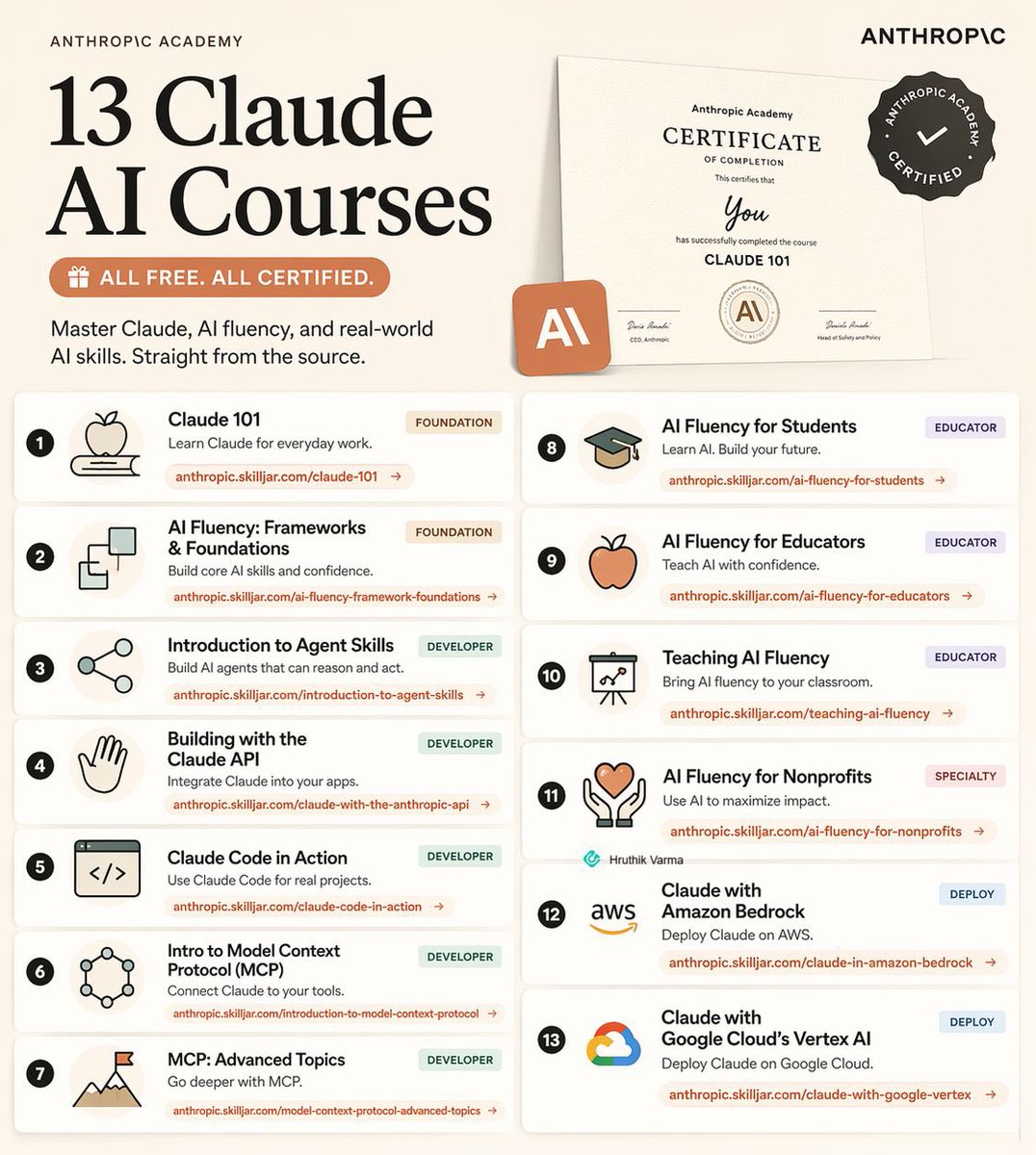
Claude just dropped 13 FREE AI courses (with certificates).
No $500 course needed.
No “guru” required.
Just real skills — straight from Anthropic.
Here’s the full list:
👇
1. Claude 101
https://t.co/lZpcdJ8BuX
2. AI Fluency: Frameworks & Foundations
https://t.co/USAV0Nq5U4
3. Introduction to Agent Skills
https://t.co/CwjLvjOnUi
4. Building with the Claude API
https://t.co/oquWGU6n0U
5. Claude Code in Action
https://t.co/r2r1GMiBaM
6. Introduction to Model Context Protocol
https://t.co/H74a7UKZoe
7. MCP: Advanced Topics
https://t.co/FGzNDboBUz
8. AI Fluency for Students
https://t.co/PKcYBT0hsx
9. AI Fluency for Educators
https://t.co/FwmI4bJ8sO
10. Teaching AI Fluency
https://t.co/IFGt8EQcvP
11. AI Fluency for Nonprofits
https://t.co/pZayqeTEdC
12. Claude with Amazon Bedrock
https://t.co/I9fpriI24s
13. Claude with Google Vertex AI
https://t.co/Kvz4uJqctq
—
If you go through even HALF of these…
You’ll be ahead of 95% of people using AI.
Most people won’t.
Because they’re still:
• Watching random YouTube videos
• Buying overpriced courses
• “Learning AI” without actually building
Don’t be that person.
Do this instead:
1. Save this post (you’ll come back to it)
2. Pick 1 course → start today
3. Share it with someone who needs this
Free. Practical. No excuses.
Introducing Inflowpay.
Collect one-time and recurring card payments from anywhere in the world. No punishing fees, no settlement delays, no chargeback hell, no local tax nightmares. Live in under an hour.
The first payment infrastructure built natively for a borderless world.
Right words can double the quality of responses you receive from #ChatGPT.
Meta has created an interactive guide covering prompt engineering for LLM.
Our favorite tip?
Ask for an explanation as if you are a beginner.
Find the full guide here: https://t.co/7qpwMABai9