1️⃣ Derrocar a un dictador suena moralmente justo. Nadie llora por un tirano. Pero el derecho internacional no se construyó para proteger a los buenos, sino para contener a los poderosos. Por eso prohíbe la fuerza casi sin excepciones: no porque ignore la injusticia, sino porque sabe que, si cada país decide a quién “liberar” a balazos, el mundo vuelve a la ley del más fuerte.
2️⃣ El problema no es Maduro. El problema es el precedente. Cuando la fuerza militar se usa para cambiar gobiernos sin reglas claras, la soberanía deja de ser un límite y se vuelve un estorbo. Hoy es “derrocar a un dictador”; mañana será “corregir una elección”, “proteger intereses”, “restaurar el orden”. El derecho no absuelve dictaduras, pero tampoco legitima cruzadas unilaterales.
3️⃣ La pregunta incómoda no es si un tirano merece caer, sino quién decide cuándo y cómo. Porque la historia enseña algo brutal: sacar al dictador es fácil; construir justicia después, no. Y cuando la legalidad se rompe en nombre del bien, casi siempre lo que sigue no es libertad, sino caos, violencia y nuevas víctimas. El derecho existe para recordarnos eso, incluso cuando incomoda.
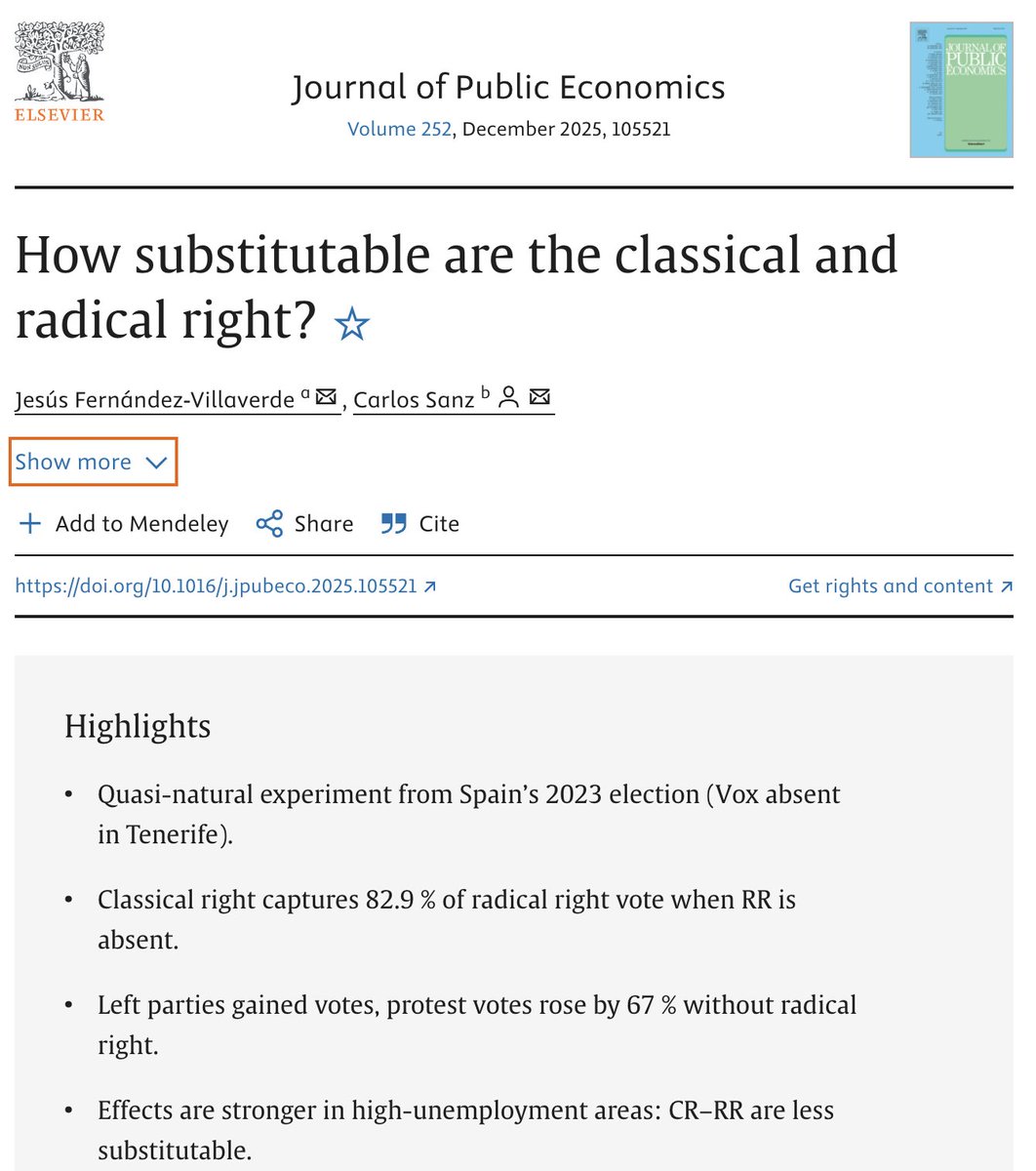
Very happy to see my paper “How substitutable are the classical and radical right?” with Carlos Sanz (at the Banco de España and CEMFI) published in the Journal of Public Economics.
The paper addresses a simple question: take a party of the classical right (e.g., CDU in Germany or PP in Spain) and a party of the radical right (e.g., AfD in Germany or Vox in Spain). Are these parties substitutes (i.e., voters think they are two slightly different flavors of the same political platform) or complements (i.e., voters think each party is sufficiently different from the other)? Note that the question is not whether the parties differ under an objective metric, but what the voters think.
The challenge is that using polls or surveys is difficult: voters of radical-right parties are reluctant to disclose their positions to pollsters. Repeated polling mistakes underestimating Trump’s support from 2016 to 2024 illustrate this point.
So, we take advantage of a quasi-natural experiment in Spain during the high-stakes July 23, 2023 general election. Vox, the radical party, failed to field candidates in one parliamentary constituency, Santa Cruz de Tenerife (Tenerife for short), due to a last-minute infight within the party over the positions on the list (Spain uses PR for its parliament's lower house). So, while Vox ran in all the other 51 constituencies, it could not run in Tenerife.
This was a genuine surprise for everyone involved, including Vox’s national direction and all the other parties that had filed candidates in Tenerife, who had assumed Vox would run.
As luck has it, Tenerife is close to being quite representative of elections in Spain: it elects seven members of the lower house under PR (so the scope for strategic voting is quite limited), it is not too left- or too right-wing leaning, and it has a moderate presence of a territorial party, as many other constituencies in Spain. Its demographics and socioeconomic conditions are also reasonably close to the median, and Vox’s local power infight was unrelated to any relevant variable that might have affected electoral outcomes.
We estimate the effects of Vox’s absence on electoral outcomes using a synthetic difference-in-differences model that controls as best as possible for all remaining differences between Tenerife and other constituencies.
Our main finding is that 82.9% of Vox’s voters in Tenerife switched to PP. So, yes, for a very large majority of voters, PP is a substitute (perhaps imperfect) of Vox. But, interestingly, it is not for 17.1% of voters, who either abstained or moved to other parties.
Moreover, this percentage of Vox’s voters not moving to PP is higher in precincts with low education, low income, and higher unemployment. For voters in less-favored precincts, Vox and PP are clearly two distinct political platforms.
Why is this so important? Because it shows that the total share of votes of the right increases when there are two right-wing parties on the ballot, a classical and a radical one, as they cater to similar but not fully overlapping demographics.
The PP leadership and many media commentators in Spain have repeatedly argued since 2023 that the PP’s failure to gain a parliamentary majority in the 2023 general election was due to Vox's presence. We argue that, given our estimates, there is no evidence of that. If we extrapolate the results in Tenerife to the rest of Spain (i.e., a counterfactual election without Vox), the PP would have still failed to gain a majority.
Of course, the paper has many more details (including tons of validation analyses and caveats about the possible limitations of our econometric exercise), so I invite you to read them.
Even more material did not come out of the cut room. Carlos and I could have written a whole monograph on this topic. For example, we have some suggestive evidence that this phenomenon of widening of the right share of the vote when a (electorally viable) radical-right party is on the ballot is present across all of Europe
Finally, a great thanks to the editor, @pereztruglia, who did a fantastic job, and the referees. Sometimes, papers do not improve much in the peer-review process. This time, it certainly did.
Se detestan la cultura del esfuerzo, el afán de superación, la búsqueda de la excelencia, la recompensa a los alumnos que obtienen mejores resultados académicos, la lucha por alcanzar las metas que cuestan o el aprender a recomenzar después de un fracaso. Se premia la mediocridad y se evita que haya diferencias entre unos alumnos y otros, confundiendo igualdad de oportunidades con igualdad de resultados. Ignacio Dánvila en ABC
Nueva publicación en Papers in Regional Science, con
@brais_chlv y J. López.
¿Hasta qué punto las economías de aglomeración influyen en los tipos impositivos locales?
Threshold effects of agglomeration on local business taxation: Evidence from Spain. https://t.co/2hg0EofIXl
Nuevo papel publicado en PIRS, con @brais_chlv y J. López. Pre-proof version.
Una implicación política: no solo de competencia fiscal viven los gobiernos subnacionales.
Threshold effects of agglomeration on local business taxation: Evidence from Spain. https://t.co/2hg0EofIXl
Escribir no es algo que ocurre después de pensar. El acto de escribir es un acto de pensar. Escribir *es* pensar.
Los estudiantes, académicos y cualquier otra persona que delegue sus trabajos escritos a un LLM encontrarán sus pantallas llenas de palabras y sus mentes vacías de pensamientos https://t.co/y6t01wBUY7
If you're an economist and haven't heard about the double descent phenomenon, you might be overlooking one of the most interesting developments in computer science and statistics today. Personally, I haven't come across anything as fascinating since I first learned about Markov chain Monte Carlo in the fall of 1996.
Let me walk you through the idea with an example and a figure from my recent survey “Deep Learning for Solving Economic Models” (check my post from yesterday):
🔗https://t.co/Tr4YrkiQW8
◽ Step 1. Draw 12 random points from the function
Y = 2(1 - e^{-|x + \sin(x)|})
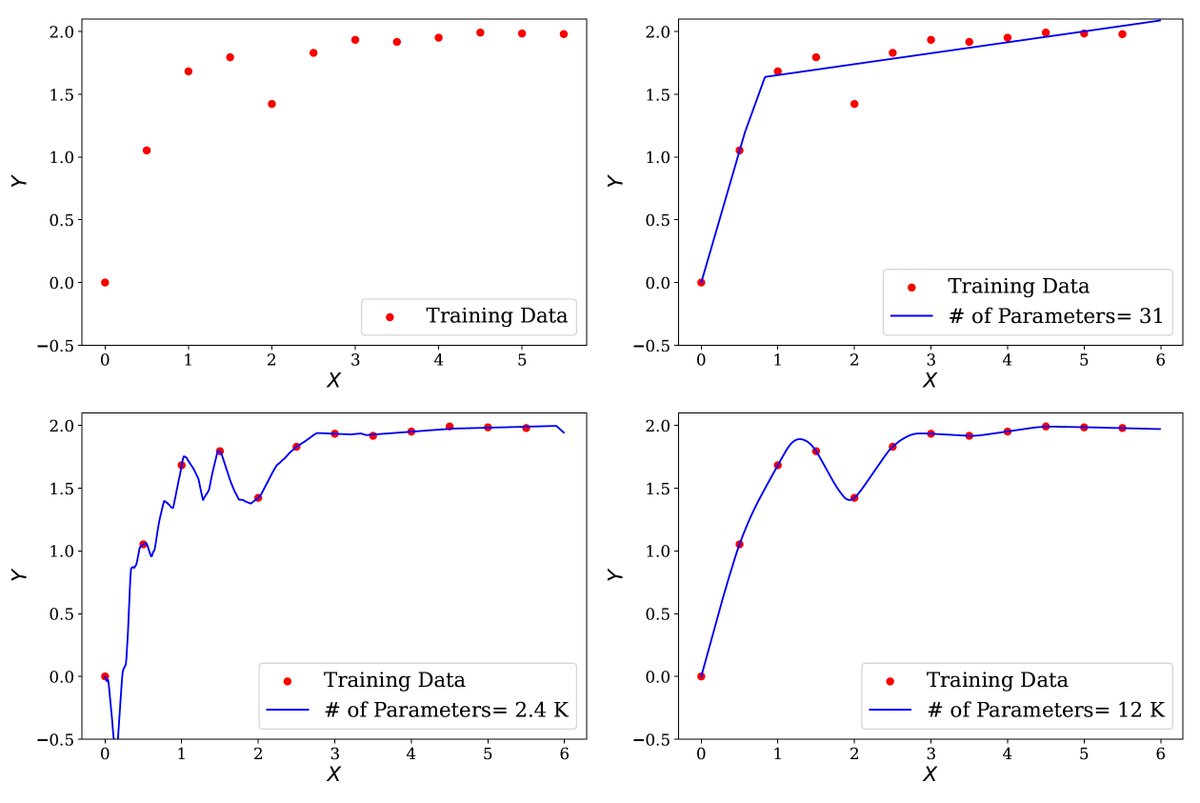
and plot them in red (panel 1, top left, in the figure I include).
◽ Step 2. Train a very simple single-hidden-layer neural network with a ReLU activation and 31 parameters on these 12 data points. This is a “simple” network, and if some of the jargon is unfamiliar, do not worry; the key is just that this network is small.
The result is the blue line in panel 2 (top right). The network captures the overall shape of the data but lacks the capacity to interpolate all points.
◽ Step 3. Increase the network’s size to 2,401 parameters. Now we hit the interpolation threshold: the network can perfectly fit the training data.
The blue line in panel 3 (bottom right) does interpolate all 12 points, but it becomes wiggly, oscillating wildly outside the observed data (see the fluctuations between the second and third points on the left).
This is the textbook warning we teach in econometrics: overparametrization fits the training data beautifully but performs poorly out of sample. This is the U-shaped bias–variance tradeoff curve in action.
◽ Step 4. Now do something insane: push the network to 12,001 parameters for just 12 data points. Surely disaster must await.
Instead, panel 4 (bottom left) shows the opposite: the network fits all the data perfectly and creates a smooth, intuitive curve.
It reminds me of the old connect-the-dots puzzles from childhood: instead of drawing a wiggly mess, the network finds the “right” curve you would have drawn by hand.
This is the double descent phenomenon: the classical U-shaped bias–variance tradeoff extends into a double dip, where performance out of sample improves again once models become massively overparameterized.
So, the solution to too many parameters might be…even more parameters! Or, as we say in Spanish: if you don’t want broth, you’ll get two cups!
Why does this happen? I will try to explain our current (incomplete) understanding of this phenomenon tomorrow in another post, as it involves quite a few ideas.
But in the meantime, three key points to keep in mind:
1️⃣ We only have 12 points — double descent is not about large datasets.
2️⃣ We are using a single-layer neural network — this is not about depth.
3️⃣ The effect is not even specific to neural networks — you can find similar behavior with high-degree polynomials.
👉 This is why double descent is so surprising: it challenges decades of conventional wisdom in statistics and econometrics.
Finally, let me thank @MahdiKahou, my coauthor on much of my recent work on machine learning, for his help in preparing this example. He is the one who truly masters these methods and patiently teaches me about them every day. Anyone who wants to understand this material in depth would benefit greatly from talking to him.
👉🏻 Un doctorado no consiste en encerrarse en casa y hacer un trabajo, es un PROCESO de años que incluye cursos nivel máster en materias específicas, una investigación innovadora, estar integrado en un equipo o centro de investigación reconocido, financiación competitiva...
1/n
Ser profesor.
Ser profesor universitario no es solo enseñar. Es exponerse. Y eso no te lo advierte nadie cuando empiezas. Nadie te dice que hay días en que lo das todo y no pasa nada. Que hay clases que te salen redondas y no las recuerda nadie, y otras que empiezan (sigue…)
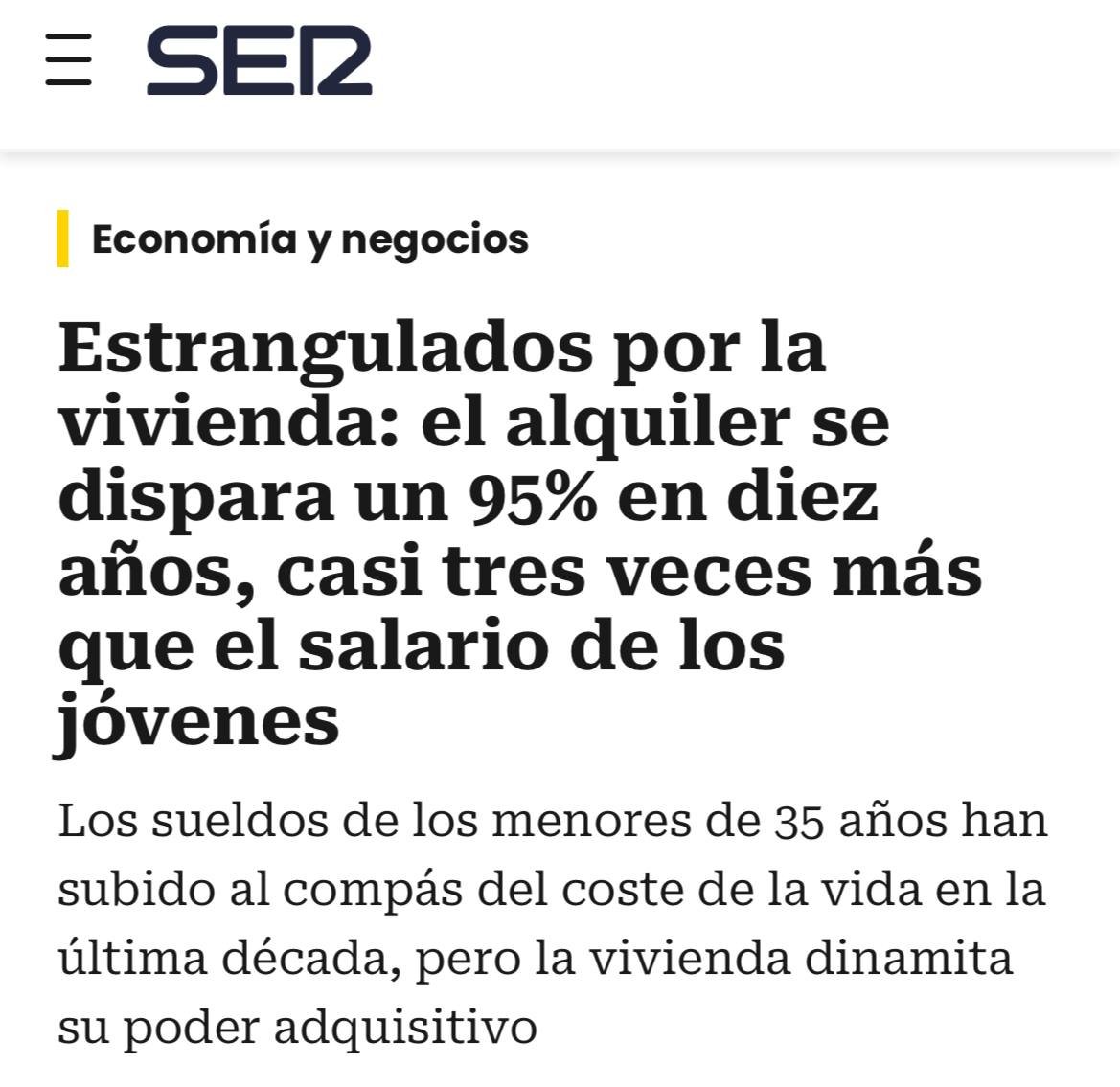
El alquiler ha subido un 95% en 10 años. Los sueldos de los jóvenes, un 33%.
Literalmente te están robando el futuro en tu cara, pero te dicen que ahorres y te esfuerces.
Acaba el curso. Hoy he tenido el último examen y las sensaciones son muy malas. En muy poco tiempo hemos visto (lo acabamos de comentar en el grupo de profes de la asignatura) una caída en picado de la actitud del alumno medio en la universidad.
Digo medio porque hay …
Meritocracia no, exámenes tampoco, esfuerzo ni en sueños. Pero eso sí: toga, birrete y fotocall en la graduación de Infantil. No han aprendido a leer, pero han aprendido a celebrar. El sistema se cae, pero cae con confeti.
Hoy en @nadaesgratis explicamos, junto a M. Diez Rituerto, Nagore Iriberri y J. Gardeazabal, por qué las respuestas incorrectas no deben penalizar en exámenes tipo test y por qué, si dudas entre respuestas, suele ser buena idea arriesgarse a contestar.
https://t.co/sytEVpGXtp
Sí: aumentar la oferta de vivienda FUNCIONA para bajar la presión sobre los precios. Hay que decirlo las veces y de las maneras que haga falta. Hoy @kikollan con datos. https://t.co/ST8Tb5tsP7