The CIA is placing several senior officials on administrative leave over their handling of a high-ranking officer who had $40 million in gold bars stashed at his home, according to three people familiar with the decisions. https://t.co/MI5V0BpKZe
Introducing a research system that enables passive heart rate monitoring (PHRM) during everyday smartphone use. Using the front-facing camera, it achieves industry accuracy standards for heart rate across all skin tones.
Check out the blog to learn more: https://t.co/O4F4Uh8gN4
Interesting how all these outfits look good because they have shape and drape. Shortly after these portraits were taken, the US imposed limits on migration from Southern and Eastern Europe, as they deemed such people "less desirable" than those from Western and Northern Europe.
President Trump's threat to slap new tariffs on trade partners the US accuses of failing to crack down on forced labor will do little to fight modern slavery — and could even make things worse, experts, business groups and some human rights groups say https://t.co/bvDqgCzGbi
In what authorities are calling an "astonishing" testament of human survival, a Mount Everest sherpa was found alive on Thursday after he went missing six days ago on the world's tallest mountain. https://t.co/sPemAFUsfa
The screwworm program wasn't charity, it was a $10 million fence that kept a billion-dollar problem from eating our own livestock alive. That's the thing with most USAID funding: it looks like "aid," but it's really cheap self-defense. Solve a problem there, and it never lands on our doorstep. But sure, let a bunch of guys who can't define DEI without Googling take a chainsaw to it. They didn't stop to ask, "Will this cut hurt us too?" Unless that's the point, burn it all down and call it efficiency.
As usual our inept agriculture secretary, blaming the Biden administration as usual, instead of offering a solution to the problem they created.
Texan here
A screwworm infestation is a nightmare for cattle, causing horrific wounds and economic devastation. For Texas, the situation has escalated dramatically in the last 24 hours with the first confirmed case of New World Screwworm (NWS) in over 60 years! This could have been avoided!
Infested animal can kill a cow in less than two weeks.
Treatment is extremely difficult and time-consuming, requiring the painful removal of every visible larva and deep disinfection of the wound. Ranchers no longer have much experience with this labor-intensive process, and there is currently no approved pharmaceutical treatment to make it easier.
This has triggered a massive economic threat. The USDA estimates that a widespread outbreak would drain an astonishing $1.8 billion from the Texas economy alone in livestock deaths, labor, and medication expenses.
How will this affect you? Tightening supplies will drive already high beef prices higher.
From mini-pigs and organ printing to cryotherapy and genetics, Vladimir Putin has turned antiaging research into a Kremlin priority. 🔗 https://t.co/n0J1MwCZAg
More than 1,100 University of California math and science professors are urging UC regents to reinstate college-entrance exams, saying that unprepared students are lowering academic standards and draining teaching resources https://t.co/GIOZgUwb3Z
As grocery prices continue to rise nationally, the House passed an appropriations bill that would cut $141 million in funding for a program that helps pregnant women and children purchase healthy foods. https://t.co/NJ8vGuBc0P
The French hate air conditioning.
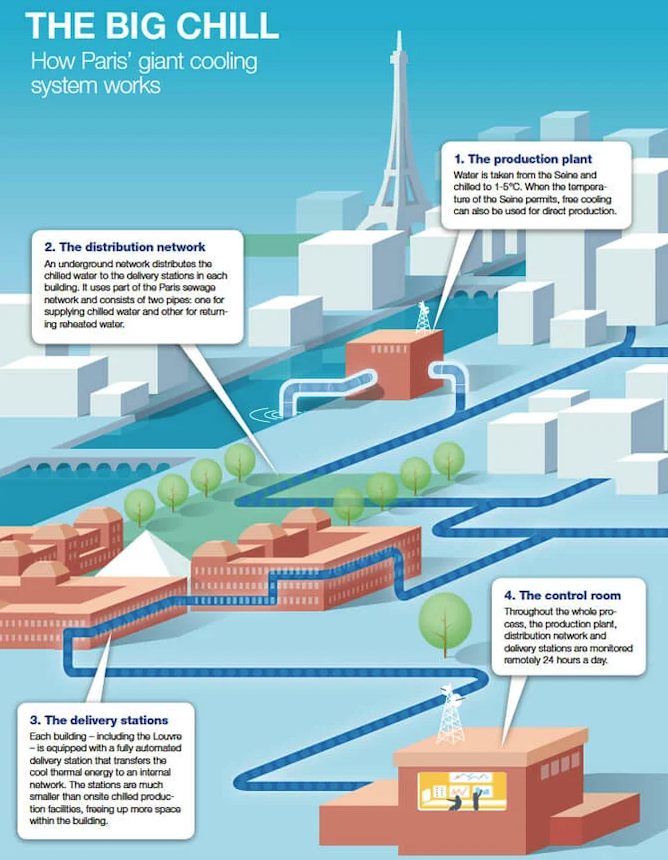
So Paris built a 120-kilometre machine under its streets for producing cold.
It’s called Fraîcheur de Paris, and it does for summer heat what district heating did for winter: centralise the problem.
Instead of every museum, office, hotel, hospital and shop bolting its own cooling plant onto the building, Paris moves cold through pipes.
The network sends water chilled to 2 to 4°C through buried supply lines. The water enters a connected building, absorbs heat through an exchange station, then returns at 12 to 14°C to be cooled again.
It essentially functions with two pipes. One carries the cold out, the other carries heat back.
The production plants cool the circuit from 12°C to 4°C. Some sites use the Seine as a heat sink. In colder periods, the system can use the river’s own temperature for free cooling, which means the machines work less and the electricity demand drops. The Seine water doesn’t become the building water. It stays separate, passing temperature across heat exchangers.
The scale is pretty strange when you see it written down though.
It's got 15 production sites, 4 storage sites, 120 km of underground network with 924 subscribers. This has resulted in 7 million square metres cooled, and 493 GWh of cooling sold.
A cold utility running beneath one of the densest cities in Europe.
The Forum des Halles has been cooled this way since 1979. The Louvre since 1986. Galeries Lafayette, Opéra Garnier, Hôtel de Ville, Station F, La Samaritaine and the National Assembly all sit on the same idea. Tourists stand in the Louvre looking at paintings while a municipal cold loop does part of the dull work below ground.
The boring part is the breakthrough.
Cold can be stored at night in chilled water or ice, then used during daytime peaks. The network is monitored from a control room with more than 125,000 control points. A delivery station inside a building takes 5 to 7 times less space than a standalone cooling installation and avoids the roof and façade clutter that turns cities into compressor farms.
That matters because conventional air conditioning solves heat by moving it somewhere nearby. In a dense city, thousands of private machines mean thousands of outdoor units rejecting heat into streets, courtyards and roofs, plus refrigerants, noise, vibration and maintenance spread across every building.
Paris’s public cooling network has a stated coefficient of performance of 4, against 3 for a wet standalone system and 2 for a dry standalone system. Against an equivalent set of autonomous installations, Fraîcheur de Paris says the network gives 100% higher energy efficiency, 35% less electricity use, 90% fewer refrigerant-fluid emissions and 50% lower CO2 emissions.
The climate backdrop is the real reason this exists.
Paris ran a full crisis exercise called “Paris at 50°C” in 2023. Météo-France’s 2050 reference trajectory for France points to heatwave days becoming five times more frequent, hot nights rising sharply in urban centres, and some local extremes around 48°C becoming possible.
The city signed a 20-year concession in 2022 with Fraîcheur de Paris, owned 85% by ENGIE and 15% by RATP. The contract is worth a projected €2.4 billion. The plan is to extend the network by 158 km by 2042, add 20 production plants and 10 storage sites, and reach more than 3,000 subscribers, including hospitals, nurseries, schools and care homes.
This is basically the infrastructure version of admitting that summer is becoming a public systems problem...
I used to love a web tool called StumbleUpon. Added a button to your browser that would take you to random blogs and websites. Found so much fascinating stuff that way, and it was the antithesis of today’s winner-take-most centralised web.
We've made a breakthrough in self-evolving AI scientists moving from "search" to "principled discovery": Scientific discovery requires that the search space itself changes, and an AI scientist must perceive this shift without intervention. We built an AI that achieves this for the first time with the ability to discover the scientific vocabulary it reasons in. Evidence, tools, artifacts, verifiers, failures & claims become typed provenance. We show three distinct modalities: 1) retrieval, adding known objects; 2) search, exploring a fixed schema; and critically: 3) discovery, a verified regime transition.
We solve the open-endedness evaluation problem by lifting agentic workflows into a typed copresheaf and proving, via a Kan obstruction, that true discovery is not unbounded generation but a verifiable schema expansion: old evidence is transported by Left Kan extension, and genuine novelty is mathematically quantified by the pointwise residual beyond the transported image - separating discovery from mere search and making novelty objective and measurable rather than a subjective judgment or benchmark delta.
Our AI scientist is built in a way that does not pre-conceive the approach it chooses; instead, we endow the system with formal power to adapt, evolve, and reason from first principles. Case studies include:
1⃣Builder/Breaker model that discovers mode-conditioned compliance in proteins;
2⃣CategoryScienceClaw that finds anisotropic fiber-network stiffness rules.
Great work in collaboration with my graduate student @fwang108_@MITdeptofBE
F.Y. Wang & M.J. Buehler, Self-Revising Discovery Systems for Science: A Categorical Framework for Agentic Artificial Intelligence, arXiv:2606.01444, 2026
Photography had interesting effects on painting. Degas famously "cropped" peripheral figures, incorporating the organic visual structure of photography vs formal portraiture. Are LLMs having similar effects on human writing? 🤔
(Besides people now avoiding the word "genuinely")
@dioscuri I was in a recent call with people from one of the frontier labs, and either they were reading off of scripts written by AI or AI is now having those effects *in the way people talk*.
According to a release from U.S. Indo-Pacific Command, U.S. forces interdicted the sanctioned tanker, MT Davina, overnight and conducted a right-of-visit boarding in the Indian Ocean. The tanker in question was sanctioned by the U.S. back in 2024 as part of the wider sanctions regime against Iran’s shadow fleet of tankers.
Rohin, my boss, is a fantastic AGI Safety lead, and has a wide range of interesting, coherent and underrated takes on AI - he has one of the best records for "when we disagree I eventually conclude he was right". Go check out several hours of them!
@firstnameb22616@littmath@tenobrus Maybe I'm weird, but trying to solve a bunch of hard math problems by hanging out with a bunch of brilliant people who happen to be your friends is awesome and I can't see why anyone would want to skip the pain and joy of doing it.
@firstnameb22616@littmath@tenobrus Psets should be ungraded. When I did calculus in college our grade was based 100% on exams. Each exam was 5 Qs chosen from the last ~80 in the psets, which we solved in groups. Some of the folks in my group were part of our national IMO team. Every pset took us a week to solve.