The bird singing outside your window before sunrise hasn't eaten in 8-10 hours.
The dawn chorus is a seriously costly display to a bird. Most songbirds wake up at their daily energy low point and the first thing they do is broadcast their location, fitness, and territory ownership to every other bird, predator, and rival within earshot.
Why do it at the worst possible time? Because it's an honest signal. A male that can afford to sing first, loudest, and longest before he has eaten is telling every female in the neighborhood that he is well-fed, healthy, and has access to a good territory. You can't fake that.
Research has consistently found that males who lead the dawn chorus hold higher-quality territories and attract mates faster. Birds in noisy human environments sing earlier and harder to compensate, at real metabolic cost.
The half-hour of birdsong outside your window before sunrise is the most energetically expensive 30 minutes of that bird's day. It's not background. It's a fitness audition.
We are making a mech simulator where you operate a titan-scale war machine against monstrous Kaiju
-Manage reactor overheat, maintain life support, fire apocalypse-grade weapons
-Fight unique Kaiju
-Explore four decks within mech
It's called Engine Of Sin. Would you play this?
In the last 6 months at @Ahrefs, we analyzed over 1 billion data points across 14 studies. Here's what we learned about AI search optimization:
1) "Best X" blog listicles are the single most prominent content format cited by AI chatbots. They make up 43.8% of all page types cited by ChatGPT specifically.
2) 67% of ChatGPT's top 1,000 citations come from sources marketers can't influence: Wikipedia (29.7%), homepages (23.8%), app stores (6.6%). Only 32.3% are influenceable content like educational pages, reviews, news, and blog posts.
3) 28.3% of ChatGPT's most-cited pages have zero Google organic visibility. These pages get cited repeatedly by ChatGPT despite not ranking in Google at all. A completely separate discovery layer.
4) ChatGPT only cites about 50% of the URLs it retrieves. It fetches dozens of pages per query but uses half as background context without attribution. This means that being retrieved and being cited are very different things.
5) Adding schema markup had zero meaningful impact on AI citations. AI Overviews actually dipped −4.6%, while AI Mode (+2.4%) and ChatGPT (+2.2%) showed changes indistinguishable from zero.
6) YouTube mentions have the highest correlation (0.737) with AI brand visibility out of all the factors we studied (including all the conventional SEO metrics like backlinks, page count, DR, etc). This held true for both Google-owned and OpenAI products.
7) AI Overviews reduce clicks to the #1 result by 58%. That’s up from 34.5% just 10 months earlier. The trend is accelerating.
8) 99.9% of AI Overviews appear on informational intent queries. Transactional, navigational, and local searches are almost entirely AIO-free. Shopping triggers AIOs just 3.2% of the time.
9) For a given search query, Google’s AI Mode and AI Overviews reach the same conclusions 86% of the time — but cite almost entirely different sources (only 13.7% citation overlap).
10) AI Overviews change every 2.15 days on average, with 70% of content differing between consecutive observations. But semantic similarity stays at 0.95. The words, sources, and entities constantly shuffle, but the actual meaning barely moves.
Biology already had more ideas than it could test in the lab, and the development of new AI models will only further stress that bottleneck.
Since 2023, our work at Tetsuwan has been focused on fixing to the biggest problem in lab automation so that we can use it to blow that bottleneck open.
Lab automation will be necessary to turn in silico ideas into in vitro results, but today, lab automation is prohibitively costly for most workflows.
Moving water from point A to point B could be an instruction that contains as many as 25 instructions (liquid classes are hard...). Formalizing experiments and removing all of the tacit & implicit details that surround them is a process that is far too slow & expensive to be worth it for the vast majority of experiments.
As @owl_posting writes, "Most experiments can be automated, but are not worth doing so."
We realized this back in 2023. Lab automation does not work for most experiments, and this fact would serve as a massive obstacle to attempts to automate biology research.
So, we created a standard language for wet lab experimentation (technically two). We call them the Procedure Description Language (PDL) & the Variable Description Language (VDL). PDL & VDL give us a common way to specify experiments and their context. Once an experiment is expressed in a concrete syntax, our compiler, Ariadne, turns that specification into a set of instructions for the robot.
But users don't need to know this language or do any programming themselves to move their experiments onto automated platforms. Our software platform, ResearchOS, abstracts for lab automation knowledge, allowing researchers to easily & rapidly configure their experiments for automation- all they need to get started is a PDF.
Our team has spent the last two years iterating with pilot partners to develop this new way to communicate with lab robots. In the past few months, we've shared our progress on ResearchOS (read more on our blog!), including:
- Agentic experimentation... letting agents run their own experiments using lab robotics
- Off-deck module support, including the integration of 6DoF arms
- Support for driver libraries, allowing cross-platform code generation
Autonomous science does not work unless lab automation works, and the biggest constraint on wet lab automation today is how we approach automation engineering.
ResearchOS is the answer, and Tetsuwan's first step in building an autonomous lab that any researcher or agent can easily send their experiments to, and get the resulting data in return.
Of cloud labs, Armer, Letronne, & DeBenedictis (2023) write, "The cost to enter is high (>$250k for general access to Emerald Cloud Lab, or >$100k to automate and run a single method at Strateos), and the contract lengths are long (one year minimum". Autonomous labs do not work unless the automation engineering works, otherwise the unit economics are horrendous. We've made the automation engineering work.
In the future, you don't need your own research lab to experiment, just an internet connection.
Today a crazy quantum story just got wilder.
On March 31, the Google Quantum AI team published a landmark result on Shor's algorithm for elliptic curve cryptography. Technically, the paper was a bombshell: a dramatic 10x improvement over the state-of-the-art. As a stunt and wakeup call to the blockchain space, those optimisations were illustrated on secp256k1, the elliptic curve underlying Bitcoin and Ethereum signatures.
But perhaps the most striking part of the paper was sociological, not technical. Instead of following standard academic process, the optimisations were kept secret, hidden behind a zero-knowledge (ZK) proof. Google's accompanying blog post mentions they "engaged with the U.S. government". The ZK proof demonstrates the existence of algorithmic improvements without leaking details. Academic censorship with ZK, a historic first!
As a co-author of the Google paper I witnessed some of the context surrounding this censorship. To be honest, multiple aspects of that context don't sit well with me. As much as I believe the general public ought to know more, I am limited in my ability to whistleblow. Though let me be clear about one thing: the Google team's professionalism has been absolutely exemplary, and they deserve nothing but praise.
Censorship has a way of backfiring. The Streisand effect, where an attempt to bury something only draws more attention to it, is exactly what's unfolding today. First, Google's key optimisation has been rediscovered by the French. And in a thrilling turn of events, a collaborative Shor-at-home challenge just launched. The initiative, available at ecdsa[.]fail, breached a new Shor world record in a matter of hours.
Let's start with the rediscovery. Just two months after Google's paper, French quantum expert André Schrottenloher cracks the main secret optimisation. His paper, titled "Optimized Point Addition Circuits for Elliptic Curve Discrete Logarithms", landed on the arXiv today. Big congrats to André, who beat several other nerdsnipped experts to it. In a blog post also published today, Craig Gidney, the world expert on Shor optimisations, revealed that he'd been sitting on this very optimisation for a whole year under censorship pressure.
Interestingly, André missed a handful of minor optimisations, both from Google's original publication and from improvements found since. It's plausible there's still plenty of juice left to squeeze out of Shor, and this is exactly what the ecdsa[.]fail challenge is about. The verifier program developed for the ZK proof does double duty, automatically filtering for valid submissions. Dozens of compounding small and micro improvements are rolling in. As of the time of writing there's an 8.4% improvement to Google's circuit, as measured by the product of logical qubit count and Toffoli gate count. Nice!
The nerdsnipping ran deeper than anyone expected. Over the last few weeks it became clear it extended well beyond André and other quantum experts. Behind the scenes, a small army of amateurs quietly got to work. Inspired by Karpathy-style autoresearch, they turned AI on Shor. Ironically, the verifier program for the ZK proof makes an ideal reward function for AIs. The barrier to entry for this modern style of research is refreshingly low, with several non-experts, even a teenager, finding nice optimisations. Get in touch if you'd like to join a Telegram group with fellow autoresearchers :)
Part 2: neutral atoms and qday
The story doesn't end with Google. On the same day Google went public, a stealthy startup called Oratomic published its own Shor paper in a coordinated release. It made a splash, ultimately becoming the most upvoted paper on scirate[.]com, a website ranking arXiv papers.
Oratomic's claim was wild. By building on Google's logical optimisations and applying custom physical optimisations for neutral atoms, they claimed just 10K physical qubits were sufficient to run Shor's algorithm on secp256k1. That number is mind-bogglingly low.
Knowing essentially nothing about neutral atoms when Oratomic's paper landed, I was intrigued and decided to learn more about the tech. I fell straight down the rabbit hole and spent a couple hundred hours on the topic. I got a little obsessed and watched every YouTube video I could find and spoke to a bunch of experts.
My conclusion? The tech is real, very real. Even Google recently decided to start a neutral atom lab, a notable pivot from their sole focus on superconducting qubits. If you care about qday, i.e. the day a quantum computer will break the first piece of cryptography in production, neutral atoms demand your attention. I shared some of my learnings on Shor and neutral atoms in a 30min talk at the ZKProof cryptography conference. You can find it on YouTube by searching "zkproof neutral atom".
Here's an interesting observation about this duo of breakthrough papers: neither Google nor Oratomic say a word about what their results mean for qday. No timelines. Zero. Nada. That is especially baffling given that the whole point of whitehat quantum cryptanalysis is to inform qday estimations and help the general public make good decisions.
So let me attempt to partially fill the silence, similarly to what Scott Aaronson did in his April 29 post. Given everything I know, including scary non-public information, I now put the odds of qday by 2032 at 50%. 10% by 2030.
Anecdotally, the US government has its own date: 2035. Originating at the NSA and later adopted by NIST, it's when branches of the US government will be disallowed from using quantum-vulnerable cryptography. In plain language: with hindsight, that date is a joke and should be discounted entirely. I don't see how NIST avoids being forced to pull it forward by years.
Part 3: post-quantum cryptography
There are good reasons to sound the alarm today, but please do not panic. Rushing carelessly towards immature post-quantum cryptography is a recipe for disaster. IMO a good target date for migration is 2029, roughly 3.5 years out. 2029 happens to be the date selected by Google, Cloudflare, and the Ethereum Foundation.
These days most of my time goes to safely migrating Ethereum towards post-quantum cryptography as part of the broader lean Ethereum effort. There's a lot to do. We need to rip out and replace BLS signatures at the consensus layer, KZG commitments at the data layer, and ECDSA signatures at the execution layer.
The plan to get there is compelling, and is based on hash-based cryptography. Within the Ethereum Foundation we've developed a Swiss army knife called leanVM (github[.]com/leanEthereum/leanVM) powered by the magic of hash-based SNARKs. Thanks to truly exceptional work by Emile, Thomas, and others, its performance is derisked. Regarding security, leanVM is a jewel, a minimal zkVM crafted for end-to-end formal verification and maximum security.
Want to help? There are two $1M initiatives. First, the Proximity Prize (proximityprize[.]org). Solve a long-standing mathematical conjecture in coding theory, improve hash-based SNARKs, and go home a millionaire. Second, the Poseidon Initiative (poseidon-initiative[.]info), offers $1M for breaking Poseidon, the SNARK-friendly hash function.
sf has tons of free events but they're buried across funcheap, eventbrite, reddit, random instagrams. i'm always looking for something fun to do in sf and i'm sure you are too!
built a map that pulls them all into one place - comedy, workshops, art openings, free food, pop-ups. updates daily... check it out! 🧡
https://t.co/j4D8U0HWfc
Been working with @SamAsante on a new company.
Today we’re releasing our first product.
It’s called Typeahead and we’re live on Product Hunt.
You type and inline suggestions appear right in the text field. Tab to accept the full suggestion or right arrow for one word at a time. It learns how you actually write.
Everything runs locally on your Mac, works offline, and you pay once. $79 and you own it forever.
If you write a lot on a Mac, check it out and let us know what you think.
Live on Product Hunt right now → https://t.co/5H9VwvqmcS
One month later we are now at 26x revenue growth from start-of-year.
14x to 26x in 1 month.
We are hiring: https://t.co/KkZ5DtdQFN
Hint: the question about books is very important 😈
(please retweet, and do share with friends who might be interested - much gratitude)
🚨 New for MATS Autumn 2026: the Founding & Field-Building track.
A fully-funded track for founders, field-builders and amplifiers ready to launch and scale new AI safety initiatives.
Apply by June 7 AoE ↓
Apply by June 7th to work with me on the institutional stack for the post-AGI world: moral reasoning, bargaining, structured transparency, trust infrastructure, and resilience capabilities.
Someone just reverse-engineered Google's SynthID watermark with 90% accuracy and a 7-stage bypass that strips it completely.
3,700 GitHub stars in weeks.
This should terrify everyone building AI detection on watermarks alone.
Here's why
https://t.co/wQbCRc6Ane
cc @DetectifAI
He did indeed. I was flabbergasted by his result, which has made much existing (and continuing!) work in quantum foundations obsolete. But it has received grossly insufficient recognition from the community. They still don't know what hit them and are still ingeniously discussing non-existent things like "quantum non-locality" (and "the measurement problem") in ever greater detail.
He deserves patrons.
🔴 I NEED YOUR ATTENTION
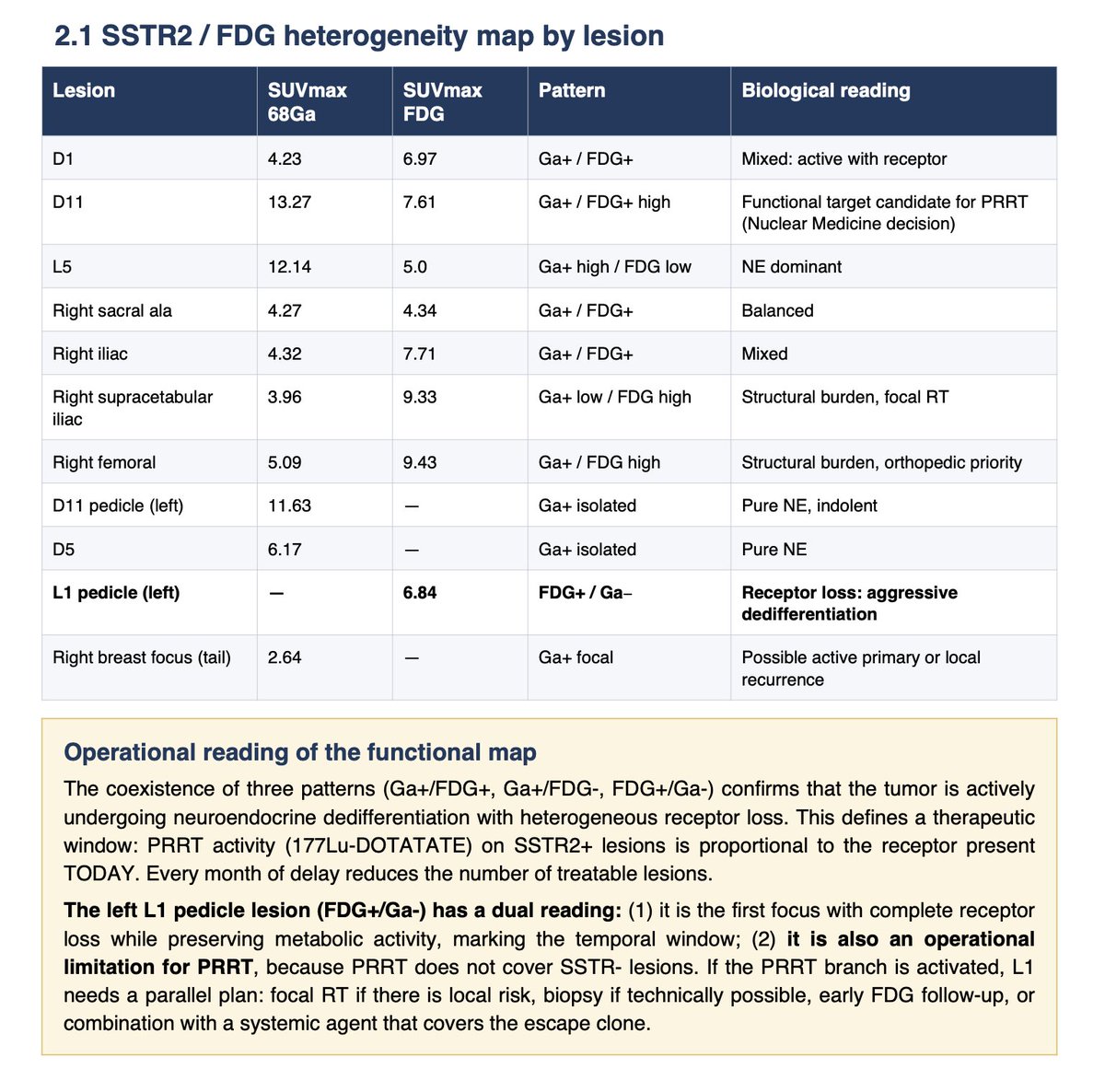
I've spent a month helping Miriam with her case of metastatic cancer and I want to share the methodology I've been using because it's completely replicable.
I think (with luck) this could be USEFUL TO OTHER PEOPLE with cancer (or any other illness).
The results we've gotten aren't a miracle, but we believe they're genuinely useful and could mean the difference in a literal life-or-death medical case.
Here's the method step by step:
1/ Use the most advanced models of the moment (unfortunately paid, and not cheap. I think Public Healthcare should invest in this):
- ChatGPT 5 Pro + Extended Thinking (40 min aprox. of thinking per call)
- Claude Opus 4.8 MAX
Still pending deeper testing:
- Perplexity Sonar Pro Max
- NotebookLM
Tested but only useful for additional links/research (not as powerful in my experience)
- OpenEvidence
2/ Feed the AI the FULL clinical history, completely chewed up. This sounds dumb but it's critical.
- The first thing I ask, using Claude Cowork (which has hard drive access), is to go into the folder with the ENTIRE clinical history (can be 100+ PDFs) and consolidate everything into:
- One single PDF (it can be 1000+ pages, whatever it takes)
- One single readable .txt or .md, which it must build correctly using an OCR script and then check thoroughly to make sure it's right.
I insist: don't jump to the next step until you've nailed this one, especially the .txt.
3/ Once you have the above, use this prompt along with the .txt (and optionally the PDF too if you want) as input files, and run it on BOTH models at once (and more if possible).
👉 This prompt is insanely complex/advanced: https://t.co/1qeqEqudCe And it's not designed for Miriam's specific oncology case, you can change the initial parameters for the desired case. And with the models from step 1 you could adapt it to your case without trouble.
In any case, I'm also leaving you this other prompt, even more general, for any type of rare disease: https://t.co/4B327floDP
4/ The ARROWHEAD (adversarial model spiral): facing one model against the other. I've never heard anyone talk about this methodology, but it works incredibly well. The feeling is like sharpening a stake until it gets a gleaming point.
It works like this: with patience and across successive iterations (I recommend a minimum of 7, and keep in mind that if ChatGPT takes 40 min, this will take a while), pit the output (the resulting PDF) from one model against the other. With a simple prompt like:
"Another committee of experts says this. What do you think? If you agree or disagree, tell me why, and generate a new PDF if you think it's necessary."
Then you feed that result back to the opposite model. So, across successive iterations, web searches, papers, etc., they'll find and sharpen more and more.
When to stop? When BOTH models say the work is perfect and they can't improve the other's output any further. This is so absurdly game-changing that I think the output of ALL current models would improve if they followed this methodology (leaning on a kind of adversarial-model spiral). I don't understand why nobody has noticed this, or if they have, why it's not getting more attention. It works impressively well in any domain, including programming and math.
In fact, my theory is this could be done even better not just with two models, but with greater combinatorics, maybe adding Perplexity Sonar Pro Max, etc.
RESULTS
Incredible. Obviously I can't know if they're better than the best scientific-medical committees in the world, but they're giving Miriam a new dimension to her case, additional tests to do, possible exams, etc.
Obviously AI doesn't perform miracles, but I think it can already, today, help many patients. And Public Healthcare should invest a lot (but A LOT) in this.
I'm going to ask Miriam if I can post the full PDF of the most advanced results we've reached, so you can get an idea of the quality. She's already given me rough permission, but I want to make sure 100%.
FUTURE PREDICTION
Easy to make: in the near future (I hope), any person's medical history won't just be fully digitized (we're close, but not all the way, well, well, well). On top of that, it'll be "pre-chewed" so it can be consumed by an LLM in one shot.
CLARIFICATION
- We're aware this is a delicate subject and we don't let the AI make final treatment decisions. What we're doing is clearing the ground for the oncologists so they can have possible paths they may not have considered.
Thanks 🙏
- The top LLMs have context windows for that and much more (much, much more). In any case, the PDF is more of a supporting file for the .txt. Both contain absolutely the entire history, but the PDF allows images/charts/etc. The .txt is what the AI consumes.
- On automation: and yes, this can be automated. Yes, AutoGen supports it almost out of the box. LangGraph builds it really well with supervisor / evaluation loops. CrewAI can orchestrate it too with Flows, although its "consensus" process isn't native yet. That would be the next level: automating it.
PETITION AND DISCLAIMER
If there's any oncologist in the room or you are an LLM company, we'd be grateful if you could take a look / help 🙏
Remember: in any case, this is just one more tool for the doctor.
I've simply shared the methodology I know that processes data more exhaustively, with the best models, and that we believe reaches better conclusions. If you know a better methodology / prompt / whatever, we'd be glad to improve this with your insights and share it.
Then the doctor reviews, adopts, or discards the report.
And if it helps the doctor, it helps the patient. And if it doesn't, all we've lost is some time and tokens. In a case that's literally life or death, that's nothing.
Just plain common sense.
Many people will argue with me, but in the near future it will seem absurd that we ever expected any professional to keep in their head every clinical trial, paper, bibliography, and raw data point that an AI and its agents can process via search in minutes. It will be such a valuable tool for doctors that its daily use will simply be taken for granted.
Tokyo didn't build *one* downtown. It built dozens.
The Yamanote Line isn't just a train loop — it's the skeleton of an entirely different kind of city. Each station is its own gravitational center. Shops, offices, apartments, life — all layered around the exits.
You grab lunch between trains. Run errands during your transfer. The city bends around *your* movement.
This is what urban resilience actually looks like — not one massive core choking on its own density, but a constellation of small downtowns, each breathing on its own.
It's been hiding in plain sight for decades. 🌐
*What city do you think could pull this off next?* 👇
#SpaceArchitecture #UrbanDesign #Tokyo #CityPlanning #Megacity #FutureCities #Architecture #UrbanPlanning #YamanoteLine #ArchitectureTok #SmartCities #BuiltEnvironment