A better world 4 all! Agri sector & global trade, development, regional integration. Farming is still cool.Pro-people, anti-poverty. Futurist. RT ≠ endorsement
@mteton@Sophie_Mokoena I remember being part of a SA social cohesion study for KZN under judge Navi Pillay, many years ago. The findings showed that the migrants created employment and obeyed the red tape and bylaws more than local people thought. Interesting.
Great news, South African #exporters to #China can now use immediately the #CAEPA 1st May zero tariff offer. The 2 sides have agreed on customs measures. For agriculture there are some quotas, but zero % in quota!
SA gets its oil and petrol etc from Angola, Nigeria and some from Saudi. There is no shortage now or expected. Please don't panic buy or hoard or forward wild rumours. It will ironically place stress on the fuel logistics if everyone panic buys unnecessarily! @IFPA_Africa
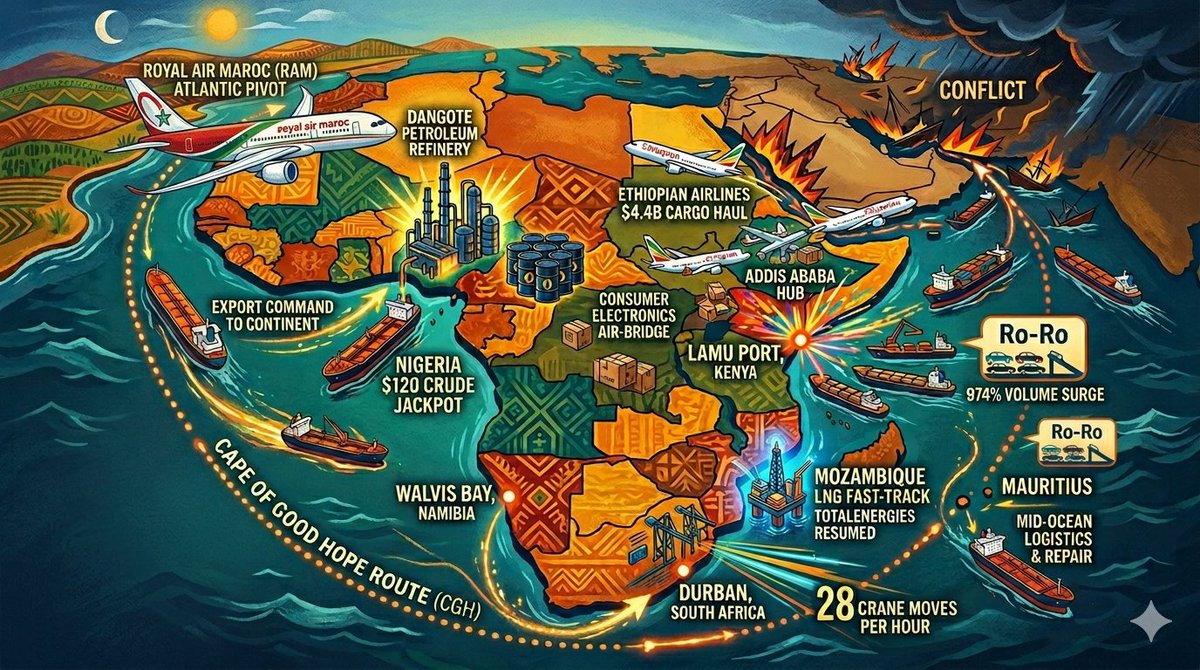
Kenya, Ethiopia, Nigeria Early African Winners as They Harvest Windfall from the Misery of US–Israel vs Iran War
As the world reels from the escalation of the US–Israel vs Iran war that erupted on 28 February, the humanitarian suffering is profound. Yet in the realm of global commerce, a quieter upheaval is underway. With the Red Sea and Strait of Hormuz rendered near impassable – shipping traffic down by 90% – Africa has emerged as the world’s most vital logistics corridor.
•In KENYA, the once-forgotten LAMU PORT has roared to life. Long dismissed by critics as a white elephant, it has seen a 974% surge in volume. Ultra-large vessels, too deep for Mombasa and too exposed for Gulf waters, now dock at Lamu’s 18-metre natural depth.
•ETHIOPIA'S national carrier Ethiopian Airlines has seized the moment. With Dubai and Doha mostly paralysed by airspace risks from Iranian missile and droke strikes, Addis Ababa has become the continent’s primary air-bridge. Cargo revenue is up 14%. High-value goods – electronics, pharmaceuticals, perishables –are now routed through Bole International, bypassing the 40-day sea detour.
•NIGERIA is counting its crude. Brent prices hit $120 per barrel in March. Against a budget benchmark of $64.85, daily revenues have doubled. The government has stumbled into an unexpected multi-billion dollar fiscal cushion.
•DURBAN, South Africa’s main port, has shed its reputation for congestion. It is now clocking 28 crane moves per hour, processing thousands of ships rerouted around the Cape of Good Hope with a rare level of precision.
•MOROCCO'S Royal Air Maroc has moved swiftly. Ten new international routes –including Los Angeles and Beirut – have siphoned off transit passengers who once relied on Middle Eastern hubs. Casablanca traffic is up 12%.
•WALVIS BAY in Namibia has become the first reliable refuelling station for ships emerging from the South Atlantic. Bunkering demand is up 30%.
•The DANGOTE Petroleum Refinery has in Nigeria, is cashing in. In March, it issued an export tender for 84,000 metric tonnes of jet fuel and diesel. It is no longer just a domestic project – it is replacing Persian Gulf supplies for the continent.
•MOZAMBIQUE'S $20 billion LNG project has been fast-tracked. TotalEnergies resumed operations in early 2026. Over 4,000 workers are racing to meet an accelerated production date. Iranian gas is out. Mozambican gas is in.
•At Mozambique's PORT of MAPUTO, volumes grew by 16% in the weeks following the war’s outbreak. Chrome and coal exporters have abandoned northern routes in favour of the safer Indian Ocean–Cape corridor.
•MAURITIUS, ever shrewd, has leveraged its mid-ocean position into a 15% revenue increase. High-end logistics and emergency repair services are now its bread and butter.
But no doubt, the most intriguing twist is the Roll-on/Roll-off (RoRo) revolution in Lamu. Manufacturers are using RoRo ships – where vehicles are driven on and off via ramps – to offload thousands of cars. These are then ferried to the Gulf on small, low-risk boats to avoid the $200,000+ war risk insurance premiums slapped on large carriers entering the Strait of Hormuz.
To protect this windfall, Kenya and Ethiopia have launched joint military operations along the once-languishing Lamu Port–South Sudan–Ethiopia Transport (LAPSSET) corridor. This unprecedented coordination is designed to ensure that the new “safe harbour” of Lamu remains shielded from regional spillover.
And because the closure of the Strait of Hormuz marooned shipping containers, an emergency air-bridge has formed. Nairobi and Addis Ababa are now the primary transit points for consumer electronics flown from Asia to Europe—bypassing the the 17,700KM sea detour.
US leader Donald Trump despises Africa, once labelling its countries "sh*thole", but while many of them will be hit hard by rising energy and fertilisers from America and Israel's attack on Iran, several of them will get a bounty he would never have wished for them.
@cobbo3 Dear Charles, great post, thanks! Can i ask, what is your data source for the 28 crane moves pe hour for Durban? That is a good figure if correct!
@WandileSihlobo 100%. We are also 2nd largest citrus exporter, largest macadamia producer globally, largest chicory producer, and largest Southern Hemisphere fruit exporter by volume. there are another half dozen examples too. :-) Viva SA agri. A national asset.
I must admit, I disagree with the concept/ fad that the #rulesbased#internationalorder is dead. It is still pushing back, institutionally battered but intact. it has majority support and no coordinated, systematic, institutional alternative replacement structure has arisen...
I must admit, I disagree with the concept/ fad that the #rulesbased#internationalorder is dead. It is still pushing back, institutionally battered but intact. it has majority support and no coordinated, systematic, institutional alternative replacement structure has arisen...
Canada PM Mark Carney spoke at the World Economic Forum, calling on "middle powers" to stop mourning the old-world order. He asked them to create new alliances to oppose pressure tactics and intimidation https://t.co/0GR7zrWPc0
@RediTlhabi@richardcalland However, it is indeed welcome that we are not explicitly excluded. SA agri exports and indeed many other goods under AGOA offer good value a d reliable inputs to US factories and keep prices lower for US consumers. It passed House 340-54, that's bipartisan support.
@RediTlhabi@richardcalland Redi you are correct. Also good for colleagues to remember this process is only half complete. Senate must approve a d has authority to amend the text (or pass it as is). If amended, a Senate-House compromise text must be presented to the President. So SA remains in currently.
@RediTlhabi@richardcalland What is also important is that as it is not yet law, the AGOA preferences we previously enjoyed therefore do not yet apply. Apologies Redi if I missed you saying that in the thread!