What is the largest source of electricity in each country?
Coal generates one-third of the world’s electricity, more than any other source.
But zoom into the country level, and the picture is much more varied. The map shows which source generated the most power in each country in 2024 or 2025 (the latest year available).
Thanks to large reserves, coal dominates across Asia. It’s the largest source in China, India, Indonesia, and Malaysia. These are huge power producers, which is why coal is so dominant at a global level.
Across most other regions, it’s mostly a mix of gas and hydropower. On islands and parts of North Africa, it’s oil.
Europe has the most diverse mix, with nuclear power dominating generation in countries such as France and Finland, and solar and wind overtaking fossil fuels as the largest sources in countries such as Spain and Germany.
Solar and wind are growing quickly in many countries; when these sources are combined as “variable renewables”, they become the largest source in six more countries: the Netherlands, Portugal, Greece, the United Kingdom, Belgium, and Pakistan.
(This Data Insight was written by @_HannahRitchie.)
Bottom line: The era of unchecked, cheap Chinese solar expansion is over. Beijing is transitioning the sector into a formal tool of economic statecraft.
Read the complete institutional brief on the new rules of global PV geography: https://t.co/peVDJ58W27
This isn't just a corporate cleanup. Amidst the ongoing shipping blockades in the Strait of Hormuz, the Politburo is cementing the shift of its 15th Five-Year Plan—from a purely climate-driven agenda to a strategy of hard energy security and sovereign resilience.
To stop the bleeding, the State Council implemented a major geoeconomic shift: cancelling the export tax refund. The China Photovoltaic Industry Association welcomed it to "restore rational pricing" and mitigate growing international trade frictions.
China’s solar industry just hit a massive structural turning point.
Facing 10 consecutive quarters of corporate losses and rampant overcapacity, Beijing is stepping in with aggressive fiscal interventions that just crashed solar exports by 40%.
Here is the real story
🧵 👇🇨🇳🌞
African gas geopolitics just hit a critical turning point. Algeria, Niger, and Nigeria have officially broken ground on the 4,128km Trans-Saharan Gas Pipeline (TSGP) to pump 30Bcm of gas to Europe.
But the project is a massive geopolitical gamble.
🧵 🇩🇿🇳🇪🇳🇬👇
@VuslatBayoglu@mteton@Eskom_SA@DOEE_ZA@PresidencyZA What alternatives would you propose as 16GW of coal fleet no longer meets operational or emissions standards by 2035 and therefore must be retired? What tariff would Medupi or Kusile bid into the merit order? It might even surpass the numbers you quote above.
Big step for Eskom: Signed Heads of Agreement with Zululand Energy Terminal for Richards Bay Gas-to-Power - 3 000 MW flexible power. Gas will balance renewables and support jobs & investment. Eskom is back and building.
#Eskom#PoweringGrowthSustainably#RichardsBayGasToPower
Japan plans to replace its aging nuclear reactors over the next few decades to meet rising power demand and curb dependence on imported fossil fuels
🇯🇵❤️☢️
The plan calls for as many as five new reactors by the 2040s and another nine the following decade
https://t.co/OQ6EOrHhCa
BREAKING: Iran says negotiations have now fallen apart completely, seizing all messaging channels with the US following new US strikes on commercial vessels in southern Iran and the ongoing Israeli military's invasion of southern Lebanon, per Fars.
Iran also says talks were already fully deadlocked over the US refusing to release $24 billion in frozen funds without nuclear concessions in return. Iran is also rejecting Al Arabiya's claim today that Iran agreed to transfer part of its enriched uranium to a third country, calling it "incorrect" with nuclear discussions being "fundamentally not on the current negotiation agenda."
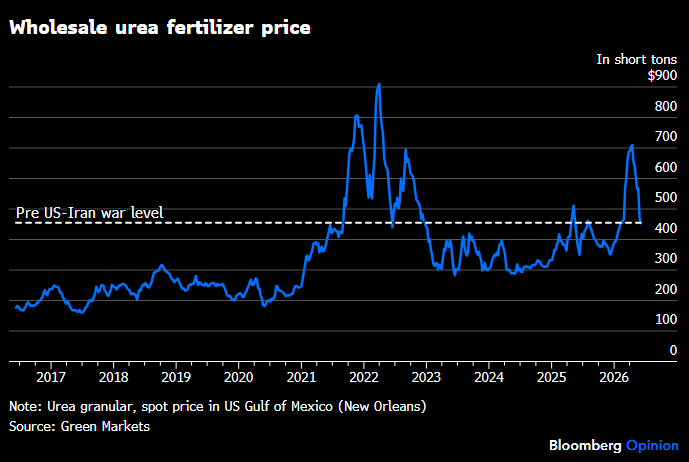
CHART OF THE DAY: The cost of the most important nitrogen fertilizer is back to pre-war levels in the US, benefiting from ample natural gas supply in America. Urea prices are sharply down too in Europe and Latin America, but remain elevated in most of Asia.
What just happened?
The S&P 500 just erased nearly -$2 TRILLION of market cap just hours after 3rd strongest US jobs report in 18 months.
Meanwhile, Bitcoin is officially down over -50% from its record high in October 2025.
What's happening? Let us explain.
(a thread)
Big Oil sees shortages coming
Exxon: We're nearing inventory levels that are truly unprecedentedly low.
ConocoPhillips: critical shortages of oil on the horizon.
Chevron: shortages in oil supply will begin appearing.
Saudi Aramco: fuel stocks are heading for critically low levels.
Meanwhile, markets are hitting all-time highs...
Apparently shortages don't matter until they do.
Nice JPM chart explaining what has happened on the other side of the Hormuz supply destruction
The big unexpected number is demand destruction and the big question is how much of this is temporary
Of note: The cost of urea fertilizer in the US GoM (New Orleans benchmark) is down to pre-war levels of ~$470 per metric ton (down ~33% from a peak of ~$710 in mid-April).
Urea prices also sharply lower (30-40% down) in Latam and Europe, although still above pre-war levels.
BREAKING: Venezuela’s crude oil exports have surged +61% YoY, to 1.25 million barrels per day, the highest in 7 years.
The surge was led by rising shipments to the US at ~558,000 barrels per day, India at ~427,000 barrels per day, and Europe at ~169,000 barrels per day.
In total, 67 cargoes were exported from Venezuelan ports in May.
Since November 2025, Venezuela’s oil exports have surged +150%, or ~750,000 barrels,
This comes as the US eased sanctions on Venezuela's oil industry following the capture of Maduro earlier this year.
Venezuela's oil ministry is now targeting output of 1.37 million barrels per day by year-end, which would mark a +22% increase from 2025 levels and the highest since US sanctions were first imposed in 2019.
Venezuelan oil is increasingly flowing into global markets.
Pakistan buys most expensive LNG shipment in four years to help ease gas shortfall 🇵🇰💰
🚢 Pakistan LNG purchased a shipment for June 6-7 delivery at ~$19/mmbtu via tender on Thursday
🇶🇦 This spot was bought to replace a planned shipment from Qatar that was canceled last minute
Pakistan is looking to buy LNG from the spot market as Hormuz closure chokes supplies 🇵🇰🚢
Pakistan LNG just released a tender seeking a shipment for this weekend (very prompt). While Qatar was able to get some LNG through Hormuz to Pakistan, flows are still way below normal
”South Africa once had 66 Ferrochrome smelter running at peak. Today, only 11 remain operational. That is an 83% collapse in productive capacity, and the geology never changed.“
https://t.co/v4Nd4PGQbU
BREAKING: Kuwait’s General Civil Aviation Authority has said an emergency plan has been activated at Kuwait International Airport after the T1 building was hit by Iranian drones and missiles.
🔴 More on https://t.co/5H0QqpfIYw