📣 RARE CAREER OPPORTUNITY
We are recruiting for an Executive Director of the @ucsc Genomics Institute!
Applications are due January 3.
https://t.co/XVLtZd51Oe
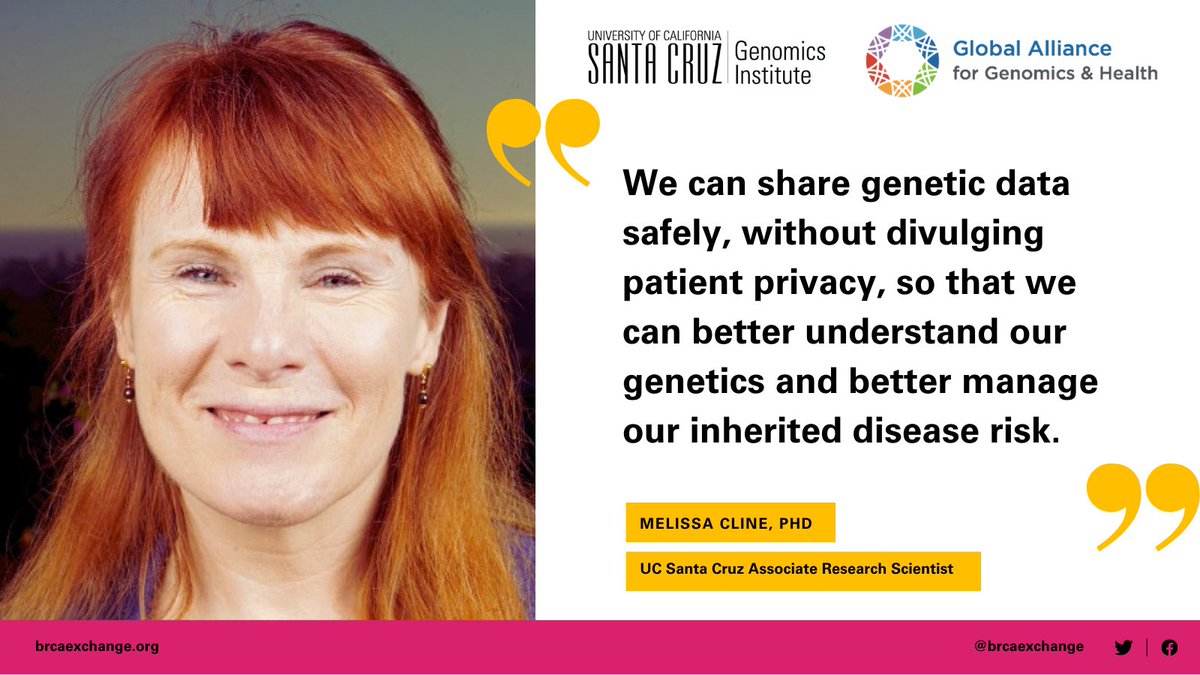
We thank the GA4GH for this article on our work on federated analysis! This approach can enable responsible data sharing which both preserves patients' privacy and informs expert variant curation, ensuring that more women receive the right clinical care.
https://t.co/RlbrgAnu8e
Want to know if you inherited an increased risk of cancer from your parents? Interested in finding out about your ancestry? It's important to get the right genetic test! Learn more in our latest blog post and check out (and share!) our infographic! https://t.co/x4A5GdjOwv
We are thrilled to announce the publication of our article in Cell Genomics! By "bringing the code to the data", we can gain valuable insights from protected data without compromising patient privacy #federatedanalysis
https://t.co/UfWaUGM1QL
Come join us next week for what should be a great, thought-provoking town hall with our patient advocacy colleagues at The Light Collective! #BeLikeLight.
https://t.co/5R4Umy4Owo
We are thrilled to announce the new BRCA Exchange Blog! This patient-oriented blog will address topics that are commonly asked about in patient communities, including: types of genetic tests, genetic data privacy, and variant interpretation. See https://t.co/WqOi8KNwdI
UC Santa Cruz is proud to be a long-standing member of an international coalition of scientists and policy advocates, the Global Alliance for Genomics and Health (GA4GH).
👏 👏🏻 👏🏼 👏🏽 👏🏾 👏🏿 BRCA Exchange congratulates our colleagues Sadrine Caputo @sandmarie77 and Bing-Jian Feng @fengbjlab for their work showing the power of family-level data for classifying harmful BRCA variants.
@sandmarie77@fengbjlab Several genetic testing laboratories are now working to apply this methodology to their own variant interpretation. Read "Cosegregation powerfully classifies BRCA 1/2 variants": https://t.co/uGV9E6ElE8, check out the study:
https://t.co/Wdz65kLsfX
The panel discussion, "Optimizing the Treatment of Breast Cancer to Empower Patients," featuring #MammaPrint inventor @LVVPrint and #breastcancer survivor Angie Trang Nguyen about the importance of personalized medicine is starting soon!
Tune in here: https://t.co/Iqt5efAW0A
We want to give a shout out to the many people who contributed so much work and thought to this functionality, especially team members Michael Parsons and Zack Fischmann. #heritablecancer#knowyourrisk#BRCA
We are excited to announce that Release 50 of BRCA Exchange will soon be live with more than 67K variants!!! Thanks to our collaboration with the ENIGMA Consortium, this release offers new data on laboratory functional assays.
This is why functional assays are considered a rich source of information that can help people understand and manage their potential genetic risk for cancer.
Researcher Melissa Cline won an award of $150,000 from the National Cancer Institute to fuel a web portal designed to help researchers identify individuals at risk of heritable stomach cancers. Cline this effort. Congratulations, Melissa! 🙌 @brcaexchange@melissascline
.@UofCalifornia researchers are at the forefront of discovering new ways to prevent, treat and cure diseases. But they can’t do that without federal funding. Help us tell that story by sharing how medical research has impacted you! #UCinDC https://t.co/gThDhXadKG
@useAnVIL@genome_gov Security is critical because even if it isn't patient-level data, we might have data submitted by genetic testing labs. These data can be a very valuable addition to our collection, and so we must preserve these labs' preference to keep their data secure.
@GA4GH
We're delighted that BRCA's lead investigator at UCSC Melissa Cline won BRCA Exchange some @useAnVIL cloud credits. This is a small but significant award that should help us reduce friction in the variant interpretation process.
@useAnVIL@genome_gov It turns out that just about all the variant interpretation consortia have the same struggle: We need a place for pulling data together, in a location where everyone can access it, but where the data will be stored securely.