Built a full-stack AI schema audit tool in two sittings. Solo. One day.
Not a side project. A real tool:
→ Fetches + renders any URL
→ Audits existing schema
→ Flags what's missing and why it matters
→ Generates the JSON-LD
→ Gives you CMS-specific implementation steps
Built for small business owners who don't speak developer.
First test site? My own. It found 3 real issues I hadn't fixed.
0-Tech Schema is live at https://t.co/62TtYQs3bS
Free. No login. Just paste your URL.
The assumption that small clients aren't worth the time is part of what keeps consolidating every sector toward the same five companies. I've seen more SMBs doing informed, self-directed hiring in the last six months than ever. That's a real market. Not every business model has to chase the biggest retainer in the room.
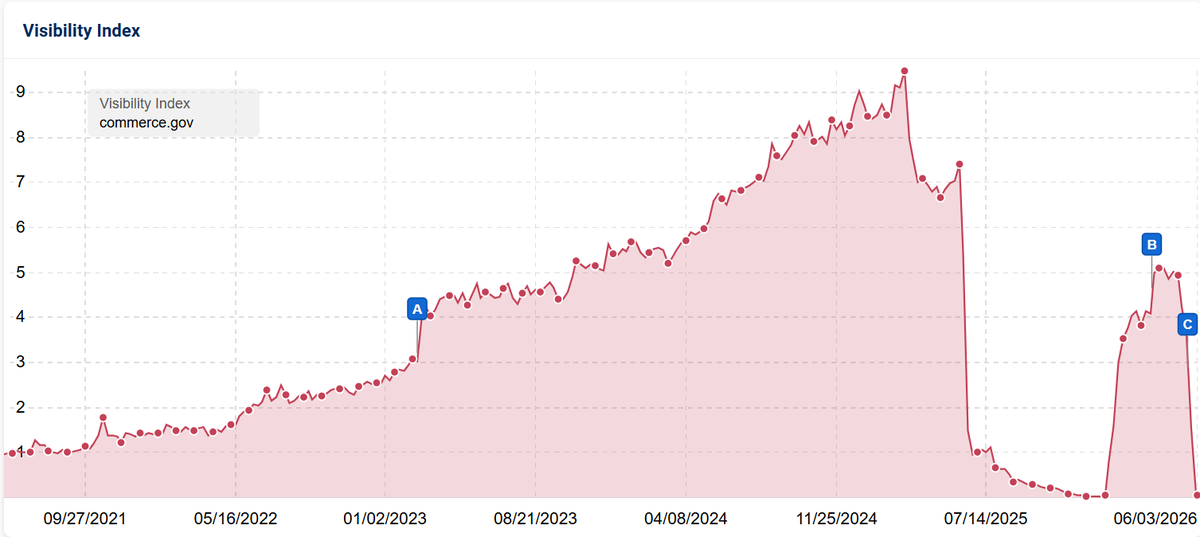
Looks like the US Chamber of Commerce website (https://t.co/9igEqW9eyB) just dropped out of Google's search results entirely 🤯
This site houses a lot of important content, like the official page listing all U.S. federal holidays
It appears the site returns a 403 to Googlebot
@1topicalhq Inherited messes are their own category. You can't quote the real scope at the start because you don't know what you're walking into yet. By month three, you know, and the conversation has already happened once at the wrong price.
@1topicalhq That lag is where most retention problems start. They see no movement in month one and assume nothing's happening — when the real question is whether the foundation was worth building on. Your point and mine are related: clients who came in informed are easier to keep.
That's a real segment — the completely-hands-off buyer exists. But the list isn't asking them to fix anything. It's asking them to look at five things before signing a contract. That's a different ask than managing their own site. A business owner who can Google their business name and read gray text is a larger group than the one who knows what h1 means.
For local service businesses the calculus is different. They're not monetizing pageviews — they want phone calls and contact form submissions. An AI citation for "best roofer in [city]" that skips the click is still a conversion path. The opt-out conversation is really a publisher problem. Service businesses opting out by default are walking away from the most direct route to AI recommendations.
Structured data at +21.60% is the most actionable item here — it's the only one you can add without rewriting existing content. And it compounds: FAQ schema directly implements the Q&A format signal, Article schema with proper description fields supports the summarization quality signal. One implementation pass that addresses multiple citation drivers at once.
b + c + d, but b is the multiplier the others can't replicate. The quote shows HubSpot ran serious AI optimization work — but the reason those experiments could produce 1850% is that they started from a corpus where HubSpot was already the dominant CRM reference. Same experiments at a smaller brand would produce a fraction of that result.
The 1% click rate matters, but the more useful question is whether AI citations are producing a downstream lift in branded searches in GSC. If your AI visibility goes up and your branded query impressions don't move, you've got reach without influence. Most current tooling measures the first and mostly ignores the second — which is why the price is hard to justify.
@searchless_ai The legal angle is the one most brands haven't hit yet. If you can't audit what was synthesized from your content, you can't argue it was misrepresented. Conflation at that scale stops being a monitoring problem and starts being a liability one.
@searchless_ai 22% materially distorted while still scoring as a win in the dashboard is the exact failure point. The URL match creates a false confidence — the content is 'there' but the claim has already been swapped out.
The fix is real, but secondary category has limits. Adding "plumber" as secondary helps, but a Plumber-primary competitor will still edge them out on intent matching in a tight market. For a 4-trade operation, the real move is identifying which category drives the most search volume in their area and making that the primary — even if it's not the highest-margin service they offer.
The 5% probably holds as an average, but the distribution is the whole story. "How to change a tire" in AI Mode → near-zero clicks, that query is basically gone for publishers. "Emergency HVAC repair tonight" → someone still has to call, so they click. Publishers covering evergreen informational content are taking the hardest hit. Service businesses with transactional and local queries are hurting less than the headline number suggests.
The EU/UK overtaking the US despite launching later is the data point I'd watch most closely. You'd expect a later-launching region to still be catching up — but it's ahead. That suggests once AI Mode hits a certain feature and user density threshold, adoption doesn't climb gradually, it tips. For US practitioners, Q1 2026 numbers are probably a starting line, not a ceiling.
Yeah, for local it's even more pointed. A service business can rank well in AI responses on GBP data, reviews, and citation consistency alone (no page link involved), and this report will show them nothing. The measurement gap isn't just an analytics problem. It's a strategy misdirect if people optimize the page layer while the entity layer is doing the actual work.
The problem is worse for local/service businesses. Google's AI responses regularly recommend them by name, pulling from GBP data, reviews, and citation networks, without any linked URL. That entity gets zero impressions in this report even though AI just drove someone to call them. The entity layer and the web layer have been drifting apart since local pack evolution; AI Mode just made the gap impossible to ignore.
New AI reporting features finally coming to GSC.
Reporting on impressions and not clicks says a whole lot here 🫠
But yes, grateful to have any AI reporting at this point 🙏🏽
https://t.co/7MWjkYuNEh
@harjjotsinghh Good catch on the webhook sig — already handling it, just didn't include the full implementation in the thread. The Web Crypto path is more steps than constructEvent but it's not complicated once you've done it once.
I needed a paid tier on a free tool. $9, one time, 100 credits. No subscription, no SaaS bloat.
Built the whole payment flow inside a Cloudflare Worker. No Stripe SDK, because you can't run their Node library at the edge. Here's how it actually works.
@mostly_agree@gaganghotra_ That's a better framing, yeah. It's not that they're safe — it's that the downside volatility is severe enough that brands treat defense spending as cheaper than exposure. Different reason, same behavior.