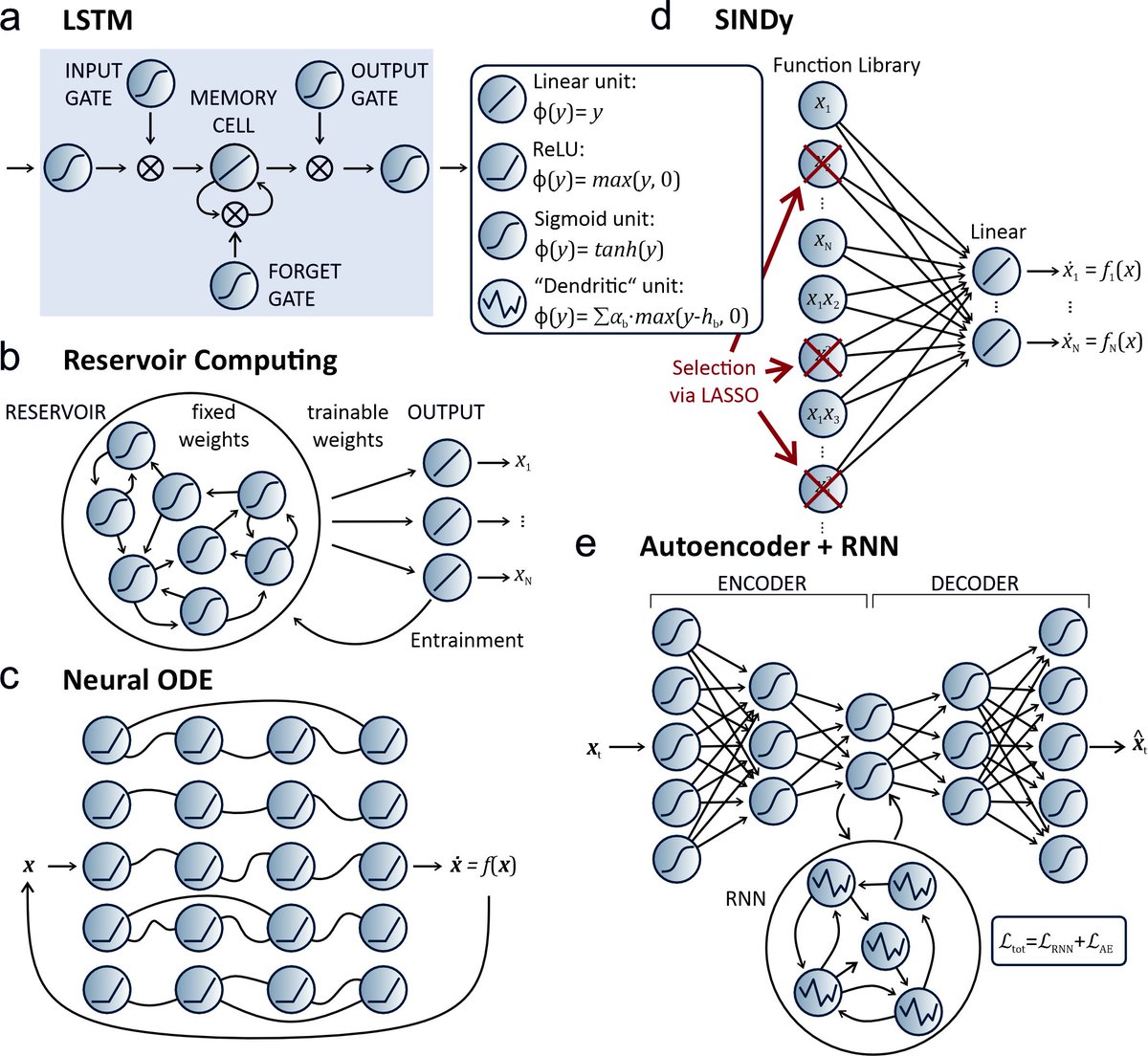
The field of ML has evolved to balance these 2 forces: leveraging the simplicity of linear models where possible, while incorporating nonlinearity to handle the complexity of the world. Read more from @brenner_manuel.
#LLM#MachineLearning
https://t.co/9u3Z4rqgWP
Symbolic dynamics bridges from #DynamicalSystems to computation/ #AI!
In our #NeurIPS2024 (@NeurIPSConf) paper we present a new network architecture, Almost-Linear RNNs, that finds most parsimonious piecewise-linear representations of DS from data: https://t.co/sePJ4WHGkg
1/4
Interested in interpretable #AI foundation models for #DynamicalSystems reconstruction?
In a new paper we move into this direction, training common latent DSR models with system-specific features on data from multiple different dynamic regimes and DS:
https://t.co/uaf1RcyTBi
1/4
This is awesome - using neural flow operators trained by multimodal teacher forcing to produce generative dynamics models of human behavior in social contexts ... social strategies as attractors in state space!
Just wanted to stop by & say: We have 2 new accepted #NeurIPS2024 papers:
1) @brenner_manuel , Hemmer, @Zahra__Monfared, DD:
Almost-Linear RNNs Yield Highly Interpretable Symbolic Codes in Dynamical Systems Reconstruction
--> *this takes DSR to a new level!*, details to follow
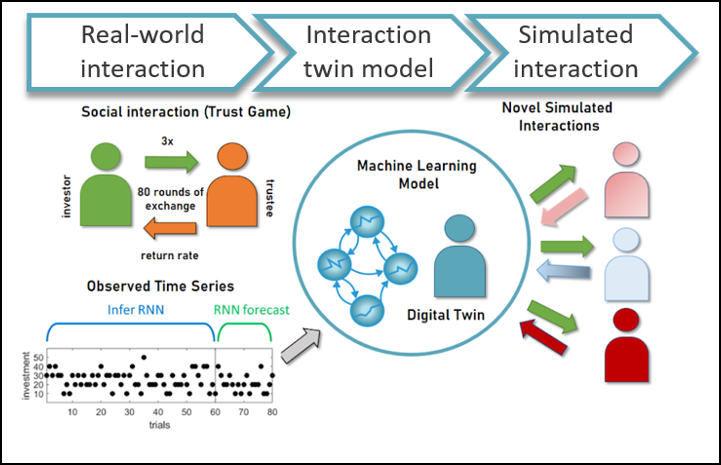
Creating digital twins of social interaction behavior with #AI! Our study shows how generative models can predict interactions from limited data, revealing hidden dynamics. Together with @brenner_manuel@DurstewitzLab. Explore: https://t.co/4zoEniAQcc #DigitalTwin#SocialBehavior
⚠️New paper out in Psychological Medicine⚠️ The experience sampling methodology as a digital clinical tool for more person-centered mental health care: an implementation research agenda.
Read it here https://t.co/vopCy3AXLO
Weight pruning by size is a standard #ML#AI technique to produce sparse models, but in our @icmlconf paper https://t.co/R3u5M3cxkX we find it doesn’t work for learning #DynamicalSystems!
Instead, via geometry-based pruning we find *network topology* is far more important! (1/5)
3) Integrating Multimodal Data for Joint Generative Modeling of Complex Dynamics
(prelim. vers.: https://t.co/9SFba4iiyC)
Fantastic teamwork, as usual, by @niclas_goering, Florian Hess, @brenner_manuel, @Zahra__Monfared, Jürgen Hemmer, @GeorgiaKoppe
Cool, 3 papers accepted at #icml2024:
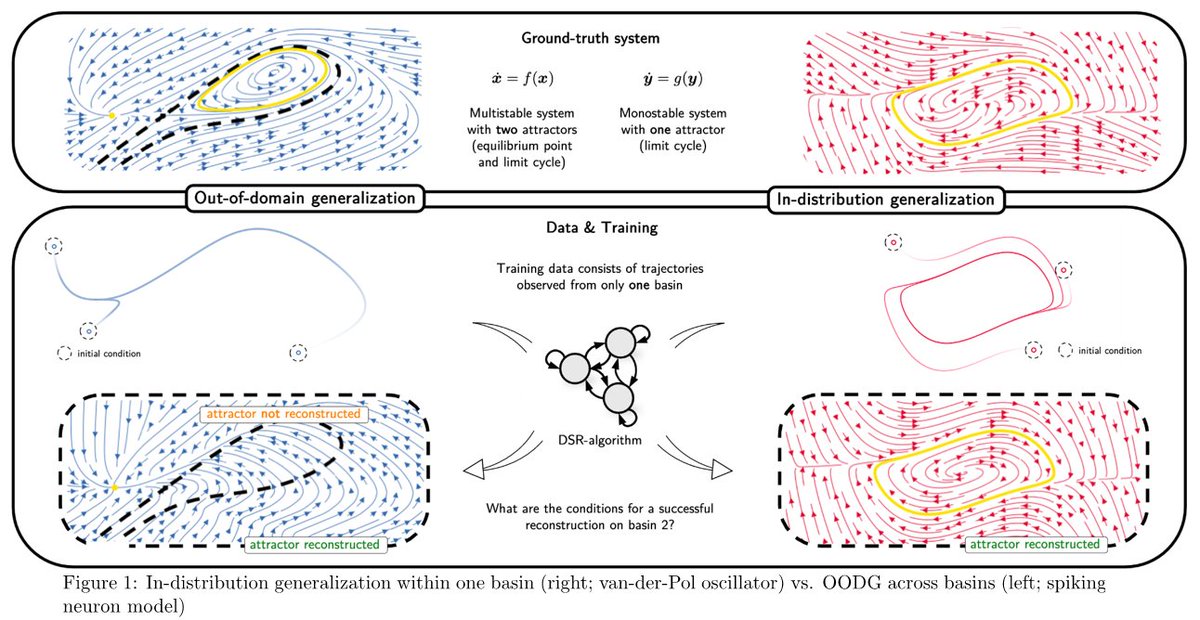
1) Out-of-Domain Generalization in Dynamical Systems Reconstruction
(prelim. vers.: https://t.co/urxNeLE6wh)
2) Optimal Recurrent Network Topologies for Dynamical Systems Reconstruction
(details to follow)
...
Can we learn from time series data a dynamical systems model that *generalizes* to unobserved dynamical regimes (basins of attraction), like a good scientific theory should?
Out-of-domain generalization in #DynamicalSystems reconstruction:
https://t.co/urxNeLE6wh
#AI#ML
(1/3)
Surprisingly, our framework enables to reconstruct chaotic attractors from just *symbolic* time series alone under certain conditions. This gives hope that it may be possible to infer dynamical systems just from behavioral class labels or language.
(3/4)
How to reconstruct #DynamicalSystems from many different data modalities observed simultaneously?
Here we introduce a novel generative modeling framework for this, based on control-theoretic ideas for efficiently guiding the training process: https://t.co/9SFba4iiyC
#AI#ML
(1/4)
How to analyze comput. & dynamic mechanisms of RNNs?
1/2 Our #NeurIPS2023 spotlight on a highly efficient algo for locating all fixed points, cycles, and bifurcation manifolds in RNNs: https://t.co/qmINjJB40h
@NeurIPSConf
By brilliant @Zahra__Monfared, @lukasironman, Nic Göring
⚠️ New PhD blog alert ⚠️
Dive into the future of mental health care! Explore the incredible potential of 𝐀.𝐈. in predicting trends and uncovering hidden patterns. Curious? Check out this month's blog by @brenner_manuel
https://t.co/Tzu02qQuDA
Our Perspective on reconstructing computat. system dynamics from neural data finally out in @NatRevNeurosci!
https://t.co/mje21ShyWC
We survey generative models that can be trained on time series to mimic the behavior of the neural substrate.
#AI#neuroscience#DynamicalSystems
In this article, @brenner_manuel dives into the fundamental mechanisms of several classes of generative models, shedding light on their inner workings and exploring their origins in and connections to neuroscience and cognition. https://t.co/X4t0zo8vNP
"SGD, along with its derivative optimizers, forms the core of many self-learning algorithms."
@brenner_manuel walks us through the inner workings of stochastic gradient descent. https://t.co/z3OC2Ee0OX
Thanks @brenner_manuel for your knowledgeable questions and for having me on your great podcast! 🎙️
🎧 Listen on Spotify: https://t.co/vaY3I5K0cN
🎧 or Apple Podcasts: https://t.co/OweHSe523m