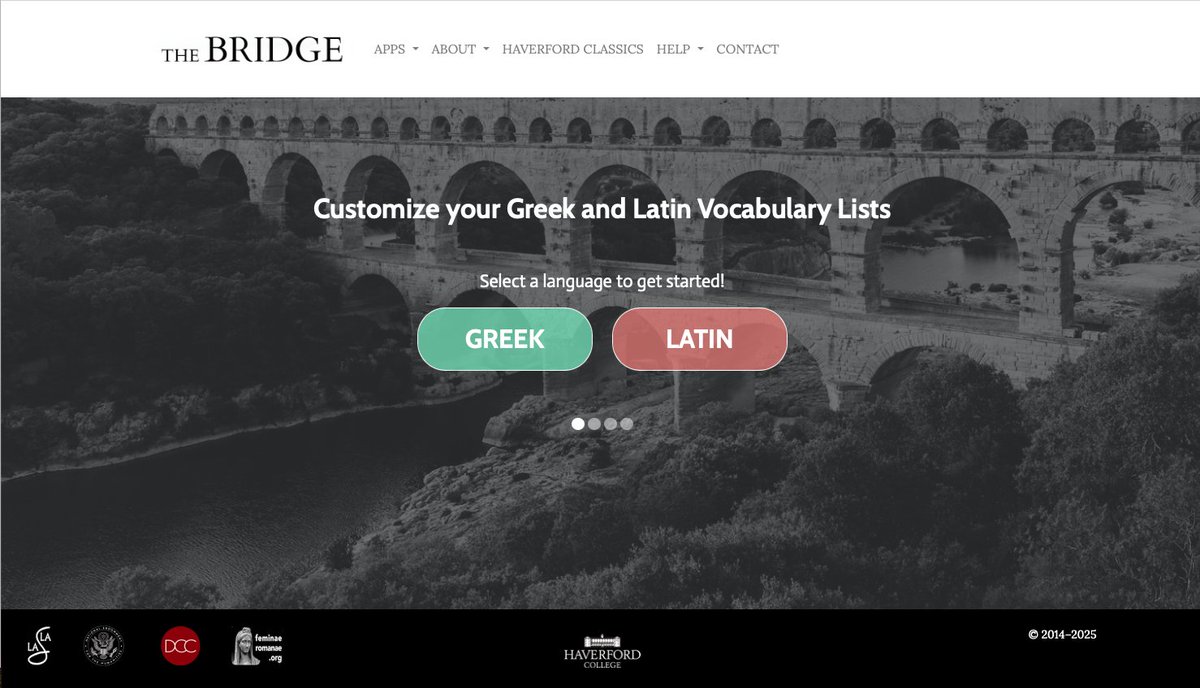
The Bridge at @HavCollClassics has had some major upgrades. Check out the new Latin and Greek lemmatizer tool. It combines approaches to produce unparalleled accuracy and allows you to easily choose when the engines disagree. Wow. Bravo @bretmulligan
https://t.co/3YyyMht9xD
🚨@diyclassics has declared a "philological emergency" at the Digital Classics Association panel at #scs2026, caused by LLMs use of corrupt OCR'd Latin. But he's assembled a team to remedy the problem.
Loved today's episode... but you've disgraced yourself yet again when discussing the Mauch Chunk Gravity Railroad. Jim Thorpe wasn't a megalomaniacal founder of an eponymous town. Rather, the town of Mauch Chunk was renamed in Jim Thorpe's honor in 1954 (and so a perfect digression for today's episode). He was a sporting icon, a three-sport professional athlete, and the first Native American to win an Olympic Gold Medal.
New commentary on selected works by brilliant Latinist Elizabeth Jane Weston now out via Pixelia Publishing https://t.co/vzRlV9dZAe (in print and OER pdf). Collaboratively made for readers everywhere by students @haverfordedu, @BrynMawrCollege & @swarthmore.
We're also working on adding user accounts. These will let users store and edit and share lists made in the Bridge, and (maybe) even upload and use their own lists of known vocabulary. Hopefully coming later this year! (calendar or academic tbd).
More https://t.co/KKnqQlF8wp news: the new AP List Core list and Project Readings (including all of the Laudatio Turiae) are available + Egeria's Itinerarium Book 1, the Book of Tobit, Makin's Descriptio Pennsylvaniae, Vitruvius Book 1, & all of Elizabeth Jane Weston!
Or imagine you'd like to find 10-line passages in Aeneid 5 for which students have seen the highest % of words once they have finished the new AP syllabus. Ecce! Clicking on the "link" creates a list of unknown vocabulary in Lists!
Big updates to https://t.co/KKnqQlEAGR now available! More accurate data and reliable creation of "Lists." . The ability to score the readability of Latin texts using "Stats". A cut/paste "Demacronizer" for Latin texts. A revamped "Lemmatizer". And "Oracle"...
"Oracle" allows you to discover works and selections that best match known vocabulary! Imagine you know the @DCComm Latin Core List and are looking for Martial epigrams that have the highest (or lowest) % of known vocabulary. Here they are! (You could also look for e.g. a range of 6 lines or an entire book).
At #IANLS2025@diyclassics lights fire on “massive Latin” (philological work that requires computation) and the field’s “race against error” because of the proliferation of machine-generated “Latin-like” texts that risk confounding our corpus of Latin texts.