814 leads in 18 days from 59,340 cold emails.
The client manufactures custom cups, bowls and plates for local businesses ordering 5,000+ disposables a month.
Their market was huge, and the contact data on it was a mess.
Here's the full system we built, from the first scrape to their sales team's inbox:
1. Map the market off Google Maps
> Pulled every local business that could buy
> Ran it through Serper and Clay
> Found a segment we didn't expect: megachurches
2. Find an inbox when there's no owner
> No owner? Claygent finds a personal or info@ email
> The copy skips {first_name}, so it reads right
3. Make the offer easy to say yes to
> Faster delivery
> Smaller minimum orders
> A free mockup of their logo on a cup
They see what they'd get before they reply, so the email stays short and lets the mockup do the selling.
4. Route every reply
> Every reply goes through n8n to tag the intent
> Slack pings the sales team
> Interested leads sync from EmailBison to HubSpot
> Round-robin across their 5-person sales team
5. The numbers (18 days)
> Emails sent: 59,340
> Opens: 0 (tracking stays off on purpose)
> Replies: 2,083
> Interested: 814
That's 1 lead for every 58 people contacted (I call anything under 500 a solid campaign).
6. What it's turned into
> 8 deals a month, closed over email (no sales calls)
> $40,000/month in net new revenue
> $120,000/month in LTV added
We've tripled their positive replies against their old monthly quota.
That puts them on pace for 24 deals a month, $120,000/month in net new revenue and $360,000/month in LTV.
If you're a B2B company looking to scale pipeline, book a call at the link below:
One issue I keep seeing with other cold email agencies:
They only ever use half your list.
Every contact on it gets emailed, and the phone numbers never get dialed.
At bigger companies, that's the half that books.
Cold email alone rarely reaches the person who signs at a company with 1,000+ employees.
Calling needs its own team and its own tools, so email-only agencies leave it out.
We run the phone from day one, on the same system as the email.
How it works:
> One list feeds the emails and the dialer
> Every positive reply gets a call straight away
> Calls and replies all land in your CRM
> You own every piece of it, down to the domains
What it looked like for one client:
A workflow automation company selling into 34% of the Fortune 500.
They came to us after 2 agencies couldn't make calling work.
Within a month we'd doubled their daily call volume.
NASA, Samsung and Airstream came off the phones.
Our base package is 100,000 emails a month, and the mixed plan adds 1,000 dials a day on top.
If you want both built for you, DM me "CALLS"
Local business cold email vs enterprise cold email...
For local businesses, the best inbox to hit is info@, with no first name in the email at all.
For our client, a foodservice manufacturer, that got 1 positive reply for every 60 people contacted.
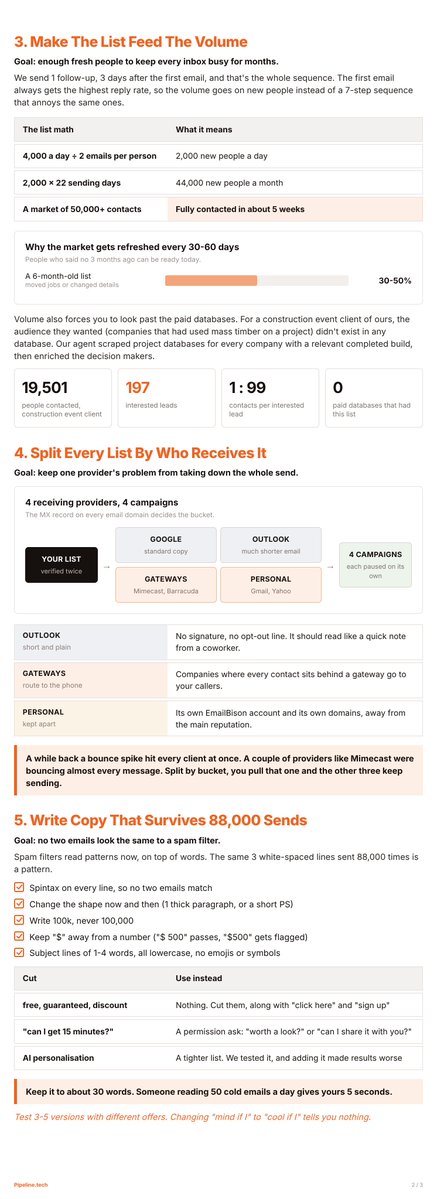
For enterprise, a lot of emails never land, because they sit behind security gateways like Barracuda and Proofpoint.
So we check every contact's email provider first, and the gated ones go to the phone.
Same channel with opposite playbooks.
We run both across 100+ B2B companies.
We've written a playbook for every part of B2B outbound
> the funnel every campaign runs through
> free lead sources the paid databases miss
> cold email setup that lands in the inbox
> the scripts behind our best campaigns
> AI that builds the lists for you
> full GTM breakdowns of Rippling, Verkada & more
I've put everything we've learned from 17M+ cold emails & 100+ B2B companies into one thread
Bookmark this and take whatever you need 🧵
I'm genuinely losing my mind watching people sleep on speed to lead...
You spend weeks on the list, the inboxes and the offer.
Someone finally replies "sure, send it over".
And the reply sits there until tomorrow morning.
Here's what that costs you:
20-30% book when you reply inside 5 minutes.
~5% book after an hour.
80-90% book when you call and they pick up.
"But we always reply the same day."
That's like answering the door 3 hours after the doorbell rings and wondering why nobody's there.
Set it up right.
A Slack alert on every positive reply. Respond within 1 MINUTE. Call every positive.
And suddenly the same campaign books a lot more meetings without sending 1 more email.
Send this prompt to your AI model of choice right now.
It builds your cold email offer for you:
> Finds the pain your buyers share
> Writes 5 offers to test
> Makes each 1 an easy yes
Hormozi says more of what works beats anything new...
He calls it "the highest risk adjusted move that you can make."
In this clip he uses a control that's won 36 split tests, where the odds of a change beating it are low.
For cold email, that means sending your working offer to more people.
A mistake I see all the time is rewriting the email instead, and swapping "mind if I" for "cool if I" tells you nothing.
The biggest thing I learned going from 60,000 emails a month to managing 3.5M: volume solves A LOT of your problems.
I wrote out the whole setup in the article below, from the inbox math to the booked call:
How it feels realizing you've been overcomplicating cold email for years when someone just dropped the entire system for sending millions of emails without burning your inboxes:
I'm building an AI agent to run our cold email offer tests
Most offer tests I see get called on noise
One offer gets 5 interested replies and another gets 3, so someone calls a winner
We call ours the Campaign Gauntlet, and here's how a client's 6-week season runs:
1/ Set the bar first
Before a single email sends, a win needs 10+ interested replies and 3X the next best (and the bar never moves)
2/ Test the offer in weeks 1-4
A straight ask goes up against 2 offers where we give something up front
3/ Score it every Friday
The agent scores the week's replies against the bar, and nothing wins until it clears it
4/ Make every loss explain itself
A losing offer has to say why it lost, since all 9 losses in our old test log said "doesn't respond"
5/ Test the wording in weeks 5-6
Once an offer is leading, the last two weeks go on the wording
The offer buckets started from Eric Nowoslawski's offer gauntlet (we've changed a lot of it since)
AI drafts the strategy and the calls
Every launch and every pause still goes through me
Cold email is the cheapest market research you can buy
Every other way to test a new market takes a quarter and a new hire.
Cold email gives you the answer in about a month, and books meetings while it does.
Here's how I'd run it if you need to know where next year's growth comes from:
Split your market into 5 segments you could sell to.
Write 2 offers for each one.
That's 10 campaigns running side by side.
At 100,000 emails a month, each campaign gets about 10,000 sends.
Sending more volume solves a lot of problems, and this is one of them (at 2,000 emails a month you're reading noise).
After the first month, check how many contacts each campaign needed to get 1 interested reply.
Past 2,000 contacts per lead, that segment or that offer is wrong.
The segment that needs the fewest contacts per lead is your next market.
How you write the offers matters too.
Buyers reply to offers in this order:
> Make them money
> Cut their costs
> Save them time
> Lower a risk
Lead with whatever your product does highest on that list.
Some segments will come back dead whatever you send.
Cybersecurity and bookkeeping buyers go looking when something breaks, so a cold email rarely catches them at the right time.
So the next rep you hire starts on a market that's already replying.
I'm building an AI agent to run our cold email offer tests
Most offer tests I see get called on noise
One offer gets 5 interested replies and another gets 3, so someone calls a winner
We call ours the Campaign Gauntlet, and here's how a client's 6-week season runs:
1/ Set the bar first
Before a single email sends, a win needs 10+ interested replies and 3X the next best (and the bar never moves)
2/ Test the offer in weeks 1-4
A straight ask goes up against 2 offers where we give something up front
3/ Score it every Friday
The agent scores the week's replies against the bar, and nothing wins until it clears it
4/ Make every loss explain itself
A losing offer has to say why it lost, since all 9 losses in our old test log said "doesn't respond"
5/ Test the wording in weeks 5-6
Once an offer is leading, the last two weeks go on the wording
The offer buckets started from Eric Nowoslawski's offer gauntlet (we've changed a lot of it since)
AI drafts the strategy and the calls
Every launch and every pause still goes through me
Dan Martell says 1 cold email has made him tens of millions of dollars...
The sender mentioned his Facebook stories and a YouTube video he’d just uploaded.
Then he asked if he could send over a quick 3 minute video.
That’s real research, done by hand, for 1 person.
Try that across thousands of leads and you end up with AI writing the first lines.
We tested those AI first lines, and they hit a 0.27% reply rate.
Emails with nothing but a first name hit 10%+.
Full breakdown in the article below:
Ranking every part of a cold email setup in tiers:
S TIER
> Google inboxes from a reseller. About $3.50 each, with DNS done for you.
> EmailBison. A vetted warm-up pool and an API you can launch campaigns from.
> MillionVerifier, then BounceBan for catch-alls. Keeps bounce under 2%.
> Replying inside 5 minutes. It turns replies you paid for into meetings.
> Calling every positive reply. Books more than any email back.
A TIER
> PlusVibe. The pick if you send under 50k a month.
> Porkbun. Lookalike .com domains at about $12 a year.
> One follow-up, 3 days later. The rest of your volume goes to new people.
> A keyword opt-out. "Reply no thanks" instead of a link.
B TIER
> Apollo. Works, and every competitor pulls the same rows.
> Clay. Great at qualifying, pricey as a data source.
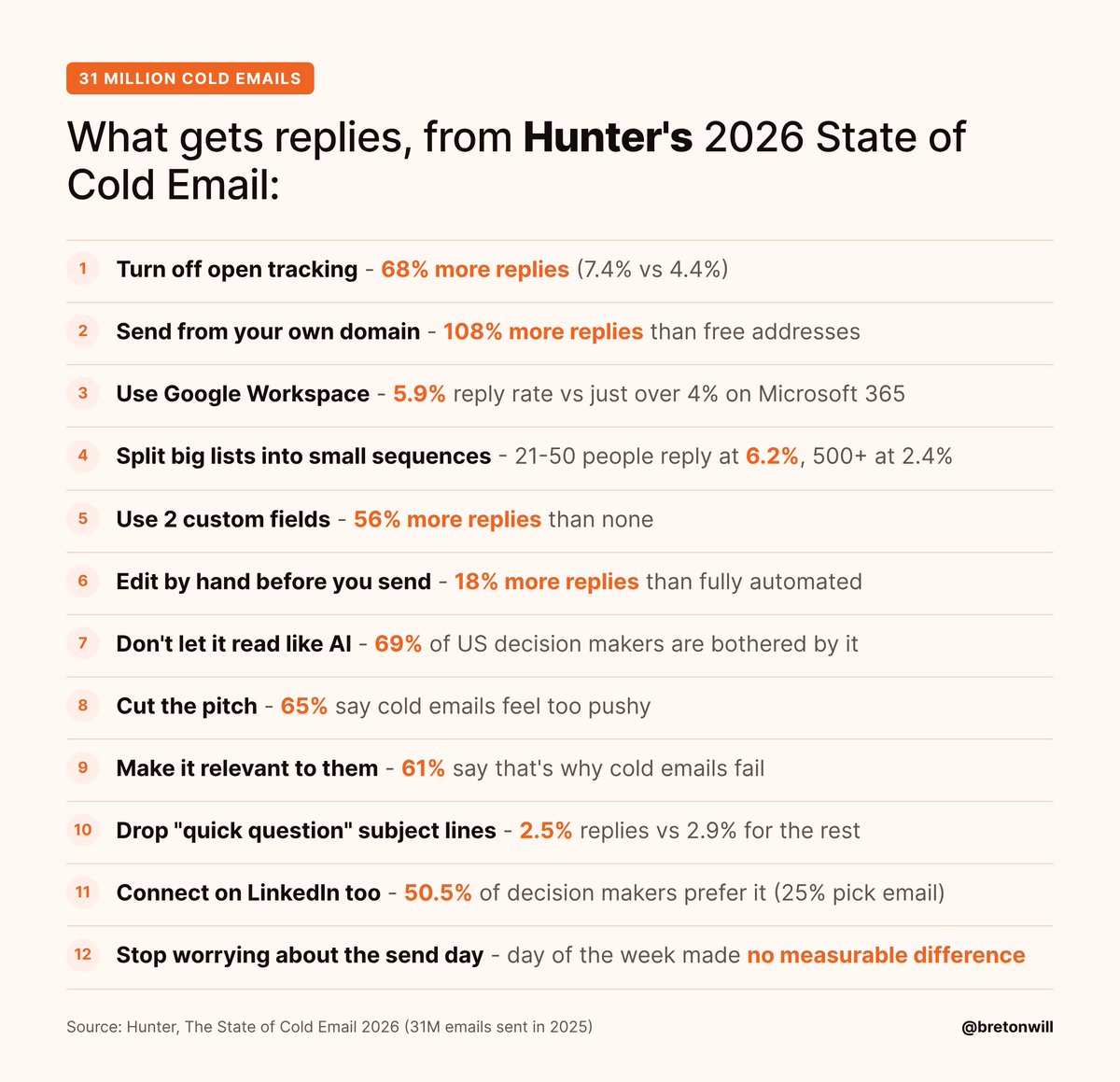
> Microsoft inboxes. Only worth testing if you sell to enterprise.
C TIER
> SMTP inboxes. Cheap, and it shows in placement.
> .info domains. Cheap, and riskier over the past year.
> Blacklist checkers. We're on a few for every client and still book meetings.
D TIER
> AI first lines. We tested them, and replies went down.
> 5-7 follow-ups. More spam risk for people who already ignored you.
> Open tracking. A pixel that hurts placement for a number you can't act on.
F TIER
> Sending cold from your main domain.
> An unverified database export. Around half of it bounces.
> A booking link as your whole reply.