Note the good Westpac credit card complimentary overseas travel insurance is being stopped. Its no longer free except for medical cover. And that's only for a months trip max.
Ask your favourite AI when its training data ends.....Gemini says "My training data and core offline knowledge base go up to January 2025". That has implications if you are relying on an independent analysis of a specific trend or opinion over the last 12 months...
In a workshop on the outskirts of Bletchley (it had to be there, didn't it), on the 26th of March this year, a small British company called Pulsar Fusion did something that has not been done by any other company or government on Earth.
It ignited a controlled plasma inside the test chamber of a working nuclear fusion rocket engine.
The plasma held, along with the chamber. The fusion reaction was the kind of reaction that, contained inside a sufficiently engineered magnetic bottle, will one day take a crewed British vehicle to Mars in 30 days rather than 8 months, and that will, within the working lifetime of the engineers presently building it, make the outer planets of the solar system accessible to anyone with a British passport.
The geography of the achievement deserves a longer moment of pause. Bletchley, in 1942, was where Alan Turing and his colleagues broke the Enigma cipher and almost certainly shortened the war in Europe by two years. Pulsar Fusion's headquarters sits roughly 600 yards from the Hut where they did it.
The country that did the maths inside that hut has just, less than a mile down the road, ignited the plasma that could power the next century of human space travel. There is a continuity of British scientific lineage here that is, on the face of it, almost embarrassingly providential, and it is almost completely unreported in the British press.
It's not quite Kitty-Hawk-to-the-moon in 61 years, but it's close.
Like so many great companies of profound importance, Pulsar Fusion is pretty small. It was founded in 2013, and employs around 50 staff. Its chief executive, Richard Dinan, is a working British physicist who has spent the last decade quietly assembling the team and the capital to do what the world's national space agencies have been promising for 60 years and consistently failing to deliver.
The competing American programmes, principally at NASA's Glenn Research Center and at the Princeton Plasma Physics Laboratory, are years behind on the propulsion side. The competing Chinese programmes are obscure but, on what is known publicly, also behind. The European Space Agency is, as ever, organising a workshop. Pulsar fired its plasma in March and has been preparing the next-stage tests in the months since.
What this kind of capability means, when commercialised, is genuinely vast.
The economic argument for getting a payload to Mars in 30 days rather than 8 months is not principally about the human passengers, though there is one. It is about cargo. Given a 30-day transit, Mars becomes a logistically tractable destination for the kind of infrastructure-build that turns it from a flag-planting science mission into a working industrial site.
The argument for the outer planets is even larger. The asteroid belt alone, on conservative mineralogical estimates, contains more economically viable platinum-group metals than the entire crust of the Earth has been mined for in industrial history. The first country with reliable fusion propulsion is the first country with reliable access to that supply. The country that holds that capacity, fifty years from now, will be holding the most consequential industrial advantage of the 21st century, and there is no obvious second prize.
The standard British response to this kind of thing is to either ignore it entirely, sell the company to an American buyer at series B (the DeepMind path) for fire-sale prices, or fund it at the level of a Whitehall departmental tea and coffee budget (the Skycutter and Orbex paths).
The standard British response will not be sufficient. Pulsar Fusion needs the kind of patient capital that turns a working demonstration into an operational engine, and that, in turn, into a manufacturing capability. The British state, on present form, is structurally incapable of providing it, British pension funds are structurally incapable of investing in it, and the British political class will, on present form, only notice if it somehow manages to swing a leadership election.
I wantt= Pulsar Fusion treated as a national-strategic asset, and beyond that as a potential subject of national destiny.
The Sovereign AI Fund that backed Ineffable Intelligence has a clear template. The Prosperity Zone programme we designed at Progress that anchors heavy industry at SaxaVord and Teesside has the geographic flexibility to include a fusion-propulsion cluster in Buckinghamshire, six miles from the most evocative site in modern British scientific history.
The procurement architecture of every major British defence and space agency should, from this autumn, be writing offtake contracts contingent on Pulsar's milestones. There's nothing extreme about these ideas. We could have been doing it decades ago.
I always conceived of Britain as being as much among the stars as it is on Earth. To buy into the idea of Britain as a culture and polity is necessarily to buy into the concept of the human being as an illimitable force. Our history is littered with happy instances of people of great fortitude hitting upon obstacles and, with a cry of "This will not stop us", clearing the way for our brothers and sisters to follow through.
A small British company in Bletchley has, while nobody was looking, extended that arm of our tradition, by accomplishing one of the most important pieces of scientific engineering of the decade.
The country that produced them is, in a measurable sense, the same country that produced the Bombe, the Colossus, the jet engine, the structure of DNA, and the World Wide Web. The capacity is intact. The political class capable of recognising it must catch up, and will.
@clarashih Every powerful technology in history had an off switch. Superintelligent AGI will not. Politicians & lawmakers aren't close to grasping it. And the people building it are the most dangerous optimists in human history..
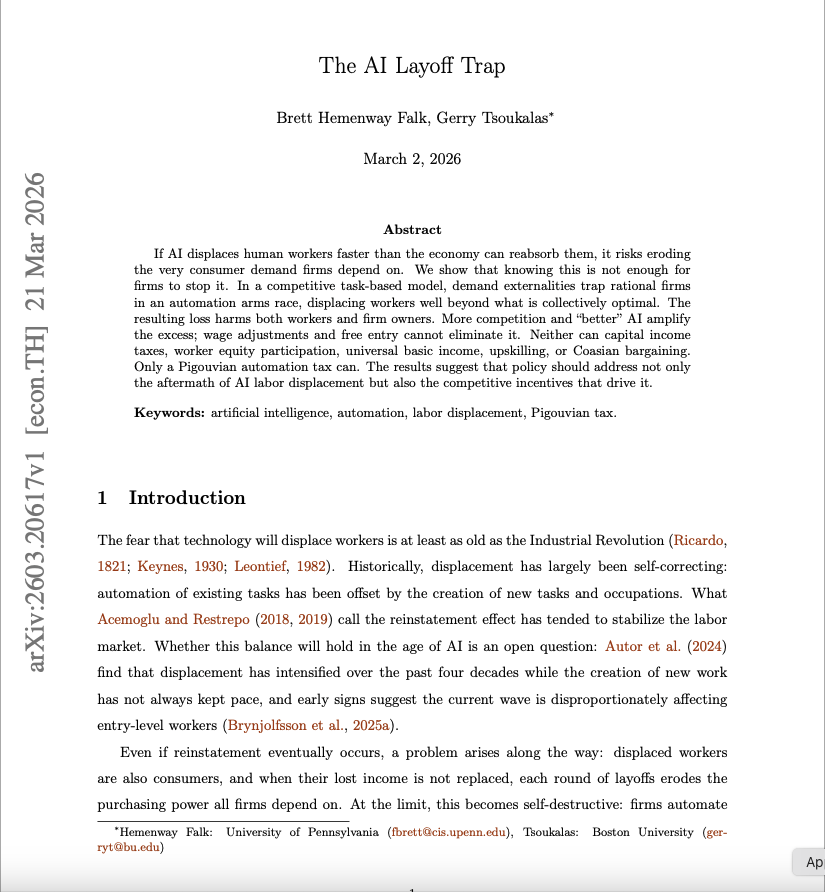
Two economists just published a mathematical proof that AI will destroy the economy.
Not might. Not could. Will — if nothing changes.
The paper is called "The AI Layoff Trap." Published March 2, 2026. Wharton School, University of Pennsylvania. Boston University. Peer reviewed. Mathematically modeled.
The conclusion is one sentence.
"At the limit, firms automate their way to boundless productivity and zero demand."
An economy that produces everything. And sells it to nobody.
Here is how you get there.
A company fires 500 workers and replaces them with AI. A competitor fires 700 to keep up. Another fires 1,000. Every company is behaving rationally. Every company is following the incentives correctly. And every company is building a trap for itself.
Because the workers who were fired were also customers.
When they lose their jobs faster than the economy can absorb them, they stop spending. Consumer demand falls. Companies respond by cutting costs — which means automating more workers — which means less spending — which means more falling demand — which means more automation.
The loop has no natural exit.
The researchers tested every proposed solution. Universal basic income. Capital income taxes. Worker equity participation. Upskilling programs. Corporate coordination agreements.
Every single one failed in the model.
The only intervention that worked: a Pigouvian automation tax — a per-task levy charged every time a company replaces a human with AI, forcing them to price in the demand they are destroying before they pull the trigger.
No government has implemented this. No major economy is seriously discussing it.
Meanwhile the numbers are already tracking the curve. 100,000 tech workers laid off in 2025. 92,000 more in the first months of 2026. Jack Dorsey fired half of Block's workforce and said publicly: "Within the next year, the majority of companies will reach the same conclusion."
Nobody is doing anything wrong. Companies are following their incentives perfectly. That is exactly the problem.
Rational behavior. At scale. Simultaneously. With no mechanism to stop it.
Two economists built the math. The math leads to one place.
Source: Falk & Tsoukalas · Wharton School + Boston University ·
https://t.co/4m8E9jQNYm
It does seem inequitable that first time buyers have to compete with property investors where advantages are heavily weighted against the 1st time buyer. A higher income investor gets massive tax breaks that a home buyer doesn't.
https://t.co/589GaNdgeF
@markbouris Using consistent OECD-style data:
Australia = mid-pack to slightly below average
Not remotely #1
Countries like:
Nordic nations
France
UK
…typically have larger public sectors.
@MichaelAArouet@Sinngleton2 Funny you mention tyranny - maybe take a look at what happened when Trump got voted in to power. Every system can slide that way if accountability disappears, not just socialism
@AAC0519@MichaelAArouet US Prosperous? I don't think so. The US minimum wage ($7.25 federal) hasn't risen since 2009, now buying 40% less than then due to inflation, full-time earners can't afford modest rent anywhere without aid. It's full of people below the poverty line.
@MichaelAArouet US Prosperous? I don't think so. The US minimum wage ($7.25 federal) hasn't risen since 2009, now buying 40% less than then due to inflation, full-time earners can't afford modest rent anywhere without aid. It's full of people below the poverty line.
@MichaelAArouet Just want to clarify a point. The US isn't prosperous. The mega corporations are very prosperous & clearly in control of the country at all levels both financially and politically. A large percentage of the population have a hard life working themselves to death with few rights
@NinaDSchick The USA is forced to import crude oil from abroad. It primarily produces light, sweet crude oil, but its refining infrastructure is largely designed to process heavy, sour crude oil from Canada, Mexico & Venezuela. This mismatch is a major reason why it invaded Venezuela. LoL
@MichaelAArouet Wrong! The USA primarily produces light, sweet crude oil, but its refining infrastructure is largely designed to process heavy, sour crude oil from Canada Mexico & Venezuela. This mismatch is a major reason why USA needs to import crude oil from abroad & invaded Venezuela
@MatthewWielicki CO2 is a poison. That's why your body expels it.
It's totally irrelevant to the effect of CO2 in the atmosphere. Infra-red heat is reflected back down to earth by CO2 molecules.The more molecules the more heat is stopped escaping into space. Sea & air get warmer. Dangerous
@ThagUlak@MichaelAArouet Its obvious what the reasons are. UK Doctors have the last word on the best treatment for the patient. The patient gets that treatment irrespective of cost.
USA has a middleman that plays "Doctor" to dictate what the patient is allowed to have to keep shareholders happy.