Pope Leo XIV explains his choice of name:
"... I chose to take the name Leo XIV. There are different reasons for this, but mainly because Pope Leo XIII in his historic Encyclical Rerum Novarum addressed the social question in the context of the first great industrial revolution. In our own day, the Church offers to everyone the treasury of her social teaching in response to another industrial revolution and to developments in the field of artificial intelligence that pose new challenges for the defence of human dignity, justice and labour."
On Divine Mercy Sunday, members of the College of Cardinals went to the papal Basilica of St. Mary Major to pay their respects to Pope Francis at his tomb and to pray Vespers, led by the Basilica's Coadjutor Archpriest, Lithuanian-born Cardinal Rolandas Makrickas.
Patriarch Bartholomew of Constantinople and the World Council of Churches draw upon the significance of the First Ecumenical Council of Nicaea 1,700 years ago to emphasize unity and their shared tradition.
https://t.co/MmtOGArOj9
This morning, Pope Francis concelebrated Holy Mass in the chapel of the apartment on the tenth floor of the Gemelli Polyclinic.
Photo Copyright: Holy See Press Office
Pope to deacons: Continue with joy and love!
Pope Francis again chose to have his Angelus address published and distributed this Sunday while he recovers at Rome's Gemelli Hospital, an address in which he also thanks his doctors and healthcare workers https://t.co/pQFUQVwP8S
Celebrating Holy Mass for the Jubilee of Deacons, Archbishop Rino Fisichella reads Pope Francis' homily in which he encourages deacons to be apostles of forgiveness, selfless servants and builders of communion, and also asks for prayers for Pope Francis
https://t.co/HAAz1vdoQO
Friar: "Since when is St. Stanislaus an obligatory memorial?"
Me: *plays with phone a moment* "1979. Apostolic letter Rutilans agmen."
What an amazing age we live in.
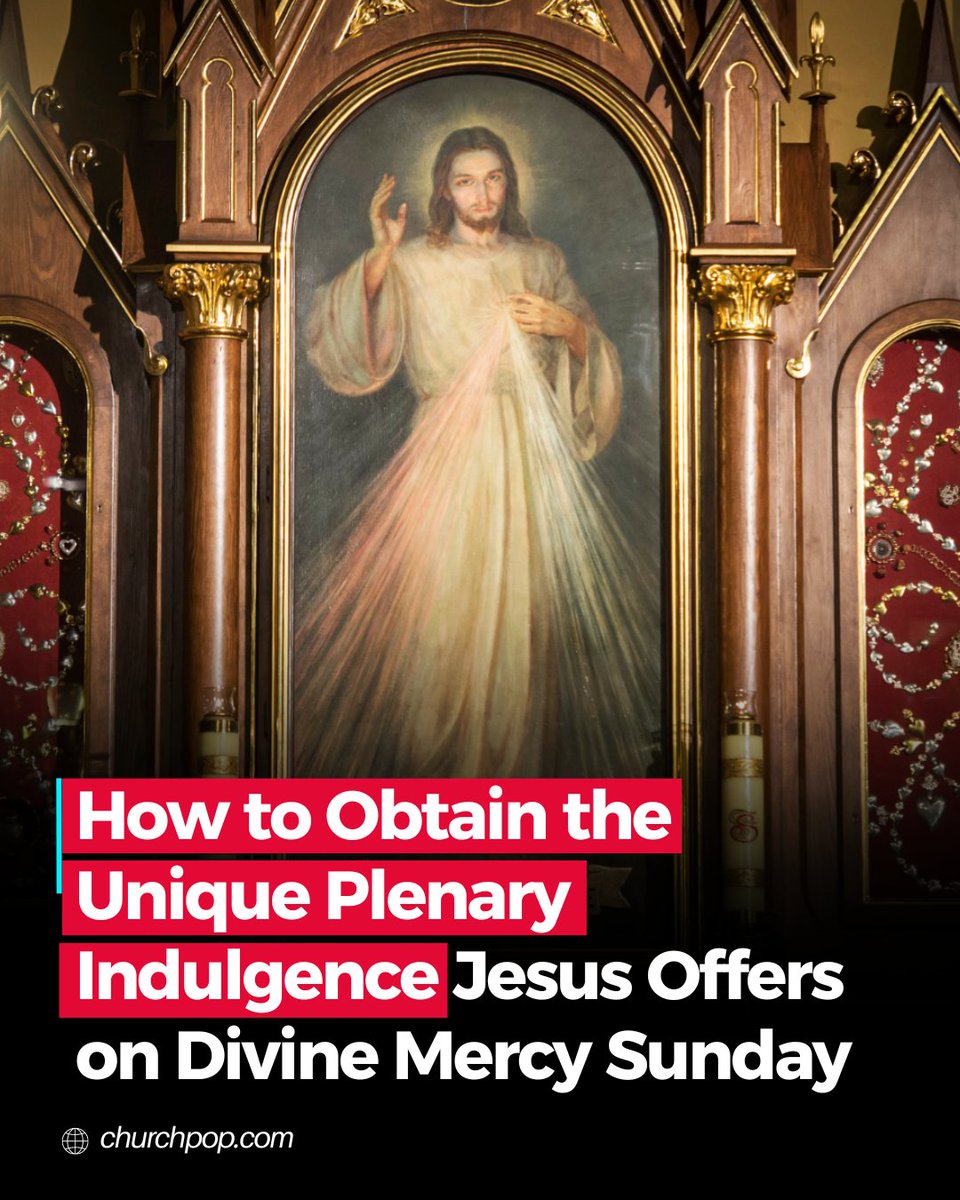
How to Obtain the Unique Plenary Indulgence Jesus Offers on Divine Mercy Sunday
The Divine Mercy plenary indulgence is probably the most powerful grace you can receive all year.
The feast of the Divine Mercy is the first Sunday following Easter Sunday.
In Saint Faustina’s diary, Jesus explains how to obtain the unique graces on Divine Mercy Sunday:
“The soul that will go to confession and receive Holy Communion shall obtain complete forgiveness of sins and punishment. On that day, all the Divine floodgates through which graces flow are opened. Let no soul fear to draw near to Me, even though his sins be as scarlet….Mankind will not have peace until it turns to the fount of My Mercy.” (Diary, 699)
What makes the Divine Mercy Sunday Plenary Indulgence so unique?
To obtain a plenary indulgence throughout the year, the individual must be detached from all sin, which is very difficult.
However, Jesus does not require complete detachment from sin with the special graces he offers on Divine Mercy. This is the only time complete detachment from sin is not required.
How to obtain complete remission of all sin on Divine Mercy Sunday:
1) Go to Confession before or on Divine Mercy weekend
2) Receive Holy Communion Divine Mercy weekend
Father Chris Alar of the Marian Fathers of the Immaculate Conception also explains in a great video how souls can obtain the incredible graces Jesus offers us on Divine Mercy Sunday.
He describes how Divine Mercy Sunday is one of the greatest feasts of the year.
“Never will your soul be cleaner other than the moment of your original baptism than it is on that day–Divine Mercy Sunday.”
Pope Saint John Paul II’s Vatican Decree for Divine Mercy Sunday Indulgences
The Vatican Apostolic Penitentiary Decree entitled, “Indulgences attached to devotions in honor of Divine Mercy” also grants an indulgence to those who fulfill the specific requirements 20 days before or after Divine Mercy Sunday.
These graces are separate from the special graces Jesus describes to Saint Faustina in her private revelation.
Here’s how to do it:
1) Go to Confession (20 days before, on, or after Divine Mercy Sunday)
2) Receive Holy Communion (20 days before, on, or after Divine Mercy Sunday)
3) Pray for the Pope
4) In any church or chapel, recite an Our Father, Creed, and a prayer to the Merciful Jesus (i.e., “Merciful Jesus, I trust in You!”) in the presence of the Blessed Sacrament, or, participate in services honoring the Divine Mercy devotion.
One must approach the indulgence with a spirit “completely detached from the affection for a sin,” both mortal and venial.
The Church also allows the ill or those who cannot attend church to obtain this indulgence.
One may fulfill the three usual conditions as described above as soon as possible, along with reciting an Our Father, Creed, and prayer to the Merciful Jesus.
“If it is impossible that people do even this,” the decree continues, “on the same day they may obtain the Plenary Indulgence if with a spiritual intention they are united with those carrying out the prescribed practice for obtaining the Indulgence in the usual way and offer to the Merciful Lord a prayer and the sufferings of their illness and the difficulties of their lives, with the resolution to accomplish as soon as possible the three conditions prescribed to obtain the plenary indulgence.”
Merciful Jesus, I trust in You!
Written by Jacqueline Burkepile
https://t.co/9SVRhL4Dz9
Holy Thursday is the day the priesthood was instituted by Christ.
Join me in praying for the priests…
…you know
…in your parish
…in your diocese
…who are struggling
…who doubt
…who are misunderstood
…who are burnt out
…who are grieving
…who are most in need of grace
“Only a love that becomes gratuitous service, only the love that Jesus taught and embodied, will bring separated Christians closer to one another.”
Highlights of Pope Francis' Ecumenical Vespers, ending the Week of Prayer for Christian Unity.
https://t.co/YLyGOBRGlo