Guidance gets old, models evolve, tools change & the code they describe moves.
Here’s what we built @Fin_AI to keep hundreds of them healthy: evals with mocked tools, a nightly judge on real usage, and loops that fix and retire skills automatically. https://t.co/ByJU0Y3XqH
Guidance gets old, models evolve, tools change & the code they describe moves.
Here’s what we built @Fin_AI to keep hundreds of them healthy: evals with mocked tools, a nightly judge on real usage, and loops that fix and retire skills automatically. https://t.co/ByJU0Y3XqH
Ran a backtest in @fin_ai code review and approval agent – Sol 6.1 (baseline) vs Sol 6.2 (treatment), same prompts, same medium reasoning effort. +23.5pp on recall (!!!) but comes with a lot of noise: precision, false-positive suppression tanked. And 50% more expensive per PR 😬
It’s going really well. We’ve had a team of ~60 eng doing this for >1 year on a 6 year old Go monolith (~7M loc).
The code that is produced is not inherently more complex than before AI. In fact it’s usually better quality, more consistent and exists in a codebase that is better through us tackling large scale refactors with AI that were previously untenable.
Sometimes the code is more complex because the ambition of what you might build increases with AI. We have small isolated parts of the codebase that are very complex now, because they’re much easier to build and can provide a better user experience for customers. Our expectations on polish have only gone up, and that comes out in things like complex perf optimisations or abstractions that we’d never consider before.
Then it’s worth touching on defect rate: with AI, we’re seeing ~70% reduction in the number of defects per 1k PRs merged. This is through agents producing better code and AI code review eliminating the majority of correctness errors. But…
The most important factor for your question is that a single engineer is now producing 2-10x as much code as before. They’re working on a codebase that changes faster than they can properly internalise it, and there’s a lot more in flight at any one time.
That means:
- Consistency and quality is even more important: all code needs to match conventions and be really clear, as you’ll often need to debug code you’ve never seen
- You can’t keep up with the rate of change by training humans on the specifics of the code
The last is important, which is that if AI is churning the codebase so quickly, you can’t expect humans to dial up their rate of learning to match the AI volume. The genie has left the bottle, it just isn’t going to happen.
So you end up needing AI to help make responders effective debugging their systems during an incident or even just in their daily workflows. AI needs to know how to use all your tools appropriately for your service and be able to operate it effectively.
When that’s in place the ‘training’ around system components or tools that humans can no longer keep up with can be encoded into skills so their agents can help them keep pace with the changes.
Sorry for long post! The tl;dr is:
1. Code is way better quality for embracing AI
2. Defect rate is way down
3. Biggest issue is rate of change exceeding human capabilities
4. You need to incorporate AI into debugging/reasoning about the system to keep pace
At @fin_ai, scaling software delivery agents meant giving the platform dedicated owners.
I recently spoke with Ciara Byrne from @JetBrains about what worked for us, and what I’d change.
Download the report here:
https://t.co/4x7hBEkHb8
What does it take to make AI agents part of everyday software delivery?
We spoke to engineering leaders at @fin_AI, @semrush, and other companies building the setup around them: shared context, repeatable workflows, verification, and cost control.
These nine real-world stories are in our free report: https://t.co/21ujNJE9lt
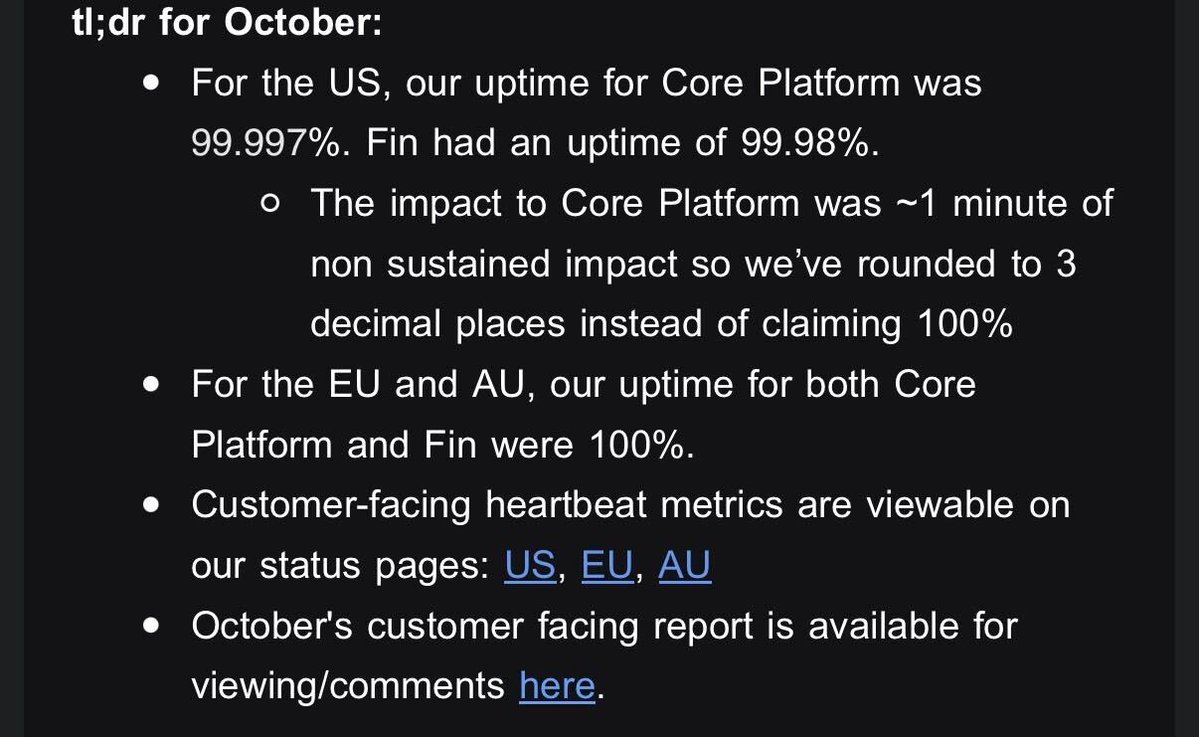
This is from our October internal availability report. We're far from perfect, but we're doing well. The biggest contributor to this is our MySQL databases being hosted on PlanetScale. Also, no sign of our AI acceleration causing serious problems.
I know that "root cause" and "five-whys" are dangerous words to use in the resilience space. The five-whys structure is too prescriptive in the human space, but agents work well with the prescription here! It's mostly just "verification" adapted to open-ended investigations.
https://t.co/7lIBpiCen6
I published my internal "five-whys" skill - it works pretty well for root cause analysis of incidents, outages, etc. We've benchmarked it against smaller prompts and less structured approaches and it justifies its existence.
This is from our October internal availability report. We're far from perfect, but we're doing well. The biggest contributor to this is our MySQL databases being hosted on PlanetScale. Also, no sign of our AI acceleration causing serious problems.
things i've been recently inspired to try building because of great How I AI guests
- jev enabled real time doc editor @ezramechaber
- actually good software factory @zachlloydtweets
- smart cmd-k app router @johnlindquist
- vertical short-form editor @brookejlacey
- faster lints + tests @zachdavis
- PR triage and approved @brian_scanlan
- hyper personal personal site @pengzheng_
- grokbot yt thumb designer @johnbai the figma bro
once teams have figured out building w AI (ai powered eng, prototypes, etc.) their bottlenecks move upstream and downstream
upstream issues:
- pm capacity
- no good ideas
- rigid org structures + process
downstream issues:
- pr review / capacity
- verification
- commercial (slow gtm, no $$ value)
how to fix:
- redesign your org for new physics
- focus on ambitious ideas, not just features
- make eng own more requirements so PMs can talk to customer and cultivate big swings
- automate your PR review + risk scoring
- cloud/preview environments + tooled agents for verification
- tighter PM <> GTM partnership
all solvable, but takes a leader willing to force the changes necessary