heard a girl on ig say that when life feels heavy, she imagines she's 85 and gets to come back to this exact day in her younger body.
Suddenly, every little thing feels precious. The coffee tastes better, the music hits differently, the sunlight feels warmer. Everything becomes magic again. Live today like the miracle it actually is.
This is free advice from an expensive psychologist.
If you're an anxious person, do everything for fun. Go to a job interview for fun. Submit documents for fun. Start a blog for fun. Anxiety feeds on importance. Don't make everything a matter of life and death.
Disagree. The best sleeping conditions are a tent, which gives exposure to natural early morning sunlight.
My experience is that all sleep "issues" go away after a week camping, and you also stop being tired in the morning.
Bedrooms need East facing windows with no curtains.
Leg extensions and leg curls before your squat movements
Your knees will thank you and you’ll feel a much better mind to muscle connection when there’s a fuck ton of blood flowing in your legs alread
Groundhog Day is one of the most beloved films ever made. And yes, Andie MacDowell is cute and charming. But that is not why it hits a chord thirty years later with people who can’t quite explain why they keep rewatching it.
The reason is Aristotle. And almost nobody knows it.
1. Phil Connors wakes up on February 2nd. Again. And again. Infinitely. No consequences, no memory from others, no tomorrow. He has been given what every hedonist, every utopian, every system that promises liberation through freedom from constraint has always promised: complete freedom from accountability. The result is not paradise. It is the most precise laboratory experiment in the history of cinema – what does a human being actually become when freed from all consequences?
2. He tries pleasure first. Eats everything, seduces women, steals money. It works, briefly, the way soma works. Then it stops working, the way soma always stops working. He tries knowledge — learns piano, French poetry, ice sculpture — not yet for virtue, but for manipulation. Still instrumental. Still empty. Then he tries suicide. Repeatedly. The groundhog always wakes him. The void cannot be escaped. It can only be filled.
3. This is Aristotle’s laboratory. Not theoretical – experimental. Eudaimonia (read below) cannot be purchased, stolen, or stumbled into. It is not a feeling. It is not a peak experience. It is the condition that results from becoming, through practice, the kind of person capable of it. Phil has infinite time and zero character at the start. The loop is not his prison. It is his curriculum.
4. The turn is the most important moment in the film and the easiest to miss. Phil stops trying to escape the loop and starts trying to improve within it. He learns piano not to impress anyone – nobody will remember tomorrow. He helps people not for reward – there is none. He becomes good with no audience, no record, no consequence. This is virtue in its purest Aristotelian form: the action done for its own sake, repeated until it becomes character.
5. Rousseau would say Phil is naturally good and the loop is oppressing him. The film says the opposite: left completely free, with no social pressure, no consequences, no system to blame, Phil reveals everything that needs work before anything worth keeping emerges. The loop doesn’t corrupt him. It shows him to himself. That is the most anti-Rousseau statement in popular cinema – and nobody noticed, because Bill Murray is just very funny.
6. He falls in love with Rita not by manipulating her — he tried that, it failed spectacularly — but by becoming someone worth loving. You cannot love your way to virtue. You can only become virtuous and discover that love becomes possible. The film gets the causality exactly right – which almost no film does.
Virtue gets you true love.
7. The loop ends when Phil has become genuinely good – not performing goodness, not strategically good, but actually virtuous through ten thousand repetitions of the right choice with no reward attached. Aristotle said virtue is a habit formed through practice. Groundhog Day is the proof of concept. The film hits a chord because everyone senses, somewhere beneath the comedy, that this is how it actually works – that there is no shortcut, no hack, no liberation through freedom from consequence. Only the truth of it. Only the practice. Only becoming, slowly and without an audience, the person you were supposed to be.
This is almost hard to believe…
Disney spent ~$129B acquiring Marvel, Star Wars, Pixar, ESPN, and Fox (~$182B in today’s dollars).
Throw in all their legacy assets and the entire company's market cap is ~$169B.
The relationships you form with other people are the only thing that actually makes your life worth living. Too many people are so afraid of being "tied down" that they effectively don't exist at all.
Oasis just beasts in mid-90s.
This clip of them making “Champagne Supernova” in 1995 is gold.
Noel Gallagher writes the lyrics. Does a single play-through for his brother Liam. Then Noel goes to watch football while Liam — after one listen — smashes the song on first recording.
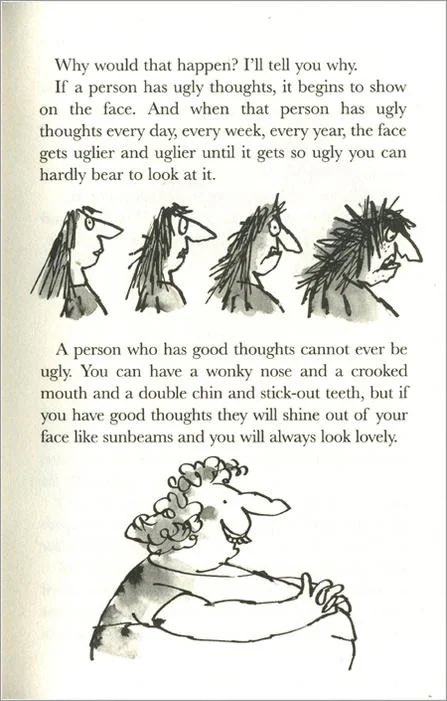
Actual truth bomb here. Time reveals more of who you are. If you are ugly spirited, mean, cruel, etc., it will eventually show on your face, in your body, etc. A beautiful mind, beautiful thoughts, will eventually show on the body too
The Roald Dahl quote from The Twits is right
The Anglo-Scottish Enlightenment – the real antidote to Rousseau and Voltaire
The French Enlightenment and the Anglo-Scottish Enlightenment happened simultaneously, in the same century, reading the same books, arguing about the same questions. They reached completely opposite conclusions. One produced the Declaration of Independence and the American Constitution. The other produced the guillotine. This is the most important civilizational fork in modern history.
1. The French Enlightenment begins with the assumption that human beings can be improved by reason – that if you strip away the corrupting institutions of Church, tradition, and inherited authority, the natural goodness underneath will organize itself into a just society. This sounds like progress. It is a fantasy with a body count. Every attempt to implement it has required, at some point, a Committee of Public Safety to handle the people who turned out not to be naturally good enough.
2. The Anglo-Scottish Enlightenment begins with the opposite assumption: human beings are what they are, not what they could be if properly enlightened. Hume grounds morality in human nature as it actually operates – sympathy, habit, sentiment, the slow accumulation of social trust. Smith shows that self-interest, properly channeled, produces collective benefit without a planner. Neither man is building a utopia. Both are building with the actual material available.
3. Burke is the direct refutation, written in real time. He published Reflections on the Revolution in France in 1790 – before the Terror, predicting it precisely – because he understood that institutions are not obstacles to human flourishing, they are its precondition. They contain accumulated wisdom — the knowledge of the dead — that cannot be recovered once destroyed. Pull society apart to improve it and you don’t get the General Will. You get Robespierre.
4. The American founders read Burke, Hume, Smith, and Montesquieu – the Frenchman who looked at England and understood what France was missing. They built a system that takes human nature as given — self-interested, power-hungry, tribal — and constructs institutions to contain those tendencies rather than assume they disappear once the right people are in charge. Checks and balances are not a design flaw. They are what you build when you don’t believe in philosopher-kings.
5. 1776 versus 1789. Same Enlightenment, same century, same vocabulary of liberty and reason. One produces a constitutional republic that has survived two and a half centuries of stress, civil war, and upheaval. The other produces, in sequence: the Terror, Napoleon, 1848, the Commune, and eventually — via Marx, who was a Frenchman in spirit if not in birth — the entire catastrophe of the twentieth century. The difference was not intelligence or intention. It was the starting assumption about human nature. Get that wrong and everything that follows is wrong with it.
6. The guillotine is not the Revolution’s failure. It is its logical conclusion. If man is naturally good and the system is corrupt, then whoever seizes the system in the name of natural goodness is licensed to do anything. The General Will cannot be wrong. Those who resist it are not opponents – they are enemies of nature itself.
7. The real antidote to Rousseau and Voltaire was never a better French philosopher. It was a different civilizational tradition – one that builds with human beings as they are; that treats inherited institutions as repositories of wisdom rather than obstacles to progress; that distributes power rather than concentrating it in whoever currently claims to know the General Will. That tradition was built in Edinburgh, London, and Philadelphia. It is currently under sustained assault — from exactly the same ideas, in exactly the same form, with exactly the same confidence — that Burke watched demolish France in 1789. He was right then. He is right now.
BREAKING: The iconic Mayflower II is arriving in Boston Harbor right now.
The replica of the Pilgrims' ship is making its first-ever Sail Boston appearance as part of celebrations marking the 250th anniversary of the Declaration of Independence.
🤎
📹: @aprilpell
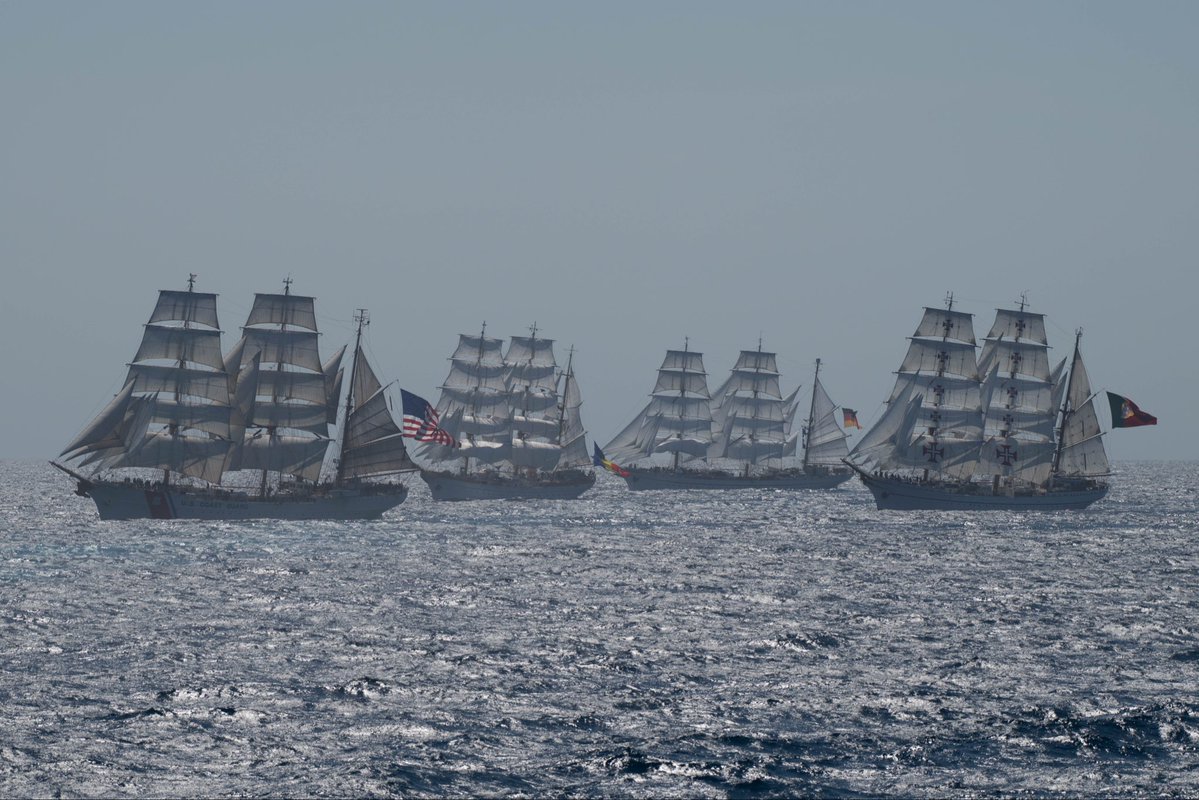
Yesterday, four of the world’s most iconic tall ships raced head-to-head offshore before making their way to Boston for #SAIL250.
This weekend, they’ll sail into Boston Harbor led by USCGC Eagle for the Parade of Sail. Don’t miss it! ⚓🇺🇸 #fivesisterstallships
John Lavery's picture (1925) depicts the hallway of Argyll House in Chelsea, London, when it was owned by Lady Sibyl Colefax. Argyll House was a prominent address in the early 20thC; visitors included Fred Astaire, George Gershwin, and Winston Churchill.
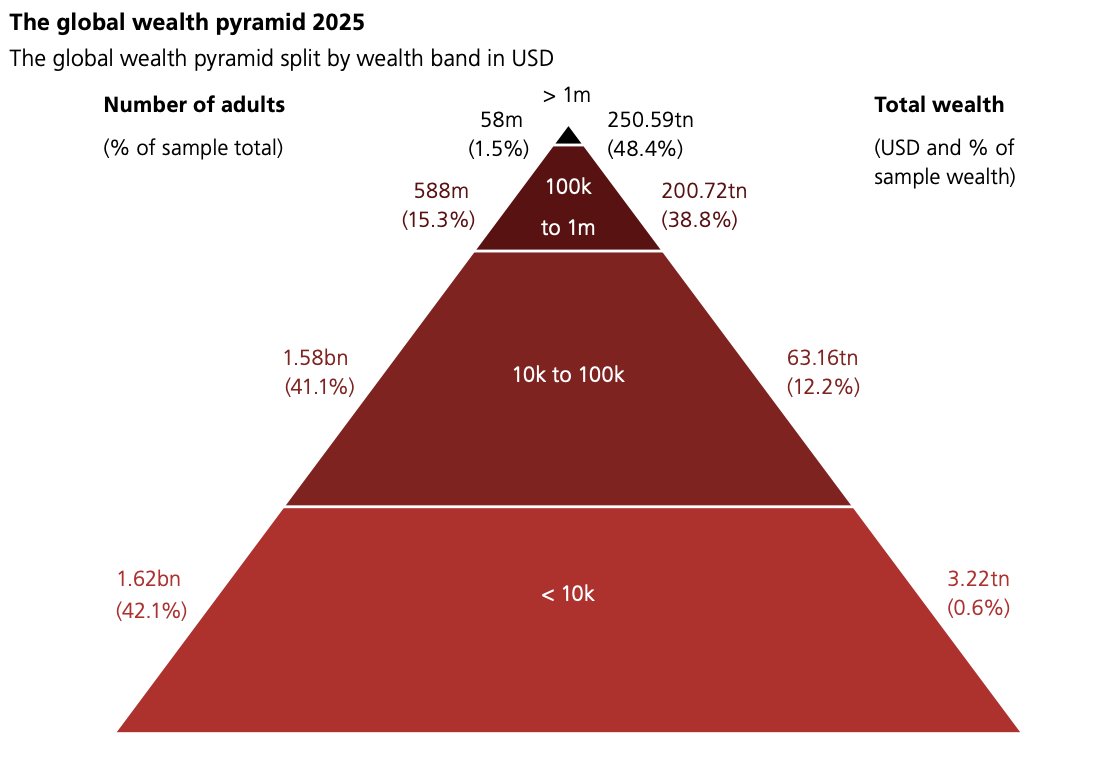
Only 58 million people (1.5% of adults) have a net worth over $1 million.
Those 58M hold 48.4% of all global wealth.
The bottom 1.62 billion adults — 42% of the world — hold 0.6%.
Source: UBS Global Wealth Report 2026