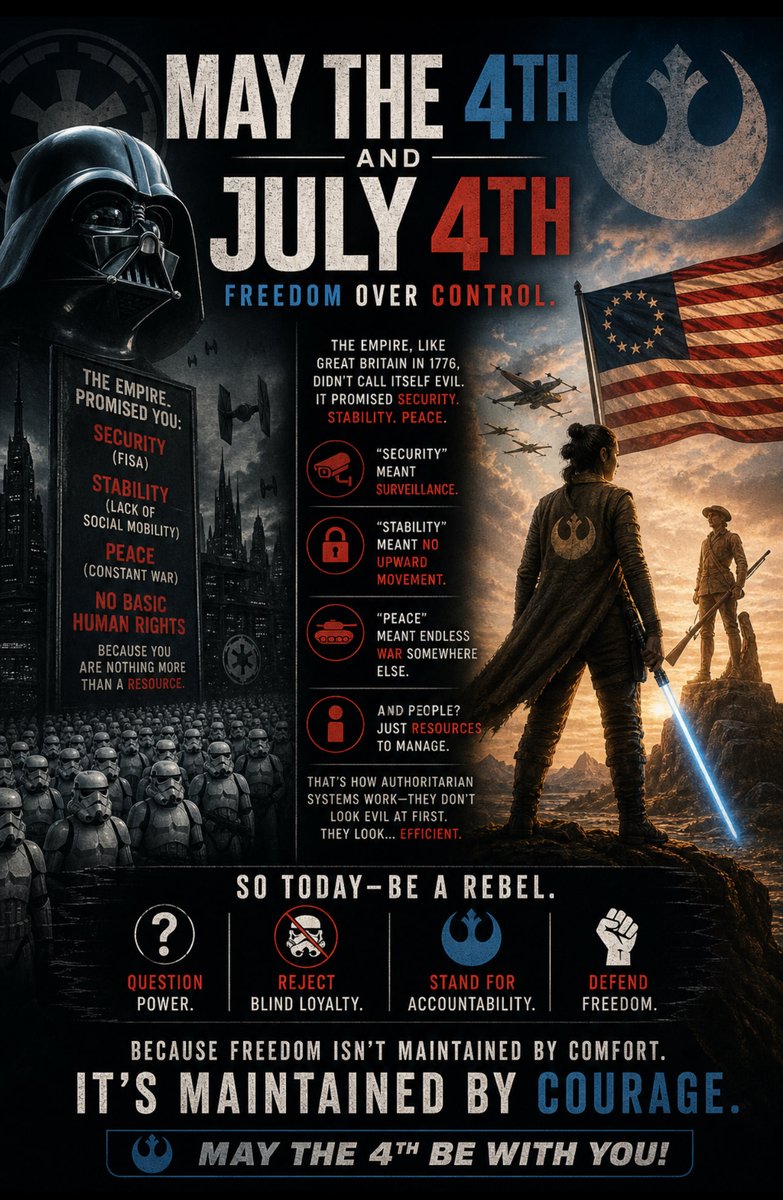
@Timcast If the answer to corruption continues to be “but so and so did it too” then we have no path forward. Corruption is bad, it is bad when Hunter did it and it is bad when Trump does it. Let’s have some integrity.
Please don’t be fooled into thinking it’s just about Trump. He’s a cog in a corruption machine. Our responsibility as citizens is to push for changes bigger than “then next election cycle”. Please share!
Teacher: “What are the 3 branches of government?”
Student: “Central Bankers. Pedos. The Military Industrial Complex.”
Teacher: “That’s wrong.”
Student: “I know. We really should abolish the entire thing and start over.”
My first book - Each story is an invitation — to slow down, to listen, and to reconnect with the part of you that already knows. Healing The Inner Child: Parables by Firelight https://t.co/o8jJzCWXtd
"Principles" are the things you uphold even when it's not to your personal advantage.
For example, if you've ever espoused the principle of "States Rights", then of course you oppose the "SAVE Act" which overrides states rights.
It doesn't matter if you want "Voter ID" laws. The principle dictates that it's up to each state to decide whether they want Voter ID laws.
And in any case, the "SAVE Act" is far more than simple "Voter ID", but a whole scale invasion of the federal power into how state's run elections.
The paid grifters, partisan hacks, and bots are out in force—misleading people about the Constitution and the law—to defend Trump’s unconstitutional war.
Here’s an important Iran war PSA:
Contrary to what you may have heard about the War Powers Resolution (50 U.S.C. §§ 1541–1550), it does not allow the president to take military action for any reason for 60–90 days without congressional approval so long as the president notifies Congress within 48 hours.
Section 1541(c) of the War Powers Resolution states clearly:
“The constitutional powers of the President as Commander-in-Chief to introduce United States Armed Forces into hostilities, or into situations where imminent involvement in hostilities is clearly indicated by the circumstances, are exercised only pursuant to (1) a declaration of war, (2) specific statutory authorization, or (3) a national emergency created by attack upon the United States, its territories or possessions, or its armed forces.”
Of the three cited authorities, not one indicates a presidential power to take unilateral (without Congress’s approval) offensive military action.
The first two authorities allow the president to take offensive military action but only with Congress’s express approval (Article I of the Constitution grants Congress the exclusive power to declare war).
The third authority allows the president to take defensive military action without Congress’s approval in the event of a specific type of national emergency, a sudden unforeseen attack on the United States (happening too quickly for Congress to meet) necessitating immediate action to protect Americans.
It’s for this last situation (or for situations in which the president introduces forces into hostilities unlawfully) that the War Powers Resolution provides for the oft-mentioned 48-hour report to Congress (§ 1543) and 60-day (up to 90-day) timeline (§ 1544). If there’s an attack in progress on the United States (i.e., currently happening), we expect the president to respond swiftly to neutralize the attack and protect Americans—and then we will hold the president to account.
The Framers of the Constitution agreed at the debates in the federal convention of 1787 that the president should have the “power to repel sudden attacks” but not the power to otherwise introduce forces into hostilities without congressional approval.
The War Powers Resolution does not confer any new authority on the president to take offensive military action without congressional approval—nor could it under our Constitution. It instead checks the president when, as the Framers contemplated, the president introduces our Armed Forces into hostilities to repel a sudden attack.
The fact that previous presidents have violated both the Constitution and the War Powers Resolution does not—and cannot—change the law or make any present military action lawful.
So, let me get this right. UK has arrested the brother of the King. Norwegians have charged their former Prime Minister with corruption. Even UAE has punished Sultan Ahmed bin Sulayem. But the United States has not punished single client of Epstein. Our government is compromised.
Epstein required:
•Money that never ran out
•Protection that defied normal justice
•Access that crossed borders and institutions
•Silence enforced through leverage, fear, and manipulation.
That doesn’t happen accidentally.
And it doesn’t happen without institutional cover
We are living through a moment where a group of people do not just disagree, they do not even acknowledge a shared fundamental reality.
There is no common frame of reference, no mutual set of facts from which discourse can even begin. They can watch the same video, from multiple angles, and walk away convinced they saw a completely different event.
They exist inside a narrative so deeply entrenched that to question it, to even acknowledge a contradiction, is to commit some sort of ideological treason.
This is a deliberate, conditioned immunity to contradiction. It is a cultivated resistance to evidence. They have developed a mind so thoroughly welded to its chosen reality that it will alter, discard, or fabricate whatever it must to maintain coherence.
They can be shown, in real time, the unraveling of their worldview, and they will patch over the holes with fantasy rather than face any doubt whatsoever.
Politics has turned knowledge itself into a partisan weapon. The expectation is no longer to seek truth, but to defend your team at all costs.
There is a lingering obligation to have an opinion on everything, to be informed at all times, to adopt the correct stance. And so, they improvise. They adopt prefabricated opinions handed down by their faction. They fill in the gaps with instinctive loyalty rather than demonstrating any semblance of independent thought.
The game is rigged, and they know it. Two parties, two choices, two sides that everyone is herded into, and neither is worth the loyalty demanded of them.
But to acknowledge this would be to admit powerlessness, to admit that they are trapped in an illusion of choice. So they cope. They retroactively justify their allegiance by turning their side into something righteous, infallible, and necessary. The alternative is too terrifying.
It is a coping mechanism turned mass psychosis. And it is escalating. When reality itself is dictated by allegiance, when loyalty outranks reason, when every fact must be bent into submission to fit the tribe’s chosen narrative, the outcome is inevitable: war.
When factions exist in separate realities, they cannot coexist. They cannot negotiate, they cannot reason, they cannot even comprehend the other side as anything but a threat.
This is irreconcilable. We cannot function like this. A society cannot sustain itself when its people are no longer individuals but ideological husks, possessed by abstractions, fighting battles for masters who do not even know their names.
You are not your faction. You are not your party. You are not an extension of a collective mind.
The moment you outsource your thinking, the moment you allow yourself to believe that your side must be right because the alternative is unbearable, you have ceased to be an individual. You have become another interchangeable pawn in a game that does not need you to think, only to obey.
Wake up. This war for reality is not one you want to be drafted into.
@AnnaRMatson@GovTimWalz The only church attack I’m aware of is the LDS church attacked by a person who was a Trump supporter and who was twisted into believing things about the LDS faith by his Christian Nationalist leader. So, how is your comment relevant? I’m confused.
@bernesto Legal principle: Federal agents (including ICE) cannot detain or initiate enforcement actions against someone without reasonable suspicion of a law violation (for a temporary stop) or probable cause (for an arrest). The Fourth Amendment protects against unreasonable seizure.