The story of Nicholas Dockery’s bravery, refusing to leave his fellow soldier behind, is truly remarkable:
"Nick rushed through the compound until he found the sergeant being dragged unconscious through an alleyway by two Taliban fighters with very bad intentions."
"Nick eliminated both terrorists in close quarters, then pulled Sergeant Hansbrou back to cover, but found he was not breathing. So urgently, Nick administered CPR until the sergeant's heart kicked back in."
"As mortar fire thundered down all around them, Nick covered his incapacitated teammate with his own body, shielding him from further injury."
"In his final act of unbelievable valor that day, Nick climbed his way to the open roof where he was again vulnerable to Taliban gunfire at highest levels."
"He signaled enemy positions with smoke grenades, allowing American gunships to come to the platoon's rescue. Major Dockery, you were the last man to depart the battlefield that day, and you left it a legend and a hero."
🇺🇸
Listen to Rupert Lowe read out just 5 minutes of survivors testimony from the rape gang inquiry.
What sounds like a horror movie, was actually perpetrated against British children by predominantly Pakistani Muslim men.
Legacy media refuse to cover it.
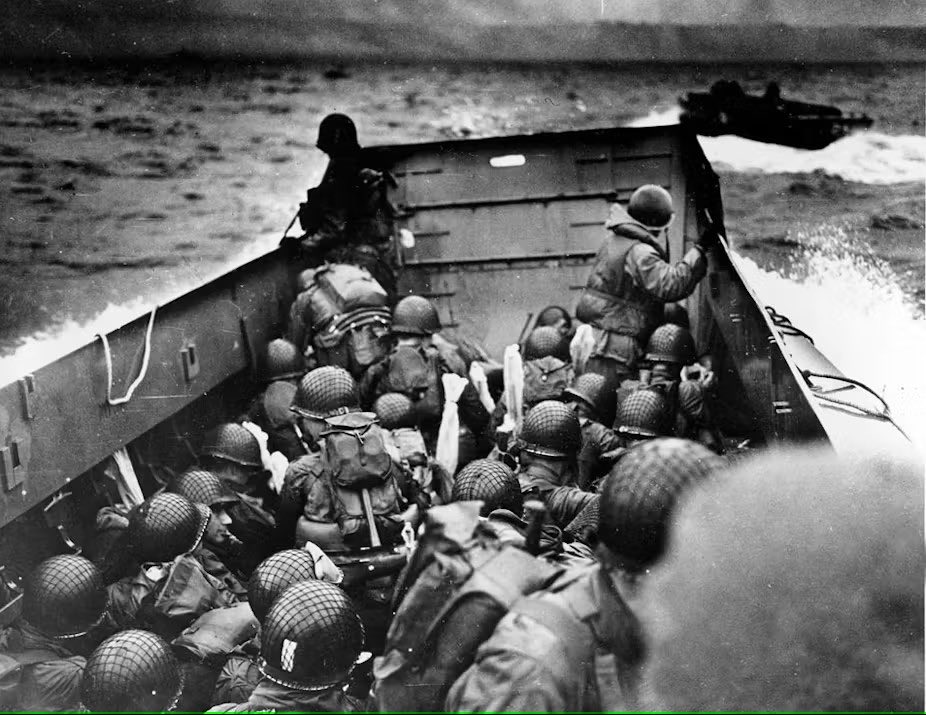
Thank you to all who fought and sacrificed in freedoms defense all those years ago. Incredible footage here. Blessed that both my uncles survived and will never forget the over 400,000 who did not come home.
June 6th, 1944.
The English Channel is angry and half the men in the landing craft are seasick. Diesel fumes mix with saltwater and vomit while rifles are checked for the fifth or sixth time by hands that need something to do. Nobody talks much anymore because the jokes have all been told and the bravado has finally burned away somewhere behind the English coast.
You are nineteen years old and carrying more weight than you’ve ever carried in your life. You don’t know it yet, but it’s the most weight you will EVER carry in this life. However long or short it may be.
Your rifle rests across your knees. Your life hangs from a few pounds of steel, wood, and training. Somewhere beyond the gray horizon sits a continent that has spent five years tearing itself apart, and in a few minutes you are going to step into the middle of it.
Across from you sits another kid. He can’t be much older than you. His jaw is clenched. His knuckles are white around his weapon. Neither of you says a word because there is nothing left to say.
Then your eyes drift toward his shoulder.
That red numeral catches your eye: “1”.
You’ve seen it a thousand times before. In barracks hallways, on training fields, in motor pools, and on long marches. It never meant much beyond belonging to the same outfit.
Now it means everything.
Because in a few minutes the world is going to ask something terrible of both of you, and there is comfort in knowing that whatever waits on that beach, neither of you will face it alone.
The historians will eventually reduce this day to arrows on maps and casualty figures. Politicians will give speeches. Journalists will write books. None of that exists inside the landing craft.
What exists is fear, and duty.
What exists is the understanding that courage was never the absence of fear. Courage was always charging into the maelstrom anyway.
The shoreline emerges through the smoke. You can see flashes now. You can hear the distant percussion of artillery. Men stop checking their equipment because there is no point anymore. Whatever mistakes were made are already made. Whatever prayers were going to be said have already been said.
The coxswain throttles down.
The boat grinds forward.
The ramp is about to drop.
Into the abyss.
Overlord.
Tonight, as I do every year at this time, I’ll be raising a glass to a scared young man, who 82 years ago was preparing to go ashore on the beaches of Normandy as part of an event code-named Operation Overlord.
D-Day.
I can’t imagine what was going through his mind. I’d be scared to death and I’m sure he was too. But in that first wave was a 21-year-old Private First Class from Henry County, VA by the name of Allen Homer Sink.
Fortunately, he would survive that initial wave, participate in battle until it ended in August, then come home to marry and raise a family of four, including two daughters after the war ended.
He would also become my father-in-law until his death in 2006.
His nickname for some reason was “Hank” and when I asked him how he got it, he said some guy in the Army said he “looked like a Hank.” From the time I first met him, he was a salt-of-the-earth man who was never afraid of anything. He was a carpenter by trade, and he’d stand up on the tallest roofs, grab bumblebees with his bare hands when they tried to persuade him to move elsewhere, and never be bothered by anything.
His hands were tough and leathery, but he was a softie. He spoiled his children, complained when my mother-in-law would gripe about something involving one of his alleged misdeeds, and always thought he was fooling everybody when he snuck around the back of the house and lit a cigarette, a habit everyone opposed but he could never part himself from.
He could talk your ear off for hours at a time, and I always suggested he become a greeter at Wal-Mart when he retired because then he could talk all day to strangers and none of them would – like his wife and daughters often did – tell him to be quiet for a few moments. Yet for all his love of talking, there was one subject he just wouldn’t discuss.
June 6, 1944. Omaha Beach.
In 1998, when he was 76 years old, the subject came up again. The movie “Saving Private Ryan” came out and the beginning was gruesome. Reviews said it was incredibly realistic to what really happened that day. I asked Hank if he wanted to go see it.
“No,” he shook his head. “I don’t ever want to see any of that again.”
He did offer that he remembered the night before when troops were loaded into the boats for the amphibious assault. He said it was raining and that once everyone was in place, they gave everybody ice cream and told them to try to get some sleep. Then the next thing he knew, they were waking everybody up telling them to stay low and head for the beach.
No, that doesn’t sound like somebody drugged the ice cream. Not at all.
That’s all he would say about the subject, and he never said another word about it until the final months of his life. Alzheimer’s would gradually rob him of his mind, and as his condition deteriorated, memories of the past would briefly spill out. One evening he thought I was his commanding officer and he was back at Normandy. It is the only time I ever saw him where he appeared to be scared. Ever.
It reminds me every day of something I had unknowingly taken for granted. The greatest generation did fight in and win World War II, then did incredible things over the next 50 to 60 years after the war. But many carried unspeakable memories from the War, ones they would never talk about and carry inside them to their graves. Those veterans lost a piece of themselves in battle they would never, ever, get back.
I mean, how can you at the tender age of 21 storm a beach, see friends die only a few feet from you, wonder each night if you will wake up alive the next morning and then return home a year later and try to pick up on the same normal life you had before you left? I told him once that after seeing “Saving Private Ryan”, I understood why he was never afraid of anything; after you’ve made it through something like that, everything else pales in comparison.
So tonight, I raise a glass to Hank and the 150,000-plus men, who like my father-in-law, were very young, very scared, and still charged that beach, paying a price that even for the survivors would last the rest of their days.
Rest In Peace...
This is literally one of the worst things I’ve ever watched in my life.
He’s begging for his life, the police do nothing.
This is INFINITELY worse than George Floyd.
The police officers literally killed Henry Nowak because he was White.
HE WAS BEGGING FOR HELP!!!!!!!!!